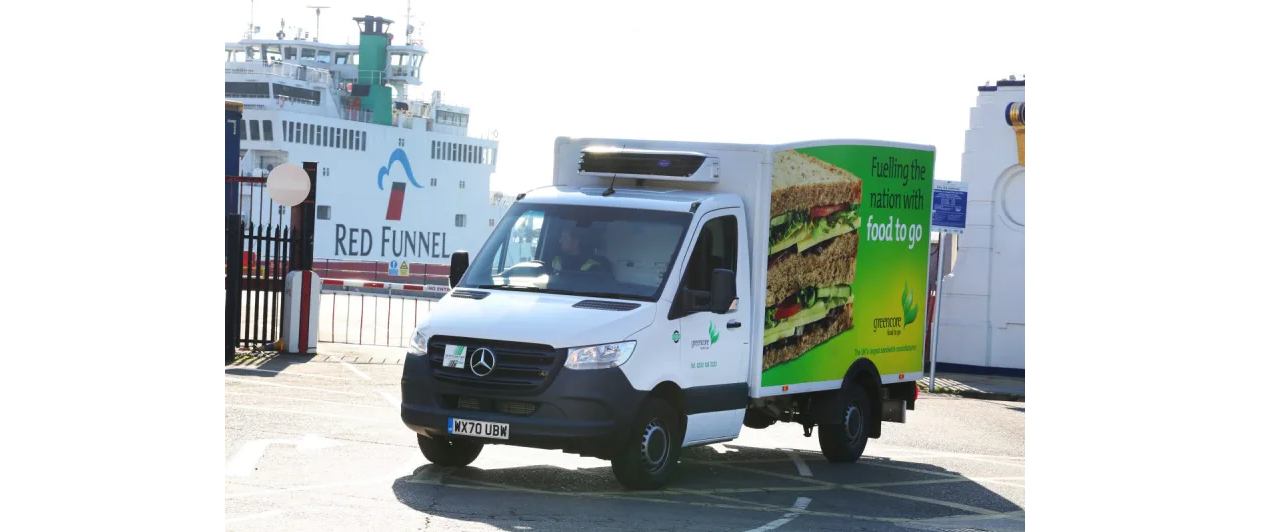
Convenience food producer, Greencore, has praised Carrier Transicold, Petit Forestier and Clayton Power for its collective approach in developing a battery-powered solution to a unique problem experienced when delivering to the Isle of Wight.
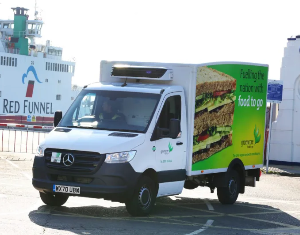
When crossing to the island by ferry, Greencore’s 3.5-tonne Mercedes-Benz Sprinters are required to turn off their engines – meaning the vehicles’ direct-drive Carrier Transicold Xarios 350 units stop operating. Ordinarily, this poses no problem as the insulated van body – built by Solomon Commercials – can maintain the required set point for the length of the crossing. However, in rough or foggy conditions the ferry may remain at sea for hours waiting for a clear weather window, putting chilled loads at risk.
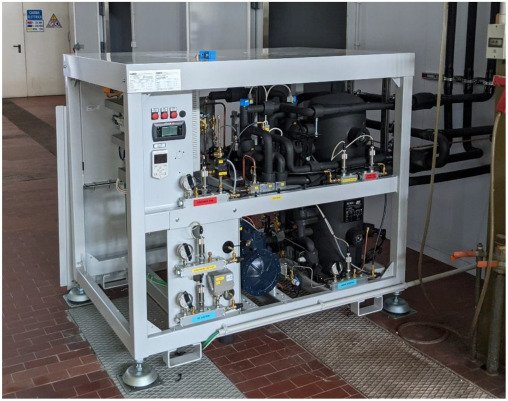
Working closely with Petit Forestier – which supplies Greencore’s van fleet on contract hire – Carrier Transicold brought in the services of Clayton Power, which developed an autonomous battery system capable of powering the unit for an extended period of time if the van engine is switched off.
“This isn’t a new problem, but we have been waiting for the technology to be available to provide a workable solution – and what we’ve got now is fantastic,” said Ben Martin, network and transport director, Greencore. “We’ve been a Carrier Transicold customer for more than 10 years, and this project underlines why. Alongside Petit Forestier, we know we can count on them and their innovative approach to help improve our business.”
Greencore operates a mixed commercial vehicle fleet of more than 550 assets nationwide, including 460 refrigerated light commercials that are all mounted with Carrier Transicold Xarios refrigeration units. The lightweight and powerful Xarios unit is ideally suited to work with the new Clayton Power battery system, with an advanced electronic controller that ensures high reliability and a long product lifetime.
For an initial test vehicle, Carrier Transicold modified a Xarios 350 unit that could switch between direct-drive power and the new 230v Clayton Power battery system, which is neatly housed beneath the passenger seat. When not in use, the battery has been designed to recharge directly from the van’s alternator when the engine is running, or via mains power when the Xarios unit is hooked up to the grid. With sustainability in mind, Carrier Transicold continues to innovate to find progressive solutions for customers, part of its Healthy, Safe, Sustainable Cold Chain Program.
“We took delivery of a trial vehicle in the summer, coincidentally on the hottest day of the year – so it was instantly put to the toughest of tests,” said Martin. “When we switched to battery power, we had to ensure it could maintain the set point, which it did without breaking a sweat – which is less than could be said for our driver!”
After the successful trial, Greencore ordered two more identical vehicles. Now, all three operate from the company’s Southampton depot, delivering chilled convenience food to customers along the south coast and the Isle of Wight. Working five days a week, each van is expected to clock up between 30,000 and 40,000 miles a year and will be in operation for four years.
The company has used the electrification of the refrigeration units to explore the charging infrastructure it would need to eventually progress onto fully electric vehicles.
“This has been a key step to further improving our sustainability, and we are now better able to understand how viable electric power could be across more of our fleet,” said Martin.