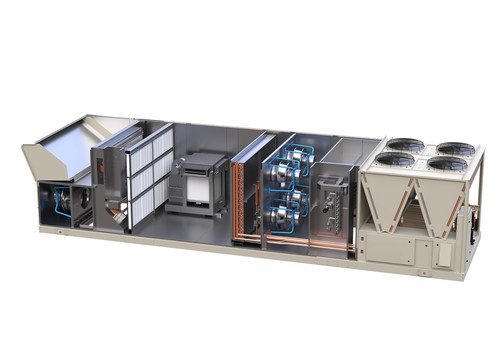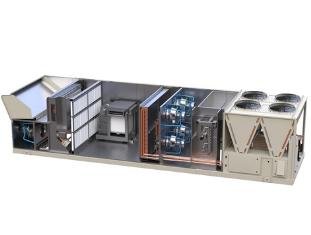
Daikin Applied introduced the upgraded Rebel Applied with enVerid Sorbent Ventilation Technology (SVT), the industry’s first packaged total-air-quality system that combines the benefits of sorbent media with a class-leading, configurable rooftop unit.
Rebel Applied with SVT helps solve a variety of common IAQ issues in buildings. For example, when people breathe in oxygen, they exhale CO2. And when numerous individuals occupy a classroom or workspace for several hours, CO2 levels rise steeply. This not only has a significant impact on air quality, but can affect occupant health and performance. Off-gassing from furniture, building materials and the like also introduces volatile organic compounds (VOCs), such as formaldehyde, into the air.
The integrated SVT system from Daikin addresses these concerns by removing CO2, VOCs and other contaminants using sorbent filtration that captures pollutants while allowing oxygen and water to pass through freely, resulting in cleaner air. And when applied using ASHRAE 62.1’s IAQ Procedure (IAQP), SVT provides the clean air changes needed for healthy indoor spaces, allowing building operators to decrease the volume of outdoor air needed and total cooling load of their facilities.
The system can reduce outside ventilation by as much as 80 percent, providing greater control of humidity and comfort while trimming annual operating expenses by up to 30 percent.
SVT is unique because it has been tested for air-cleaning effectiveness using third-party labs following ASHRAE’s 145.2 standard, assuring building operators that the sorbent filters are proven to remove harmful impurities without producing by-products. By applying this verified media and following ASHRAE 62.1 IAQP for ventilation, building operators get better air quality and efficiency in a single rooftop system.
SVT adds to a growing list of IAQ-focused features available with Rebel Applied. This includes UV lights to kill pathogens and prevent microbes from living in the unit, high-efficiency pre- and final filtration to capture more pollutants, and humidifier grids that help produce ideal building environments.