Esta página solo está disponible en inglés. Ir a la portada en español

×

Questa pagina è disponibile solo in inglese. Home page in italiano

×

Diese Seite ist nur auf Englisch verfügbar. Zur deutschen Startseite

×

Cette page est disponible uniquement en anglais. Aller à la page d'accueil en français

×

Global Refrigerated Transport Market to Reach USD 232.9 Billion by 2034

Global Refrigerated Transport Market to Reach USD 232.9 Billion by 2034

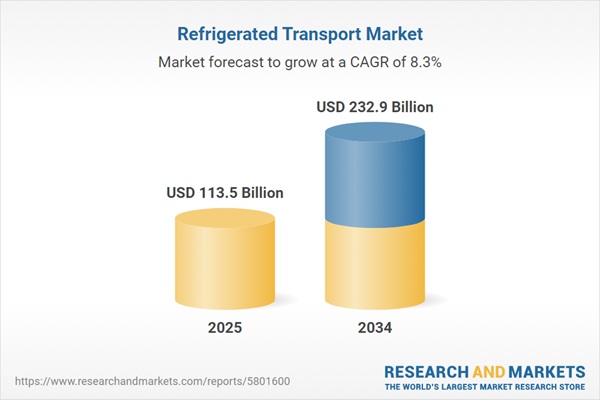
The global refrigerated transport market is projected to grow from USD 113.5 billion in 2025 to USD 232.9 billion by 2034, registering a compound annual growth rate (CAGR) of 8.3%, according to a new report from Research and Markets. The growth is driven by increased demand for temperature-sensitive goods and innovations in logistics technologies across multiple transport modes.

The refrigerated transport sector plays a critical role in moving perishable goods—such as fresh produce, dairy, meat, seafood, and pharmaceuticals—under temperature-controlled conditions across road, rail, sea, and air. Rising demand from the pharmaceutical industry, especially for biologics and vaccines, is further accelerating investments in cold chain infrastructure and transport.

Technological advancements are reshaping the industry, including the adoption of real-time monitoring systems, environmentally friendly refrigerants, and AI-based logistics tools. In 2024, electric refrigerated vehicles gained traction in last-mile deliveries, particularly in response to stricter emission mandates. The integration of telematics and IoT systems enabled operators to track cargo conditions and optimize maintenance.

Reefer containers equipped with smart sensors supported data-driven compliance in seaborne logistics, while modular and multi-compartment containers improved flexibility across transport modes. Retailers in e-commerce and quick commerce increasingly utilized refrigerated transport to meet fast delivery expectations.

Looking ahead, the market is expected to benefit from digitalization and sustainability trends. AI-driven platforms will enhance route optimization and fuel efficiency. The adoption of electric and hydrogen-powered refrigerated trucks is projected to expand, supported by government incentives and green financing. Demand for ultra-cold transport solutions is rising in line with pharmaceutical developments.

Key challenges remain, including high capital and operational costs for refrigerated fleets. Nonetheless, the market is expected to become more efficient and resilient, supported by greater cold chain transparency and traceability solutions, including blockchain.

The 150-page report includes insights across five global regions and 27 countries, as well as profiles of 28 leading companies, including Hyundai Motor Company, DB Schenker, Daikin Industries Ltd., and Ingersoll Rand.

Read More

Get the daily refrigeration briefing

One email a day. Trusted by 3,000+ RACHP professionals.

More on Cold Chain

All on Cold Chain →

Insights

Secop's Solar Direct Drive (SDD) System Earns WHO PQS Approval – The Team Behind It
Article

Secop’s Solar Direct Drive (SDD) System Earns WHO PQS Approval – The Team Behind It

Partner's material In March 2026, Secop’s Solar Direct Drive Power Management Module was granted WHO PQS prequalification and officially listed in the WHO Catalogue of Prequalified Immunization Devices. The WHO IMD-PQS (Immunization Devices Performance, Quality and Safety programme) is the global benchmark for cold chain equipment used in immunisation. Being listed in its catalogue is

22 Jun 2026
Case Study - Effect of Louvers or diffusers on air flow distribution and cooling time on a meat log during Chill cycle
Tech Guide

Case Study – Effect of Louvers or diffusers on air flow distribution and cooling time on a meat log during Chill cycle

By Kushal Aurangabadkar An experimental analysis was conducted on a cooler space measuring 3.66 m × 6.096 m (12.0 ft × 20.0 ft), equipped with an ammonia refrigeration coil, five 30 cm (12 in.) fans, and five diffusers. The study measured airflow patterns, cooling rates, and heat transfer efficiency in meat storage by testing two configurations:

Kushal Aurangabadkar · 21 Jan 2026
Total Cost of Ownership (TCO) for Modular Refrigeration Systems in Life Sciences Distribution Centers
Tech Guide

Total Cost of Ownership (TCO) for Modular Refrigeration Systems in Life Sciences Distribution Centers

by Ramez Naguib, P.E. Introduction Life sciences distribution centers are under immense pressure to deliver consistent temperature control, comply with increasingly stringent regulations, and optimize operational efficiency. Traditional built-up refrigeration systems often prove cumbersome, costly, and slow to implement. In contrast, modular, factory-assembled refrigeration systems have emerged as a compelling alternative. Drawing on lessons from

Ramez Naguib · 14 Jan 2026
Everything on Cold Chain: 2,062 articles, 2 case studies, 23 insights

Most read this month

All news →
Contact us