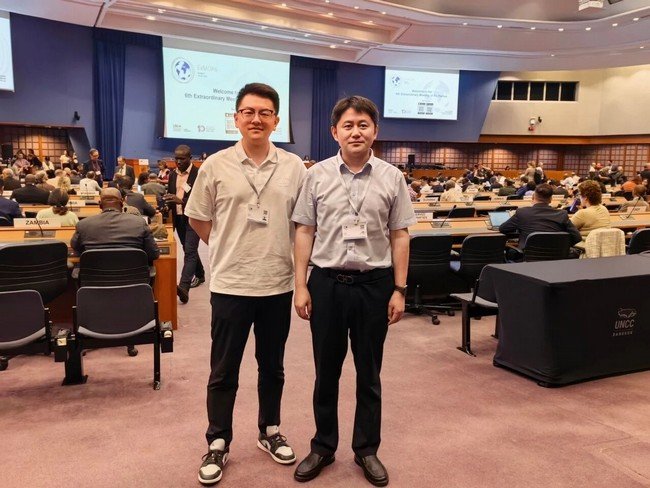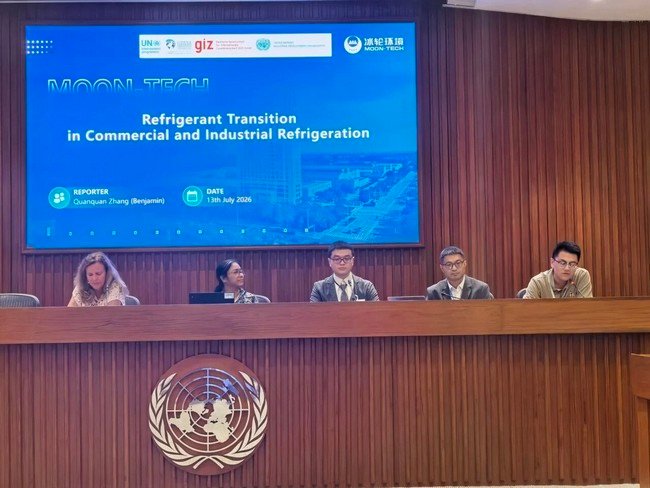
Moon-Tech Environment Technology presented its natural refrigerant technologies and sustainable cooling projects during the 48th Meeting of the Open-ended Working Group of the Parties to the Montreal Protocol in Bangkok, Thailand. The meeting, held on the 10th anniversary of the Kigali Amendment’s adoption, focused on the low-carbon transformation of refrigeration and sustainable cooling in developing countries.
At a consultation meeting organized by the Climate and Clean Air Coalition, convened by the United Nations Environment Programme, and the United Nations Industrial Development Organization, Moon-Tech Chief Engineer Chen Wenqing outlined the company’s international development strategy and global market presence. He also presented operational projects using natural refrigerants and discussed ultra-low-GWP refrigerant alternatives, energy-efficient refrigeration technologies and sustainable cooling solutions.
At a separate side event organized by the same organizations, Zhang Quanquan, Director of the Refrigeration System Innovation Research Center at Moon-Tech’s Central Research Institute, described the company’s refrigeration technology system. It uses natural refrigerants including ammonia (NH3), carbon dioxide (CO2), propane (R290) and water across a range of temperature and pressure conditions.
Moon-Tech also presented technologies for screw compressors, centrifugal compressors and magnetic levitation high-temperature motors. Its industrial system combines core component research and development, complete system integration and performance testing.
The company said it integrates heat exchange, compression, energy storage and power generation technologies to provide coordinated cooling, heating and electricity systems. These systems are intended to support energy conservation, carbon reduction and refrigeration-sector transformation in developing countries.