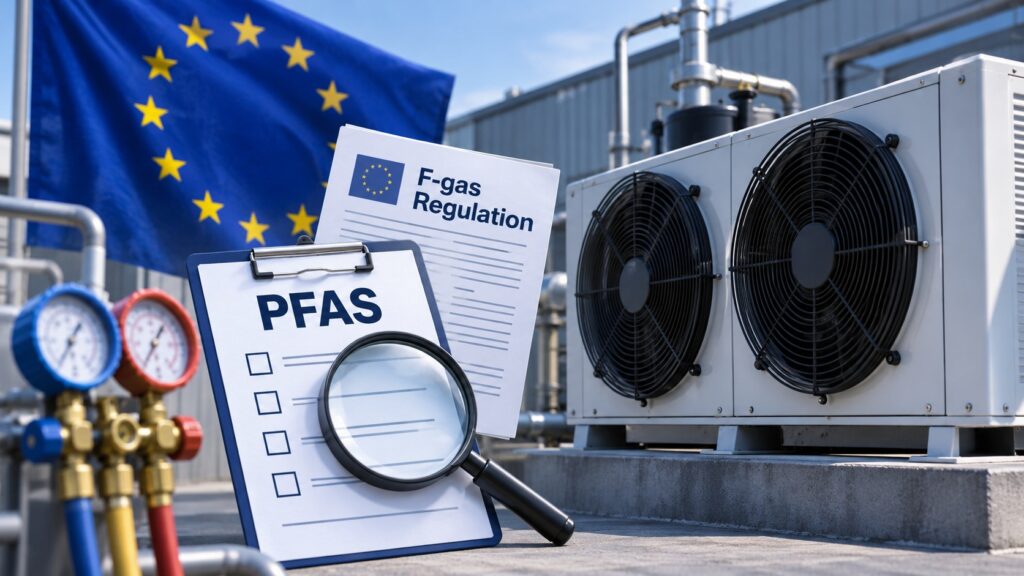
Three German refrigeration industry organizations—VDKF, Bundesfachschule Kälte-Klima-Technik and BIV—have criticized conclusions drawn from a study by Öko-Recherche on the future use of PFAS-containing fluorinated gases under the revised EU F-gas Regulation. In a statement issued on November 16, 2026, the organizations called for a more differentiated assessment of additional PFAS restrictions, taking account of safety, energy efficiency, emissions and equipment lifecycles.
The study, commissioned by Deutsche Umwelthilfe (DUH), the European Environmental Bureau (EEB) and ChemSec, projects annual EU demand for PFAS-containing fluorinated gases of approximately 24.6 kilotonnes in 2050. Of this total, 20.18 kilotonnes, or 82%, would be used in mobile air conditioning, including 18.05 kilotonnes in passenger cars and light commercial vehicles. By contrast, demand in stationary refrigeration is projected to decline from 9.63 kilotonnes in 2020 to 0.85 kilotonnes in 2050, a reduction of more than 90%.
The associations argue that refrigerant demand should not be equated with actual emissions. They say environmental assessments should consider leakage rates, servicing emissions, refrigerant recovery, end-of-life treatment and the formation of trifluoroacetic acid (TFA). They also emphasize that mobile air conditioning is primarily regulated under the EU Mobile Air Conditioning (MAC) Directive rather than the F-gas Regulation.
Another concern involves existing refrigeration and air-conditioning equipment. While PFAS-free refrigerants can be considered during the design of new systems, changing refrigerants in installed equipment may require replacing major components or entire systems. The associations warn that restrictions affecting refrigerant availability for maintenance could result in the premature replacement of technically functional equipment, with associated costs, resource consumption and environmental impacts.
VDKF, Bundesfachschule and BIV stress that they do not fundamentally oppose further restrictions on fluorinated refrigerants. They support reducing TFA releases and using alternatives where technically feasible, safe, economically viable and environmentally beneficial. However, they maintain that the study does not establish an equal need for additional regulation across all refrigeration, air-conditioning and heat pump applications.