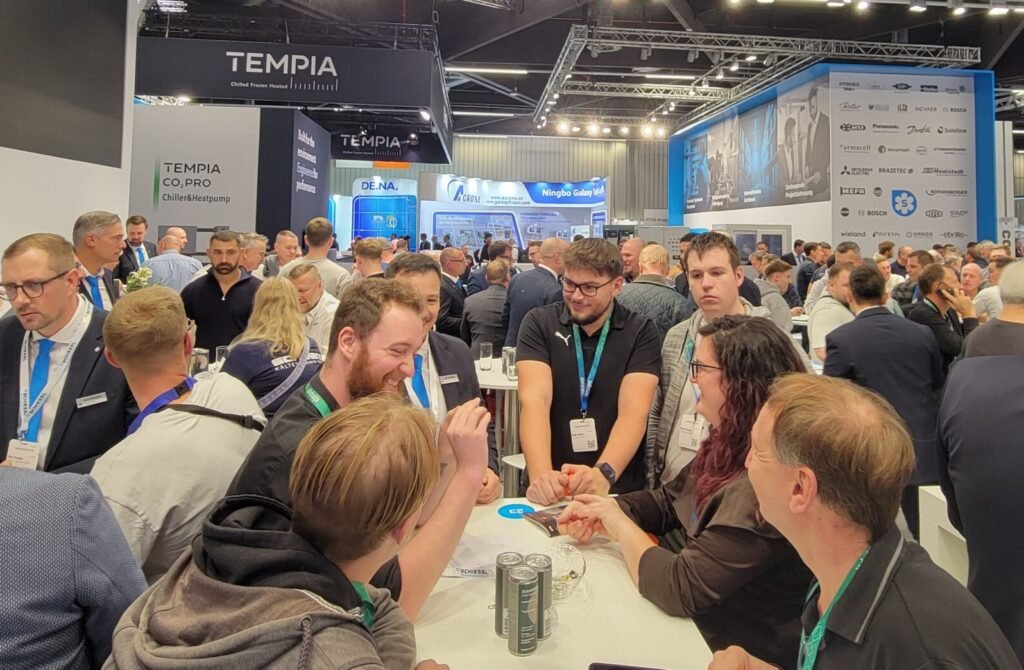
Chillventa 2026 brought 1,170 exhibitors from 50 countries (up 16% on 2024) and more than 36,000 visitors to Nuremberg on 13 to 15 October. In conversations at the stands, and in a few written follow-ups after the show, one theme kept coming back: how to show that a product delivers its rated efficiency in a real installation. Exhibitors pointed to factory test benches, hour-by-hour simulations and measurements on live sites, such as a 32 kW CO2 system in an Italian supermarket where Rivacold recorded net energy savings of 18 to 22%.
Our preview mapped what exhibitors announced before the show. This report does not try to cover every stand. It brings together what compressor makers, rack builders and control specialists told us in Nuremberg, with points from our interviews with BITZER and Copeland.
CO2: the gains come from how the cycle is run
Rivacold’s ADAPTIX adds a high-efficiency heat exchanger, a three-way regulating valve, temperature and pressure sensors and the company’s RIV-EVO controller to R744 transcritical units. It adapts operating parameters to ambient conditions and load throughout the year, lowering discharge pressure and raising evaporating temperature so the compressors do less work. “With a dedicated custom controller we modulate the operating parameters of the machine all the year in order to achieve a higher evaporation temperature,” said Francesco Romiti, Marketing Manager at Rivacold.
Rivacold positions the system against ejectors. Its theoretical comparison for medium-temperature R744 systems gives ejectors up to 30% savings in summer, 15% in mid-season and none in winter, against up to 30% in all three seasons for ADAPTIX and up to 40% when the two are combined. “Other systems work only during summer,” Romiti said. “Our system is much cheaper and works all the seasons of the year.” The only moving part ADAPTIX adds is a regulating valve, he said, whereas subcoolers need a dedicated refrigeration circuit and parallel compression needs extra compressors. ADAPTIX becomes an option on selected Rivacold R744 condensing units and racks above 13 kW during 2027, with custom projects from late 2026.
At the Epta stand, Stefano Trabucchi, Group Platform Senior Manager, answered with a tool rather than a product. The Wizard Matrix, a selection tool on the EptaTechnica website, takes the store size, as floor area or cooling load, and the climate of the site, then suggests the refrigerant, the platform and the efficiency technology. Behind it, a simplified version of an internal model simulates cooling demand hour by hour across the year, converts it into energy use for each option and then into cost. In one example he showed, a store with a design ambient of around 40°C and a load of 80 to 120 kW falls in what he called “the full CO2 region”. Plug-in cabinets can be added to the simulation, so a fully plug-in store can be compared with a remote one.
Trabucchi was blunt about the limits of datasheet figures. “Rated efficiency for us is not really a calculation of COP,” he said, because a real installation has too many variables to pin the real figure down. “The main feedback we are receiving: if the system is reliable, yes, it is surviving heat waves during the summer, yes or no.” For those conditions Hauser, now part of the Epta Group, showed ecoFusion, a modular R290 subcooler for transcritical CO2 packs developed with Graz University of Technology, in 12 kW and 24 kW sizes for ambient temperatures up to 50°C. Combined with Epta’s FTE 3.0 and ETE systems, the company estimates savings of 15 to 23% above 40°C.
Industrial CO2 had its own field argument. Luca Bresolin, Project Manager at CREA, an Italian rack builder near Milan that also installs and services its plants, showed a stainless-steel transcritical booster rack built for a food producer in Romania and rated, he said, at about 500 kW at -33°C. Its low-temperature side is pumped rather than direct expansion. “For example, minus 25 in the cold room, you put inside the evaporator liquid CO2 at minus 29. You have a small delta T,” he said, compared with roughly 7 K in a direct expansion system. Heat is recovered in three stages: around 60°C for site use, around 30°C glycol to defrost the cold room evaporators, and low-grade heat for floor heating under the cold stores, replacing electric heaters. Mass-flow meters wired into the PLC let CREA and its customers track COP in operation, and Bresolin said customers now ask for round-the-clock monitoring, recorded COP data and remote parameter changes.
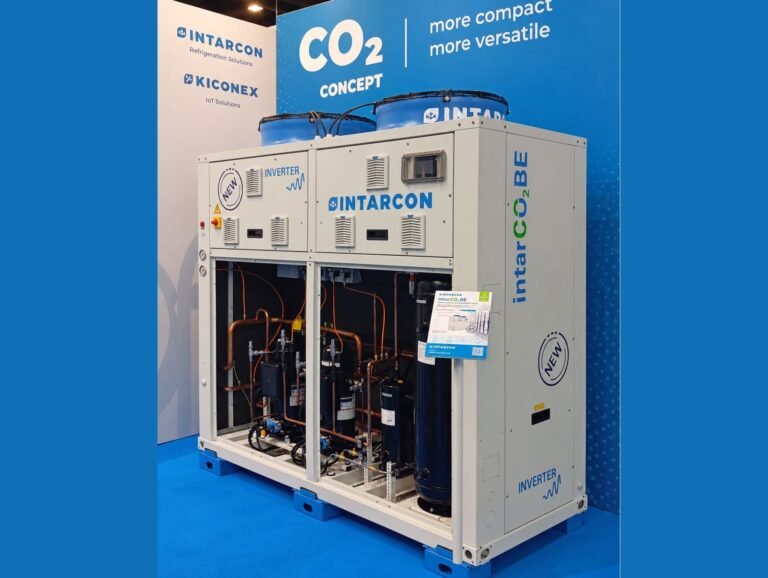
The move to smaller formats continued. Among launches not covered in our preview, INTARCON’s intarCU2BE takes transcritical CO2 into supermarkets of 200 to 800 m2, with up to 40 kW of medium-temperature capacity from an inverter scroll compressor in a unit 800 mm wide at its widest point, so it passes through standard doors. At the other end of the scale, Dorin used the show for the first presentation of the CD800, an eight-cylinder transcritical CO2 compressor with displacements of 101 to 115.5 m3/h and motors of 180 to 220 hp. Giovanni Dorin, Chief Marketing & Business Development Officer, called it the company’s flagship for industrial refrigeration and said one CD800 can replace several compressors on a rack, shrinking racks for warehousing, food processing and large shopping centres. “We have targeted CO2 as the priority gas,” he said.
Heat exchanger makers framed efficiency at the component level. Manuel Togaç, Marketing Manager at Karyer Heat Exchangers, pointed to the company’s EA unit cooler, rated in energy efficiency class A, and its gas cooler. Interest at the stand, he said, centred on cutting energy consumption, particularly in industrial refrigeration.
The pull is not only European. Sandro Matic, President Americas at Copeland, put CO2 adoption at roughly 36% in Europe against about 6% in the Americas, which leaves “a long runway for CO2 solutions” there. Martin Büchsel, Chief Sales and Marketing Officer of the BITZER Group, pointed to growing interest in CO2 in the US and China, even though US federal supermarket limits have been pushed to 2032.
What this means: the CO2 gains on show came less from new hardware than from how the cycle is run, through adaptive setpoints, subcooling and pumped evaporators. The proof offered is increasingly measured on site, in the store or the cold store, rather than quoted from a rating.
Propane and isobutane: charge limits shape the system
Fernando Fischer, Corporate Marketing Director at Tecumseh, pointed to a fixed-speed R290 compressor platform for food retail as the most efficient product on the stand. In supermarket island display cases, where it replaced the original variable-speed compressor and consumption was measured in normal use, he said it matched or exceeded the variable-speed unit, and that against other on-off compressors on the market it is up to 25 to 30% more efficient. He described demand by segment: “If you go to light commercial and commercial, it’s all about propane. It’s all about also variable speed and high efficiency.” At higher capacities, he said, customers turn to A2Ls, while Tecumseh is working on CO2 compressors and condensing units.
Gian Maria Borri, Marketing Manager at Secop, answered our questions in writing after the show and put the company’s figures on the table. Its variable-speed R290 compressors for food retail, with displacements of 10 to 18 cm3, cut energy use by up to 40% compared with a fixed-speed compressor by matching speed to the actual cooling demand. For food service, the largest model in its propane range, the SCE25MNDX, delivers up to 2,100 W of cooling capacity at a COP of 2.01 (ASHRAE MBP). For sanitary hot water heat pumps, the NLE10DNDX gives up to 1,944 W of heating at a COP of 4.08 (ASHRAE HBP), which the company puts at up to 30% more efficient than HFC-based solutions.
Arneg tackles the charge limit inside the store. Enrico Zambotto, CTO Refrigeration Systems at Arneg, showed TOWER RING, in which one refrigeration unit serves several displays, with a maximum R290 charge of 150 g per circuit. Condensing is water-cooled: the water goes either to an external dry cooler or to an internal one that heats the store, and the compressors sit in the sales area behind shelving, at the start, middle or end of an aisle.
Zambotto linked interest in such systems to labour as much as to regulation. “CO2 is a standard, but there are some applications where it’s difficult to find a skilled technician,” he said. Glycol systems are easier to install, set up and start, he added, “and also the piping system could be done by a plumber instead of a refrigeration technician”, with no high pressure inside the supermarket.
In heating, the market has moved ahead of the rules. “No regulation today requires anyone to use propane, yet many commercial heat pumps already run on it,” said Matic, adding that heat pumps in Europe are already primarily propane systems. Büchsel said BITZER is developing screw and scroll compressors for propane and isobutane, mainly for heat pumps.
Isobutane is also moving into larger machines. Danfoss and ENGIE Refrigeration used the show to present a joint development built around the Turbocor TNS385, which Danfoss describes as its first oil-free compressor designed for R600a. After initial laboratory testing at Danfoss, the compressor is now being evaluated in a dedicated ENGIE Refrigeration chiller prototype for comfort cooling in large buildings. Preliminary data point to a rated cooling capacity of about 385 kW, subject to further validation, and the partners say efficiency figures will follow only once validation is complete. Because R600a is an A3 refrigerant, the adaptations include sealing, motor cooling and integrated leak detection in the compressor, and automatic protective measures with safe shutdown sequences in the chiller. Fabio Klein, Divisional President of Danfoss Commercial Compressors, said the aim is to “evaluate performance, integration and safety requirements before commercial introduction.” Danfoss plans a controlled release of the TNS385 to selected customers during 2027; no release date has been set for the ENGIE chiller.
What this means: with charge limits fixed, propane capacity is being split into small sealed circuits or kept off the sales floor behind a water or glycol loop. For some retailers the deciding factor is not the refrigerant but who is available to install and service it.
Industrial heat pumps: the refrigerant sets the ceiling
Rajesh Dixit, Senior Director of Product Management at Johnson Controls, set out the temperature ladder at the stand. Ammonia heat pumps “typically go up to 90, 92°C”; with isobutane the new Sabroe HitemHP reaches 107°C, and with butane 122°C. Efficiency, he argued, barely changes along that ladder: depending on conditions, a heat pump is typically three to four times as efficient as a boiler whichever of these refrigerants it uses.
Dixit’s answer to the field question was the factory test block. HitemHP is validated at design and off-design conditions in Denmark, and he said Johnson Controls is the first to offer a standardised unit of this kind that can be performance-tested at the factory before shipment. “The customer has a peace of mind: show me it works before you ship it to me,” he said. After start-up, units can be connected through OpenBlue so that technicians are supported remotely during commissioning and troubleshooting, with what the company calls predictive diagnostics.
At GEA, whose stand featured a RedGenium 950 ammonia heat pump built around its V XHP piston compressor, Roland Ligtvoet, Product Manager Piston Compressors and Applications, made the case for reciprocating machines in heating duty. In cooling, he said, a piston compressor is slightly more efficient than a screw; in a heat pump, where the pressure difference is larger, the same package with a piston compressor shows “more than 20% efficiency increase” over a screw. GEA later specified that the figure comes from the AddBetter labelling of the RedGenium, the company’s in-house ecolabel, at an example condition of +20/+70°C. The manufacturer validates compressors in its validation centre during design, feeds the data into its selection software and offers a factory performance test for a small premium. Customers often report that units over-perform, he said, because GEA rates them conservatively.
Most questions to GEA this year were about heating, and much of the effort goes into training. “It’s the same basic compressor more or less, but it’s a different animal,” he said of heat pump compressors, which run at higher pressures and raise new practical issues for installers. Supply temperatures above 95°C are under development and validation, but “not market ready”.
The demand behind the higher temperatures is industrial. In industry, Matic said, about 60% of total energy consumption can be linked to heating. Food manufacturing processes typically run between 120 and 180°C, and that heat pumps able to reach them are needed to replace oil- and gas-fired boilers; Copeland’s acquisition of SPH Sustainable Process Heat was made for that range.
What this means: above roughly 95°C the choice moves from ammonia to hydrocarbons, and efficiency claims move from datasheets to factory test benches. The constraint exhibitors described was validation and installer training rather than compressor availability.
Data centres: keeping complexity under control
Büchsel does not expect the data centre boom to fade. “It is not a straw fire that will disappear soon, and it is not a bubble,” he said. BITZER used the show to present HELICOM, its new generation of screw compressors, starting with a model for data centre applications.
Copeland expects the data centre segment to grow by 165% by 2030, and Matic said that pace makes it necessary to “keep complexity under control”. Its Aero-lift oil-free centrifugal compressor “removes the complex electronics needed, for example, to drive magnetic bearings”, so the technology can be applied at a much broader scale. On the auxiliaries, Delta presented an EC fan motor with 20% lower losses than the IE5 level and HVDC pumps for coolant distribution unit loops.
What this means: as the segment scales, compressor makers are bringing out machines designed for data centres and taking complexity out of them, so that the technology can be applied more widely.
Tools for a thinner workforce
Several exhibitors redesigned the work around the equipment rather than the equipment itself. Flemming Lundberg Poulsen, Head of Marketing & Communications at SAMON and Safe Monitoring Group, showed new IR and IR+ infrared sensor options for the Glacier MIDI gas detectors, which he said cost more up front but less over their lifetime, with no sensor poisoning or drift. The new Glacier RM room monitor has a built-in Wi-Fi server, so it can be set up from any phone without an app, and the free app for Glacier MIDI guides the technician through calibration and issues a certificate that can carry the contractor’s own logo. “You don’t need special tools. All you need is your phone,” Poulsen said. GasNet, the group’s new cloud service, brings detectors from several sites into one view with text and email alerts and stored readings. On the sensor side, MSA Safety debuted an NDIR refrigerant gas sensor for its Bacharach monitors with a lowest detectable limit of about 60 ppm.
Eliwell launched Eliwell 360, a web platform for installers and distributors built around solution cards for common jobs such as cold room control, each with product selection and Learn & Go video tutorials. “Our products and solutions are more and more complex, trying to reach the best efficiency targets,” said Giovanna Rosso, Marketing Communication Leader at Eliwell by Schneider Electric.
The compressor makers framed the same problem in terms of people. Matic described commissioning services and AI algorithms that help installers start up Copeland CO2 condensing units, and the Copeland Scout tool, which uses AI to help troubleshoot systems and identify the right replacement parts. Büchsel pointed to BITZER’s training network, including a new training centre for the Asia-Pacific region in Thailand with real systems, among them a rack and ECOLITE units, so that the training is hands-on. Borri described the same shift from the customer side at Secop: buyers now expect support across the whole project, from joint system design and testing during development to after-sales support, not only an efficient compressor.
What this means: commissioning, calibration and diagnostics are being rebuilt for less specialised hands, because the number of trained people now limits how fast natural refrigerant systems can be installed.
Measured, not rated
Asked how they know their equipment delivers in the field, exhibitors gave six different answers. Tecumseh measured consumption after replacing a compressor in working display cases. Rivacold switched its system on and off in alternating 24-hour periods. CREA wires mass-flow meters into its PLC. Johnson Controls can performance-test its HitemHP units on the factory test block before shipment, and GEA sells a factory performance test as an option. Epta’s answer was simpler still: whether the system survives a summer heatwave.
What connects them is that the refrigerant decision is largely made. The open questions are how to prove the result and who will install it. “There will not be enough refrigerant to top up all existing systems, so those who wait will face two problems: refrigerants, and finding people,” Büchsel said, with the EU HFC quota stepping down on 1 January 2027. Speakers at the Chillventa CONGRESS, held the day before the show opened, reached the same point from the policy side. “CO2 would not have a chance if we would only go for COP values alone,” said Torben Funder-Kristensen, Head of Product Compliance and Standardization at Danfoss Climate Solutions, while Sarah E. Maston, 2026-27 ASHRAE President, warned that newer systems “are inherently more complicated to operate and maintain, requiring more qualified technicians that don’t yet exist.” Our CONGRESS report covers the regulatory picture, from the 2027 quota step to the Ecodesign revisions. More material from Nuremberg is on the way, including full interviews with BITZER and Copeland; subscribe to the Refindustry newsletter so you don’t miss them. For the products announced before the show, see our Chillventa 2026 preview.