Esta página solo está disponible en inglés. Ir a la portada en español

×

Questa pagina è disponibile solo in inglese. Home page in italiano

×

Diese Seite ist nur auf Englisch verfügbar. Zur deutschen Startseite

×

Cette page est disponible uniquement en anglais. Aller à la page d'accueil en français

×
Article

F-Gas Causing Refrigerant Prices to Skyrocket

F-Gas Causing Refrigerant Prices to Skyrocket

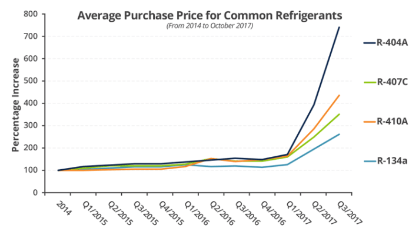
Under EU No 571/2014 (F-Gas Regulation), European markets are experiencing the start of a drastic phase-down in the availability of HFC refrigerants (a reduction to 63% of the 2015 baseline figure). This is a steep reduction from the 93% availability in 2017, and the refrigeration industry is feeling the effects. For example, during the latter half of 2017 the price of R-404A increased by 700%. R-404A, with a Global Warming Potential (GWP) of 3,922 tCO2e, is not alone in seeing these exceptional price increases. It is one of a group of gases with a GWP of more than 2,500 tCO2e that will be banned from use in stationary refrigeration equipment starting in 2020 (with the exception of equipment designed to cool below -50°C). Additional refrigerants on this list of banned gases include: R-507, R-422A, R-422D, R-434A and R-428A.

Increases Not Limited to High GWP Refrigerants

The rising prices are not restricted to these high GWP refrigerants. R-134a, with a GWP of 1,430 tCO2e, has also seen increases in the region of 400%. As illustrated in the following chart, a similar price increase is apparent for many other commonly used refrigerants, including R-407C and R-410A.
The 2018 reduction in HFC availability is expected to cause refrigerant prices to continue to trend upward. The lower GWP refrigerants (HFOs and HFO / HFC blends) replacing HFCs do not carry the same comparatively low price-tag to which the HVAC-R industry has become accustomed. Higher refrigerant prices are expected to become a global phenomenon as producers struggle to meet end-user requirements while maintaining their production quota.

Standards for Refrigerant Leaks

Leaking refrigerant gases have become more expensive than ever before. It is estimated that, in many cases, the cost of refrigerant loss is now higher than the cost of a technician’s time to repair a leaking refrigeration system. F-Gas mandates that systems containing a refrigerant charge greater than 500 tCO2e have a permanent leak detection system installed. The regulations also increase the required frequency of leak inspections if permanent leak detection is not installed for refrigeration systems containing greater than 5 tCO2e. F-Gas does not provide any guidance as to the type of leak detection systems that can be used, or requirements for the system’s capabilities. Read more
Get the daily refrigeration briefing

One email a day. Trusted by 3,000+ RACHP professionals.

Related insights

All insights →
Article

Innovations, Regulations, and Market Trends: A Summary of the XXI European Conference on Refrigeration and Air Conditioning Technologies

The XXI European Conference organized by Centro Studi Galileo took place on June 12-13, 2025, at Politecnico di Milano, bringing together industry experts, policymakers, and researchers to discuss advancements, regulatory changes, and technological innovations in refrigeration and air conditioning systems. The conference was held under the auspices of UNEP, IIR, AREA, REI, and ATF. Introduction

15 Jun 2025
Market Research

EPA Delays Low-GWP Refrigerant Deadlines, Splitting the US Cooling Industry

The deadline that supermarkets faced to install new refrigeration systems running on low-GWP refrigerants was January 1, 2027. It is now January 1, 2032. On May 21, 2026, alongside President Trump in the Oval Office, EPA Administrator Lee Zeldin announced final revisions to the 2023 Technology Transitions Rule and a proposed technical fix to the

25 May 2026
Market Research

2025 in Refrigeration — What Changed, What Mattered, What’s Next

Refindustry has released its 2025 year-in-review, compiled from the most-read and most impactful updates published on https://refindustry.com/. The review captures how the industry moved from “refrigerant choice” discussions to real-world transition execution—where compliance pathways, safety engineering, component readiness, service capacity, and digital monitoring determine outcomes on projects and in day-to-day operations. What shaped 2025 in

21 Jan 2026
Interview

From Italy to the World: How Centro Studi Galileo is Training the Future of Refrigeration

The refrigeration and air conditioning industry is undergoing a rapid transformation, driven by climate commitments, new regulations, and technological innovation. At the 21st European Conference on the Latest Technologies in Refrigeration and Air Conditioning, held in Milan by Centro Studi Galileo, industry leaders gathered to explore this pivotal shift. In a conversation with Sergei Mukminov,

Sergei Mukminov · 18 Jun 2025
Article

MCE 2026 Opens in Milan with Focus on Natural Refrigerants, Data Center Cooling, and Heat Pumps

The 44th edition of MCE – Mostra Convegno Expocomfort opened today at Fiera Milano Rho, with over 1,600 exhibiting companies from 48 countries presenting technologies across 12 halls through 27 March. The event is expected to draw more than 120,000 professionals, including official delegations of 320 selected international buyers from 39 countries. This year’s edition

24 Mar 2026
Article

Insights from KARYER at AHR Expo 2026

Partner's material KARYER, which participated in AHR Expo 2026 held in Las Vegas between February 2-4 2026 as KR Coils, states that it had the opportunity to observe the direction in which HVAC&R industry is progressing through interactions with professionals from different fields. According to the trend report published by the organizers, the main topics

17 Feb 2026

Most read insights

All insights →