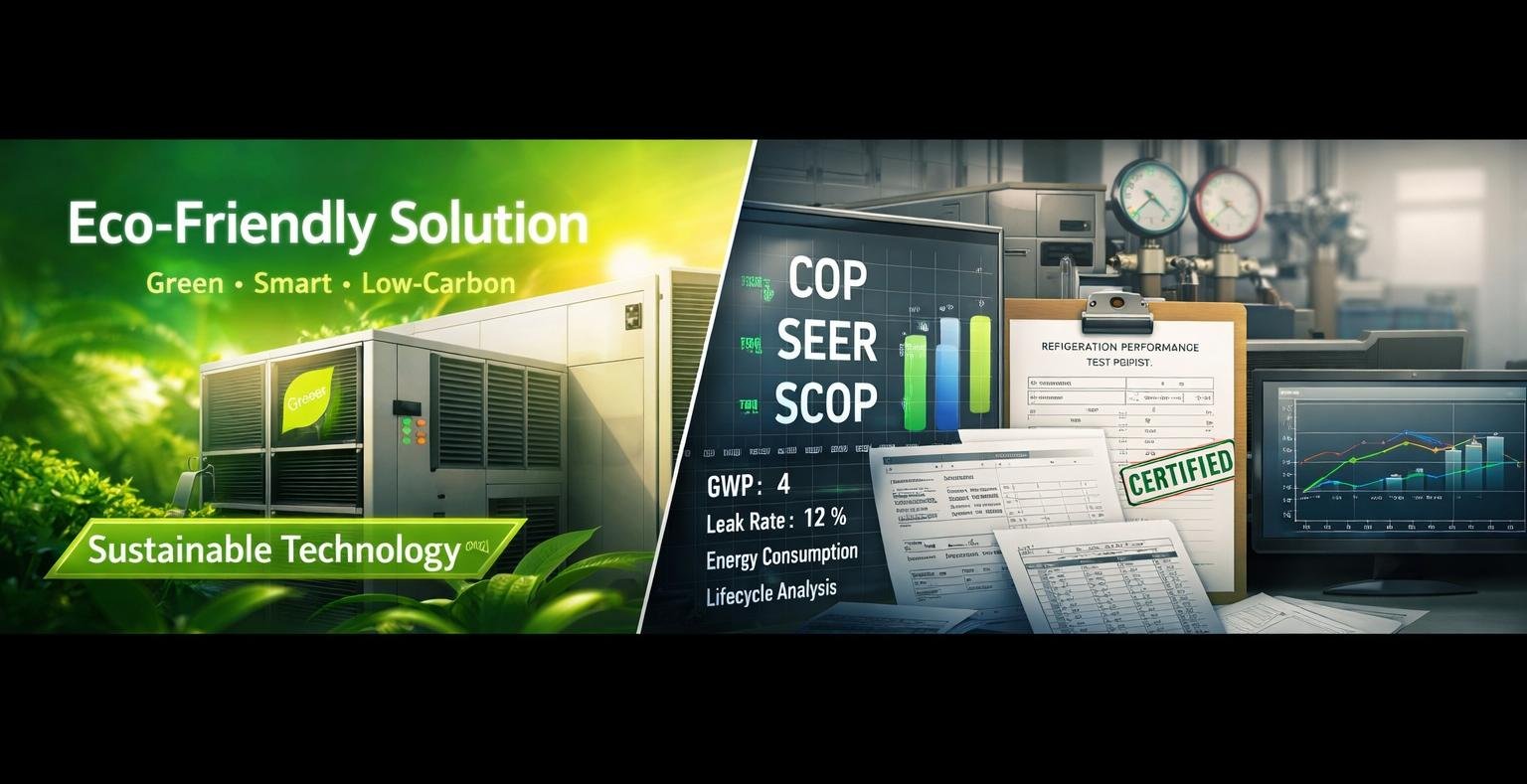
As decarbonization becomes a sales language, the industry needs better proof—not louder slogans.
Sustainability is no longer a side note in HVACR. It sits at the center of tenders, boardroom strategy, product launches, and customer messaging.
That shift is understandable. Manufacturers face pressure from regulations, ESG expectations, and rising customer scrutiny. Contractors and consultants are expected to recommend future-ready systems. End users want lower emissions, lower energy bills, and fewer compliance headaches.
But one uncomfortable question is becoming harder to ignore: can every “green” claim in HVACR really be trusted?
This is where greenwashing enters the conversation. And in a sector built on performance data, lifecycle economics, and technical credibility, the stakes are unusually high.
What greenwashing means in HVACR
In simple terms, greenwashing is the practice of making a product, system, or company appear more environmentally responsible than the evidence supports.
In HVACR, that rarely looks like a dramatic falsehood. More often, it appears in the grey zone: selective data, idealized test points, vague environmental language, incomplete comparisons, or labels that sound authoritative without offering robust verification.
That is what makes the issue so relevant now. The market is not short of sustainability messaging. It is flooded with it.
A brochure may highlight a low-GWP refrigerant while saying little about real-world efficiency. A product page may promote “up to” performance figures that reflect best-case laboratory conditions rather than everyday operation. A control platform may be marketed as “AI-powered” and therefore sustainable, even when the actual energy benefit is unclear, unmeasured, or highly site-dependent.
Not every weak claim is intentional deception. But in practice, poorly substantiated claims can mislead buyers just as effectively as aggressive marketing can.
Insight: In HVACR, a green feature is not the same as a green outcome.
Why this matters now in refrigeration and HVAC
HVACR is especially vulnerable to greenwashing because sustainability is technically complex here.
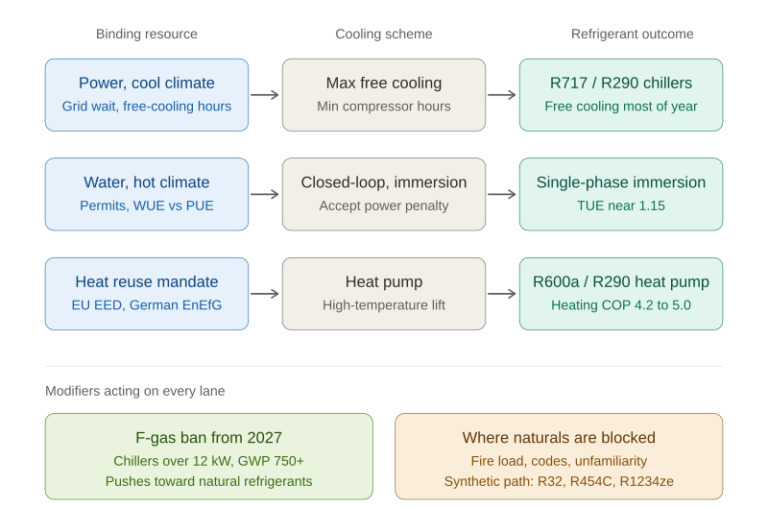
Take refrigerants. The industry debate around CO2, HFOs, HFCs, ammonia, propane, and hybrid architectures is real, important, and often polarizing. But no refrigerant story should be reduced to a slogan. A low-GWP option matters. So does energy performance. So do leakage expectations, safety design, serviceability, climate conditions, charge size, and equipment lifetime.
The same applies to “natural refrigerants.” It is a meaningful term, but not a complete sustainability argument. A system using a natural refrigerant may still raise difficult questions around efficiency in specific climates, operating strategy, maintenance readiness, or total installed cost. Calling something “natural” does not automatically settle the engineering discussion.
Energy efficiency claims create another risk area. A single COP figure at one mild test point may look impressive, but seasonal performance tells a different story. For buyers making multi-year investment decisions, selective presentation of test data is more than a marketing issue. It can distort procurement.
Then there is digitalization. Smart controls, analytics, remote monitoring, and AI can absolutely improve performance. But the industry should be careful when “smart” becomes a shortcut for “sustainable.” A connected system is not automatically an efficient one. Real value should be shown through measurable savings, operational stability, and transparent baselines.
Retrofit messaging deserves the same scrutiny. “Drop-in,” “low disruption,” or “decarbonization-ready” claims may be attractive, but retrofit outcomes depend on the existing plant, controls, piping, heat rejection, operating profile, and service capability. Replacing one component or one refrigerant does not automatically transform the lifecycle footprint of the whole system.
What Eurovent’s analysis gets right
A recent Eurovent article on greenwashing in HVACR offers a useful reference point because it moves the discussion away from ideology and back toward evidence.
Its central argument is straightforward: greenwashing in HVACR can distort buying decisions, undermine trust, and slow real decarbonization progress. That framing matters.
Eurovent points to several recurring patterns in environmental marketing: highlighting best-case test points, overstating one “green” feature while downplaying trade-offs, comparing products against weak or outdated benchmarks, and using vague environmental language without measurable criteria.
It also draws attention to the rise of labels and logos that may look credible but offer limited transparency or verification. According to the figures cited in the article from European Commission sources, vague or unfounded green claims remain widespread in the wider market, and many environmental labels offer weak or no meaningful verification. Eurovent’s point is not that every label is misleading. It is that buyers need to know the difference between independent oversight and self-declaration.
That is an important distinction for HVACR. This is a sector where technical nuance matters, and where specifiers, consultants, contractors, and operators often work from compressed decision timelines. A polished claim can travel faster through the supply chain than a full technical validation.
Insight: At the same time, broader regulatory discussions around consumer protection and green claims are gaining momentum across Europe, reflecting growing concerns about how sustainability is communicated in the market. Read more: Consumer protection: enabling sustainable choices and ending greenwashing
The real risks of greenwashing
The first risk is trust.
If buyers repeatedly discover that “efficient” systems do not perform as expected, or that “green” claims are difficult to verify, confidence in the market erodes. That hurts not only the companies making weak claims, but also those investing seriously in transparent product development.
The second risk is poor investment. In HVACR, procurement errors are expensive. A system chosen on selective data may lead to redesigns, underperformance, callbacks, higher OPEX, or missed sustainability targets.
The third risk is reputational. Contractors, consultants, and distributors increasingly carry responsibility for the claims they pass on. Even when a statement originates with a manufacturer, the downstream consequences can affect the entire project team.
The fourth risk is regulatory exposure. Eurovent notes that European rules around environmental advertising are tightening, and the direction of travel is clear: vague, unsubstantiated green claims are under growing scrutiny. Even before enforcement catches up, the commercial environment is changing.
How the industry can respond
The answer is not less sustainability communication. It is better sustainability communication.
That starts with a few basic disciplines:
-
Use third-party certification where available and relevant.
-
Show full test context, not just headline numbers.
-
Prioritize seasonal and lifecycle metrics over best-case points.
-
Disclose key assumptions around refrigerant impact, leakage, service intervals, and expected lifetime.
-
Validate both hardware and, where relevant, software or selection tools.
For buyers, that means asking harder questions. For suppliers, it means being prepared to answer them.
Mini-quote: In HVACR, transparency starts where the brochure stops.
The Refindustry view
This is not a story about “good” technologies versus “bad” technologies. Nor is it a reason to become cynical about every sustainability claim in the market.
The HVACR industry is genuinely evolving. Refrigerant transitions are real. Heat recovery is advancing. Controls are becoming more intelligent. Lifecycle thinking is improving. Many companies are doing serious engineering work to reduce emissions and improve efficiency.
But marketing often moves faster than technical reality.
That gap is where greenwashing thrives—not always through outright fiction, but through simplification. And simplification is dangerous in a sector where performance depends on context.
The industry does not need less ambition. It needs more discipline in how ambition is presented. If sustainability becomes just another branding layer, the market loses clarity. If it remains tied to transparent data, comparable metrics, and independent validation, it can remain credible.
That is the balance HVACR now has to protect.
Conclusion
Greenwashing is not just a communications issue. In HVACR, it is a technical, commercial, and strategic issue.
A more sustainable industry will not be built on the loudest claims. It will be built on evidence that survives scrutiny in the lab, on site, and over the full life of the system.
The question now is no longer whether greenwashing exists in HVACR. It does.
The more important question is this: How can the HVACR industry ensure that sustainability claims remain credible?
Meta description: Greenwashing in HVACR is becoming harder to ignore. Here is why the industry needs stronger proof, clearer data, and more credible sustainability claims.