Esta página solo está disponible en inglés. Ir a la portada en español

×

Questa pagina è disponibile solo in inglese. Home page in italiano

×

Diese Seite ist nur auf Englisch verfügbar. Zur deutschen Startseite

×

Cette page est disponible uniquement en anglais. Aller à la page d'accueil en français

×
Article

Sanitary Transportation of Food Compliance Guide

Sanitary Transportation of Food Compliance Guide

The Food and Drug Administration (FDA) published its final rule for the Sanitary Transportation of Human and Animal Food (STF). The rule, which became effective on June 6, 2016, established requirements for shippers, loaders, carriers by motor or rail vehicle and receivers involved in transporting human and animal food to use documented sanitary practices to ensure the safety of that foodThe goal of the final STF is to prevent practices during transportation that create food safety risks, such as failure to properly refrigerate food, inadequate cleaning of vehicles between loads, and failure to properly protect food.
To help key industry stakeholders stay in compliance with the rule, the International Refrigerated Transportation Association (IRTA), a Core Partner of the Global Cold Chain Alliance (GCCA), developed the Refrigerated Transportation Best Practices Guide. The following guide has been developed primarily for refrigerated carriers utilizing truck, trailer and multi-temperature means of transporting food.

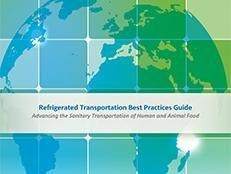
Refrigerated Transportation Best Practices Guide

The Refrigerated Transportation Best Practices Guide assists shippers in understanding and preparing qualified – and attainable – food safety plans and transportation requirements, and offering carriers, loaders and receivers a clearer understanding of expected practices so that they can be prepared to deliver. Furthermore, this guide provides the reader with useful information to better understand and become compliant with the FDA’s recent final rule for the Sanitary Transportation of Human and Animal Food (STF). The goals are: 1) To guide the user in a better understanding of the FDA’s STF final rule; and 2) To provide the various categories of service providers in the integrated industry, including shippers, loaders, carriers and receivers, with information that will assist with final rule compliance and adoption of industry best practices. Found at the end of the guide is the Sanitary Transportation of Food Compliance Matrix, which helps readers to identify specific compliance requirements included in the STF rule, the respective roles of shippers, loaders, carriers and receivers, and the section of the Best Practices Guide that includes guidance on how to comply. Click here for a recording of GCCA’s recent webinar detailing the STF rule and how to use the guide.

   Read More

Get the daily refrigeration briefing

One email a day. Trusted by 3,000+ RACHP professionals.

More on Cold Chain

All on Cold Chain →

Insights

Secop's Solar Direct Drive (SDD) System Earns WHO PQS Approval – The Team Behind It
Article

Secop’s Solar Direct Drive (SDD) System Earns WHO PQS Approval – The Team Behind It

Partner's material In March 2026, Secop’s Solar Direct Drive Power Management Module was granted WHO PQS prequalification and officially listed in the WHO Catalogue of Prequalified Immunization Devices. The WHO IMD-PQS (Immunization Devices Performance, Quality and Safety programme) is the global benchmark for cold chain equipment used in immunisation. Being listed in its catalogue is

22 Jun 2026
Case Study - Effect of Louvers or diffusers on air flow distribution and cooling time on a meat log during Chill cycle
Tech Guide

Case Study – Effect of Louvers or diffusers on air flow distribution and cooling time on a meat log during Chill cycle

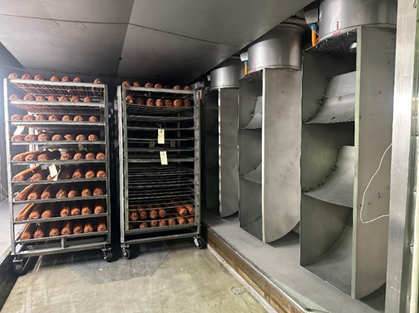
By Kushal Aurangabadkar An experimental analysis was conducted on a cooler space measuring 3.66 m × 6.096 m (12.0 ft × 20.0 ft), equipped with an ammonia refrigeration coil, five 30 cm (12 in.) fans, and five diffusers. The study measured airflow patterns, cooling rates, and heat transfer efficiency in meat storage by testing two configurations:

Kushal Aurangabadkar · 21 Jan 2026
Total Cost of Ownership (TCO) for Modular Refrigeration Systems in Life Sciences Distribution Centers
Tech Guide

Total Cost of Ownership (TCO) for Modular Refrigeration Systems in Life Sciences Distribution Centers

by Ramez Naguib, P.E. Introduction Life sciences distribution centers are under immense pressure to deliver consistent temperature control, comply with increasingly stringent regulations, and optimize operational efficiency. Traditional built-up refrigeration systems often prove cumbersome, costly, and slow to implement. In contrast, modular, factory-assembled refrigeration systems have emerged as a compelling alternative. Drawing on lessons from

14 Jan 2026
Everything on Cold Chain: 2,036 articles, 1 case study, 23 insights

Most read insights

All insights →