Esta página solo está disponible en inglés. Ir a la portada en español

×

Questa pagina è disponibile solo in inglese. Home page in italiano

×

Diese Seite ist nur auf Englisch verfügbar. Zur deutschen Startseite

×

Cette page est disponible uniquement en anglais. Aller à la page d'accueil en français

×

Carrier Transicold Solution Significantly Reduces Food Loss and Costs in Rwanda

Carrier Transicold Solution Significantly Reduces Food Loss and Costs in Rwanda

A refrigeration solution from Carrier Transicold has enabled Kigali Farms in Rwanda to significantly lower food loss and operating expenses while delivering fresh produce to local and regional markets efficiently.

Starting in 2010, Kigali Farms began cultivating oyster mushrooms to support small-scale farmers and combat malnutrition in Rwanda. The business later expanded to producing button mushrooms for packaging and shipping to Kenya, which required strict temperature control due to the perishability of mushrooms.

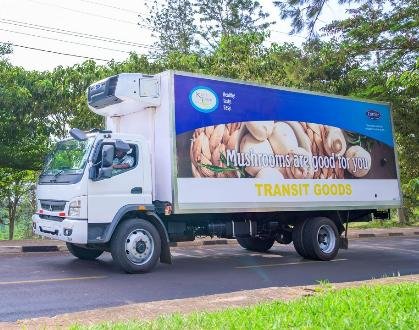
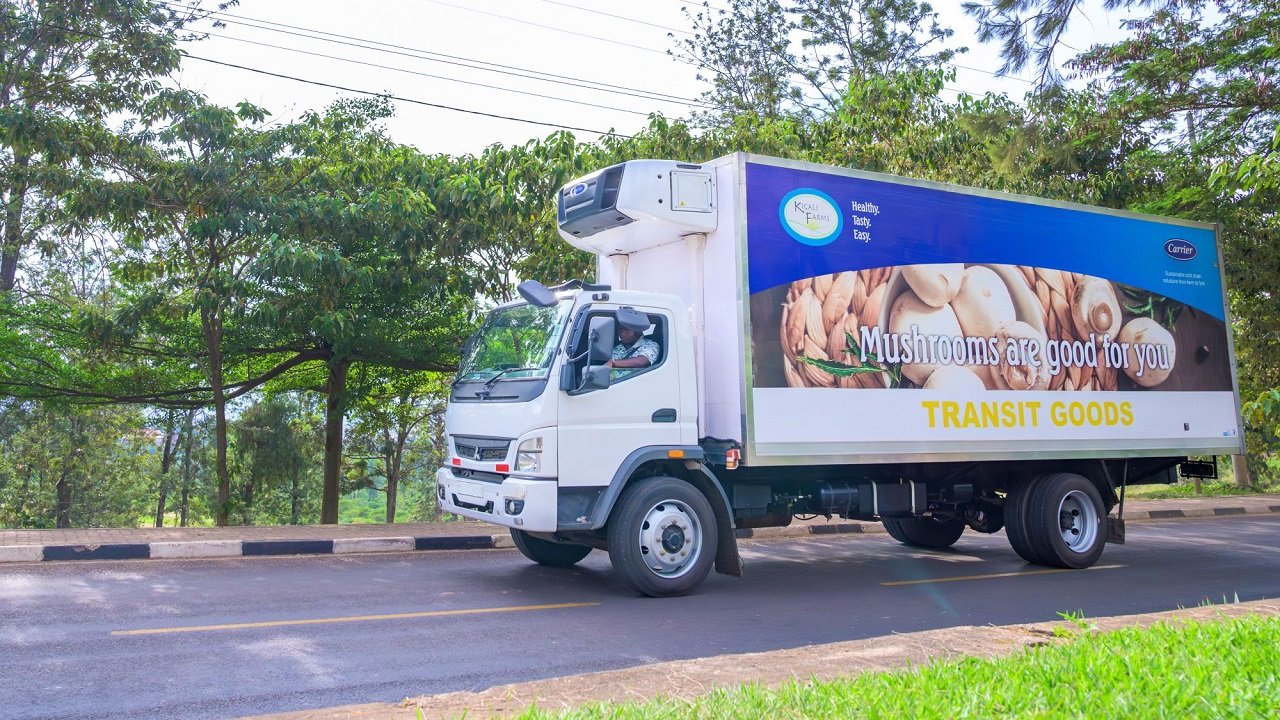
Initial reliance on third-party transporters resulted in irregular temperature logs and unreliable product quality, causing significant product losses and threatening the business. To solve this problem, Kigali Farms invested in its own refrigerated truck fitted with Carrier Transicold’s Supra 750 unit. This unit provides constant evaporation airflow, robust design, high reliability, and superior cooling performance, ensuring cold chain continuity even during multiple door openings and customs checks. Accurate temperature control at all set points was critical for maintaining the quality of the perishables.

Implementing Carrier Transicold’s solution led to a dramatic reduction in waste, from 20% to almost zero, as the temperature remained stable throughout the transportation process, preserving the condition of the mushrooms. The changes immediately impacted the business positively, allowing fresh mushrooms to be delivered to East African supermarkets, thereby reducing food waste and supporting sustainability initiatives.

In addition to solving their cold chain challenges, Kigali Farms utilized the return trips to transport third-party goods, covering the operating costs of their own truck. This strategic move reduced their transportation expenses from $100,000 annually to zero.

Carrier Transicold’s involvement provided critical cold chain expertise, ensuring that freshness was maintained by controlling the transportation conditions. The initiative not only supported Kigali Farms’ operational efficiency but also contributed to the broader goals of sustainability and agricultural diversity in East Africa.

Get the daily refrigeration briefing

One email a day. Trusted by 3,000+ RACHP professionals.

Related news

Most read this month

All news →

Related insights

Article

Secop’s Solar Direct Drive (SDD) System Earns WHO PQS Approval – The Team Behind It

Partner's material In March 2026, Secop’s Solar Direct Drive Power Management Module was granted WHO PQS prequalification and officially listed in the WHO Catalogue of Prequalified Immunization Devices. The WHO IMD-PQS (Immunization Devices Performance, Quality and Safety programme) is the global benchmark for cold chain equipment used in immunisation. Being listed in its catalogue is

22 Jun 2026
Tech Guide

Case Study – Effect of Louvers or diffusers on air flow distribution and cooling time on a meat log during Chill cycle

By Kushal Aurangabadkar An experimental analysis was conducted on a cooler space measuring 3.66 m × 6.096 m (12.0 ft × 20.0 ft), equipped with an ammonia refrigeration coil, five 30 cm (12 in.) fans, and five diffusers. The study measured airflow patterns, cooling rates, and heat transfer efficiency in meat storage by testing two configurations:

Kushal Aurangabadkar · 21 Jan 2026
Tech Guide

Total Cost of Ownership (TCO) for Modular Refrigeration Systems in Life Sciences Distribution Centers

by Ramez Naguib, P.E. Introduction Life sciences distribution centers are under immense pressure to deliver consistent temperature control, comply with increasingly stringent regulations, and optimize operational efficiency. Traditional built-up refrigeration systems often prove cumbersome, costly, and slow to implement. In contrast, modular, factory-assembled refrigeration systems have emerged as a compelling alternative. Drawing on lessons from

14 Jan 2026