Carrier Transicold Adds Automatic Battery Switching for Low-Emission Zones

New Lynx Fleet tools will monitor battery condition, while a software upgrade cuts Vector HE 19 fuel use by up to 19%.

Carrier Transicold Adds Automatic Battery Switching for Low-Emission Zones

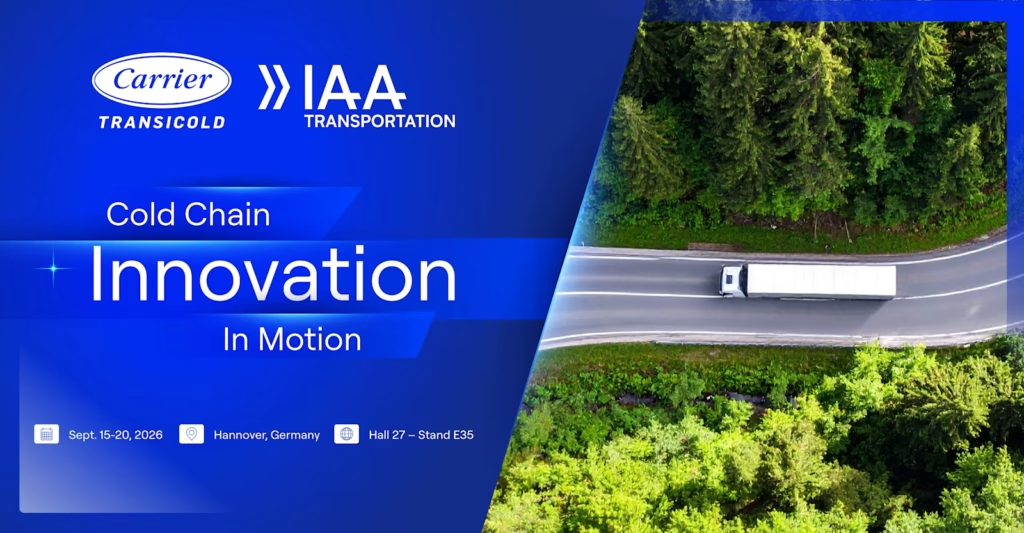
Carrier Transicold will introduce two Lynx Fleet telematics functions for battery-powered transport refrigeration units (TRUs) at IAA Transportation 2026 in Hannover, Germany, held September 15 to 20, including automatic switching from diesel to battery operation when a vehicle enters a low-emission zone.

Low-Emission Zone Management works on compatible hybrid refrigeration units and changes the power source without driver action, supporting compliance with urban access restrictions. The second function, Battery Health, tracks battery condition across the eCool and [R]eCool ranges to support maintenance planning and reduce unplanned downtime.

A fuel optimization upgrade for the Vector HE 19 trailer unit cuts fuel consumption by up to 19% through software alone, with no hardware changes. The platform is already rated at up to 30% fuel savings against the legacy Vector 1550. Fuel efficiency features across the trailer range at the stand, including the Vector HE 19, Vector HE 17 and Vector S 15.

On refrigerants, the Vector HE 17 running on the A2L refrigerant R454A will be on display. R454A carries up to 89% lower GWP than R452A. The company’s Safety by Design approach for A2L units combines modified TRU design, continuous refrigerant leak detection and an automatic two-stage protective response.

The stand will also carry the [R]eCool battery system, a 38.5-kWh unit for electric and hybrid TRUs with a stated service life of up to 16 years, available for new installations and as a retrofit for existing Vector HE, Vector and compatible third-party units. Other exhibits include the Syberia 14 unit for rigid trucks, the Eco-Drive and eCool-Drive power systems, the SAF e-Axle Power Generator, which draws energy from trailer motion to power electric refrigeration in transit, and a future platform for light commercial vehicles and battery electric trucks. A new digital service tool for faster access to service and support resources will also be introduced.

Get the daily refrigeration briefing

One email a day. Trusted by 3,000+ RACHP professionals.

More on Cold Chain

All on Cold Chain →

Insights

Secop's Solar Direct Drive (SDD) System Earns WHO PQS Approval – The Team Behind It
Article

Secop’s Solar Direct Drive (SDD) System Earns WHO PQS Approval – The Team Behind It

Partner's material In March 2026, Secop’s Solar Direct Drive Power Management Module was granted WHO PQS prequalification and officially listed in the WHO Catalogue of Prequalified Immunization Devices. The WHO IMD-PQS (Immunization Devices Performance, Quality and Safety programme) is the global benchmark for cold chain equipment used in immunisation. Being listed in its catalogue is

22 Jun 2026
Case Study - Effect of Louvers or diffusers on air flow distribution and cooling time on a meat log during Chill cycle
Tech Guide

Case Study – Effect of Louvers or diffusers on air flow distribution and cooling time on a meat log during Chill cycle

By Kushal Aurangabadkar An experimental analysis was conducted on a cooler space measuring 3.66 m × 6.096 m (12.0 ft × 20.0 ft), equipped with an ammonia refrigeration coil, five 30 cm (12 in.) fans, and five diffusers. The study measured airflow patterns, cooling rates, and heat transfer efficiency in meat storage by testing two configurations:

Kushal Aurangabadkar · 21 Jan 2026
Total Cost of Ownership (TCO) for Modular Refrigeration Systems in Life Sciences Distribution Centers
Tech Guide

Total Cost of Ownership (TCO) for Modular Refrigeration Systems in Life Sciences Distribution Centers

by Ramez Naguib, P.E. Introduction Life sciences distribution centers are under immense pressure to deliver consistent temperature control, comply with increasingly stringent regulations, and optimize operational efficiency. Traditional built-up refrigeration systems often prove cumbersome, costly, and slow to implement. In contrast, modular, factory-assembled refrigeration systems have emerged as a compelling alternative. Drawing on lessons from

14 Jan 2026
Everything on Cold Chain: 2,039 articles, 1 case study, 23 insights

Most read this month

All news →