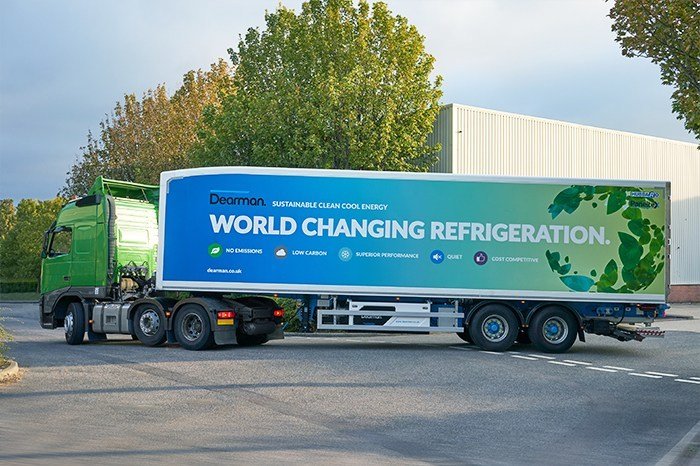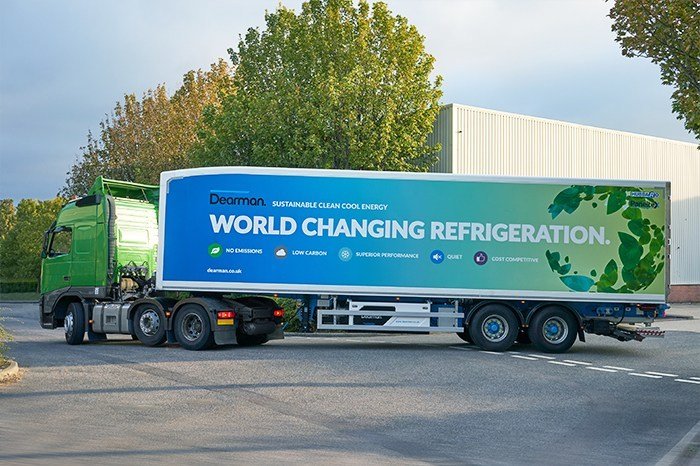
The cryogenic pump is an important component for the Dearman-Hubbard TRU as. It pumps liquid nitrogen (LiN) from the tank – mounted underneath the refrigerated trailer – through a heat exchanger, where it provides cooling. The nitrogen then expands in the Dearman Engine where it is mixed with water/glycol heat exchange fluid to enhance power and efficiency.
The development of a new cryogenic pump in partnership with Productiv – and a part of the Cryogenic Engines for Mobile Zero Emission Power (CEMZEP) programme – is hugely important to Dearman and its customers. With this solution we maximise efficiency, and ensure easy maintenance and cost-effective operation of the zero-emission Dearman-Hubbard TRU.
Partner on this project is Productiv: a UK technology manufacturer that helps enterprises – such as the Dearman Engine Company – to prototype, develop and manufacture low carbon technologies with the potential to transform the vehicles of tomorrow and enable manufacturers to meet stringent EU demands.
The key advantages of the new cryogenics pump currently being tested at the Dearman Technology Centre, London are:
Quiet
Easy to maintain
Cost effective
With the pump in place, Dearman can access a wider range of applications for their revolutionary engine.
In parallel with the development of a new cryogenic pump is a newly redesigned larger more efficient LiN tank, developed in partnership with Wessington Cryogenics. The new LiN tank is 10% larger than its predecessor in the same space, and is yet more cost effective.
Commenting Chris Owen, Head of Cryogenics at Dearman, said:
“The new cryo pump supports Dearman’s drive for excellence. It gives real-world efficiency improvements for Dearman’s zero-emission TRU while making the whole Dearman offering still more competitive. I look forward to seeing the benefits soon, as part of Dearman’s TRU currently on the road with some of Europe’s largest retailers. With support from the team at Productiv, we’ve developed a pump that has the potential to be a product in its own right, demonstrably better than comparable machines in the market.
Dearman will be able to manufacture the new cryogenics pump at its London Technology Centre, with its CNC (computer numerical control) milling machine. This machine enables the engineers at Dearman to manufacture bespoke components for its cutting-edge clean cold technology on site, reducing costs and lead times significantly.