Esta página solo está disponible en inglés. Ir a la portada en español

×

Questa pagina è disponibile solo in inglese. Home page in italiano

×

Diese Seite ist nur auf Englisch verfügbar. Zur deutschen Startseite

×

Cette page est disponible uniquement en anglais. Aller à la page d'accueil en français

×

Smart IoT Monitoring Project for the Quality of Food Products During Storage and Distribution

Smart IoT Monitoring Project for the Quality of Food Products During Storage and Distribution

During 2022, and in response to the needs of customers in the FOOD SERVICE and CONTROLLED TEMPERATURE LOGISTICS sectors to have estimates of both the reduction in shelf life at freezing temperatures and the product temperature (refrigerated) based on temperatures recorded in the air, AKO initiated a research project with IRTA, a reference center in agri-food technology, with the aim of addressing these market needs.

IRTA considered and evaluated the scope of the project, which required an analysis of the state of the art, theoretical/mathematical studies, and experimental analysis. The size and timing of the project made it pertinent for AKO to structure the project in the form of a CUPÓ (Industry 4.0 Coupons, ‘Consultancy in Industry 4.0 Implementation’ from ACCIÓ, the Agency for Business Competitiveness of the Government of Catalonia), which was granted in November 2022 with a 12-month execution period. The project was successfully completed and justified in December 2023.

The research project was articulated into two challenges: 1) Determine the loss of shelf life of food products at freezing temperatures (relative loss caused by temperature excursions) and 2) Determine the temperature of a refrigerated product considering the air temperature in the refrigeration space.

These challenges respond to the usual operations of the sectors and markets under consideration, where the effects of temperature on products allow decisions to be made about their quality and safety.

The project, built on a very solid techno-scientific food base, also used usability and user experience criteria to simplify the calculations and estimates of the new functionalities. This is why estimates have been provided for the 16 typical groups of food products already available on akonet.cloud, as shown in Table 1.

Research into these two new functionalities will enable AKO to offer new digital services related to food preservation (product care) in the Food Retail, Food Service, Controlled Temperature Transport, and Food Industry sectors, demonstrating once again AKO’s strong commitment to its markets and customers, as well as the company’s leadership in knowledge within the cold chain for food.

Get the daily refrigeration briefing

One email a day. Trusted by 3,000+ RACHP professionals.

More on Cold Chain

All on Cold Chain →

Insights

Secop's Solar Direct Drive (SDD) System Earns WHO PQS Approval – The Team Behind It
Article

Secop’s Solar Direct Drive (SDD) System Earns WHO PQS Approval – The Team Behind It

Partner's material In March 2026, Secop’s Solar Direct Drive Power Management Module was granted WHO PQS prequalification and officially listed in the WHO Catalogue of Prequalified Immunization Devices. The WHO IMD-PQS (Immunization Devices Performance, Quality and Safety programme) is the global benchmark for cold chain equipment used in immunisation. Being listed in its catalogue is

22 Jun 2026
Case Study - Effect of Louvers or diffusers on air flow distribution and cooling time on a meat log during Chill cycle
Tech Guide

Case Study – Effect of Louvers or diffusers on air flow distribution and cooling time on a meat log during Chill cycle

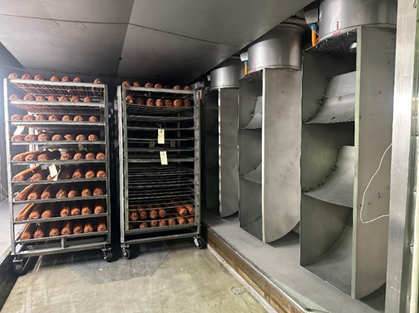
By Kushal Aurangabadkar An experimental analysis was conducted on a cooler space measuring 3.66 m × 6.096 m (12.0 ft × 20.0 ft), equipped with an ammonia refrigeration coil, five 30 cm (12 in.) fans, and five diffusers. The study measured airflow patterns, cooling rates, and heat transfer efficiency in meat storage by testing two configurations:

Kushal Aurangabadkar · 21 Jan 2026
Total Cost of Ownership (TCO) for Modular Refrigeration Systems in Life Sciences Distribution Centers
Tech Guide

Total Cost of Ownership (TCO) for Modular Refrigeration Systems in Life Sciences Distribution Centers

by Ramez Naguib, P.E. Introduction Life sciences distribution centers are under immense pressure to deliver consistent temperature control, comply with increasingly stringent regulations, and optimize operational efficiency. Traditional built-up refrigeration systems often prove cumbersome, costly, and slow to implement. In contrast, modular, factory-assembled refrigeration systems have emerged as a compelling alternative. Drawing on lessons from

14 Jan 2026
Everything on Cold Chain: 2,036 articles, 1 case study, 23 insights

Most read this month

All news →