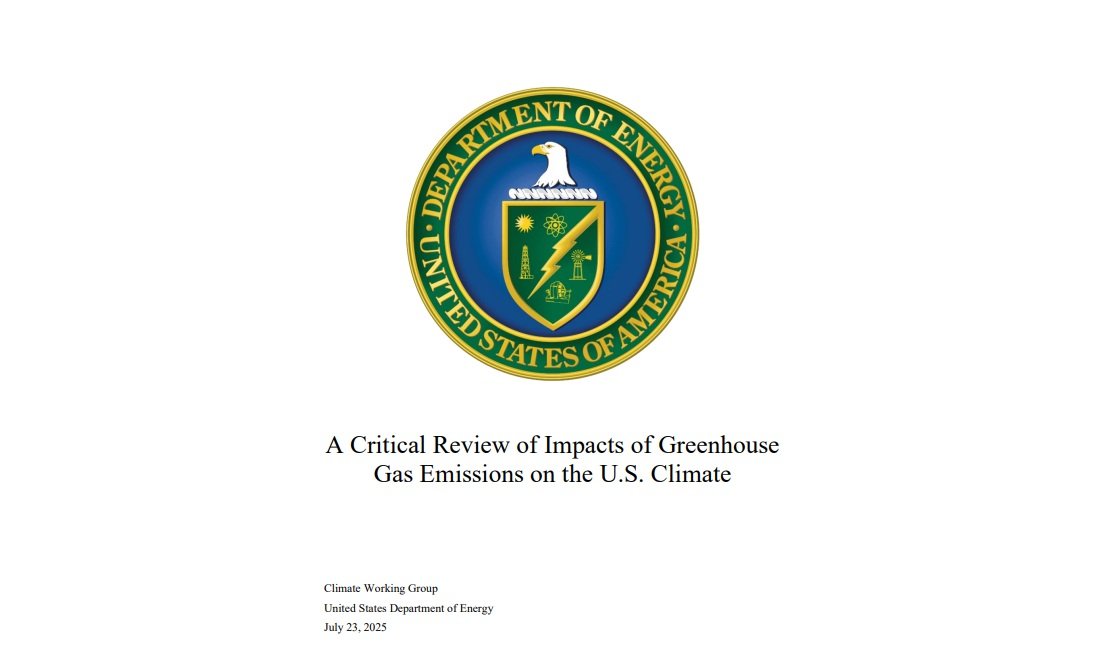
The U.S. Department of Energy (DOE) has released a new report titled A Critical Review of Impacts of Greenhouse Gas Emissions on the U.S. Climate, challenging prevailing views on climate science and policy. Prepared by the 2025 Climate Working Group—five independent scientists selected by Energy Secretary Chris Wright—the report evaluates peer-reviewed literature and federal data on greenhouse gas (GHG) impacts, particularly carbon dioxide (CO2).
The authors conclude that CO2-induced warming may be less economically damaging than generally perceived and argue that U.S. climate policies are likely to have “undetectably small direct impacts” on global temperature trends. The report also asserts that global climate models tend to overestimate warming and that future emissions scenarios commonly used in climate projections, such as RCP8.5, are implausible and misleading.
Among the technical findings, the report highlights evidence of increased plant productivity and agricultural yields due to CO2 fertilization, a phenomenon contributing to global greening. It further notes that ocean pH levels, while declining slightly, remain within historical natural variability and that observed coral resilience undermines concerns over ocean acidification.
The DOE review claims there is little evidence of long-term trends in U.S. extreme weather events, such as hurricanes, droughts, and floods. It also challenges the robustness of climate attribution methods, suggesting that natural variability and solar influences may be underestimated.
The report was released alongside the Environmental Protection Agency’s (EPA) proposed rule to repeal the 2009 Endangerment Finding, a key regulatory basis for GHG emission limits. A public comment period has now opened for the DOE report, with notice to be published in the Federal Register.
“We stand at the threshold of a new era of energy leadership,” said Secretary Wright. “If we empower innovation rather than restrain it, America can lead the world in providing more abundant energy—lifting billions out of poverty, strengthening our economy, and improving our environment along the way.”