Esta página solo está disponible en inglés. Ir a la portada en español

×

Questa pagina è disponibile solo in inglese. Home page in italiano

×

Diese Seite ist nur auf Englisch verfügbar. Zur deutschen Startseite

×

Cette page est disponible uniquement en anglais. Aller à la page d'accueil en français

×

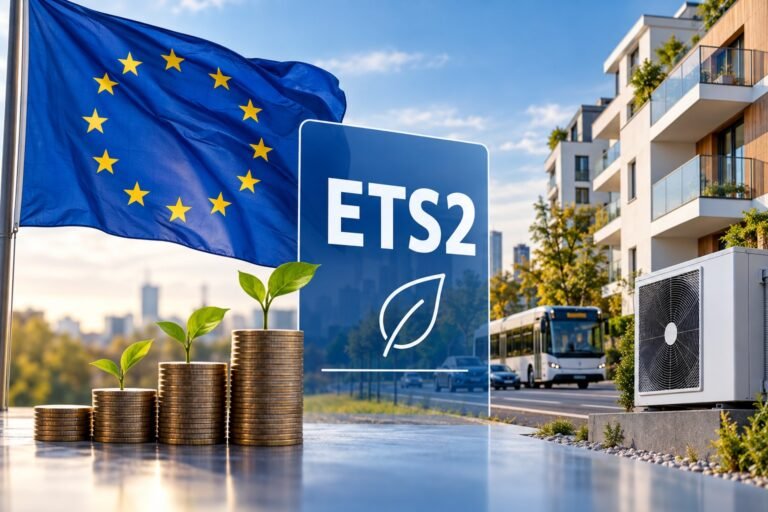
EU to Launch New ETS2 System Covering Building and Transport Emissions

EU to Launch New ETS2 System Covering Building and Transport Emissions

The European Union will launch a new emissions trading system, ETS2, in 2027 to address CO₂ emissions from fuel combustion in buildings, road transport, and small industries not included in the current EU ETS. The system aims to support the EU’s climate neutrality target by 2050 and complements existing measures under the European Green Deal and the Effort Sharing Regulation.

ETS2 will operate as a cap-and-trade system similar to the EU ETS but will regulate emissions upstream. Fuel suppliers—not end-users such as households or drivers—will be responsible for reporting emissions and purchasing allowances. The emissions cap is designed to ensure a 42% reduction in emissions by 2030 compared to 2005 levels.

All allowances under ETS2 will be auctioned. Member States are required to use the resulting revenues for climate action and social measures and must report on this spending. A portion of the proceeds will support vulnerable households and small businesses through a dedicated Social Climate Fund.

Preparations for ETS2 will begin in 2025, with monitoring and reporting of emissions. In 2027, a 30% higher volume of allowances will be auctioned to ensure market liquidity. A market stability reserve will help manage supply and demand, with provisions to release additional allowances if prices rise excessively—defined as exceeding €45 (in 2020 prices) or increasing too rapidly.

In case of exceptionally high oil or gas prices in 2026, the ETS2 start date may be postponed to 2028.

Regulated entities must obtain greenhouse gas emissions permits and submit approved monitoring plans by 1 January 2025. From 2026, emissions reports must be verified annually by an accredited verifier. Starting in 2028, companies must surrender allowances corresponding to their verified emissions by 31 May each year.

The ETS2 compliance cycle is governed by the Monitoring and Reporting Regulation (MRR) and the Accreditation and Verification Regulation (AVR). The European Commission provides guidance and templates to support implementation across Member States.
Read More

Get the daily refrigeration briefing

One email a day. Trusted by 3,000+ RACHP professionals.

More on Regulations

All on Regulations →

Insights

EPA Delays Low-GWP Refrigerant Deadlines, Splitting the US Cooling Industry
Market Research

EPA Delays Low-GWP Refrigerant Deadlines, Splitting the US Cooling Industry

The deadline that supermarkets faced to install new refrigeration systems running on low-GWP refrigerants was January 1, 2027. It is now January 1, 2032. On May 21, 2026, alongside President Trump in the Oval Office, EPA Administrator Lee Zeldin announced final revisions to the 2023 Technology Transitions Rule and a proposed technical fix to the

25 May 2026
2025 in Refrigeration — What Changed, What Mattered, What’s Next
Market Research

2025 in Refrigeration — What Changed, What Mattered, What’s Next

Refindustry has released its 2025 year-in-review, compiled from the most-read and most impactful updates published on https://refindustry.com/. The review captures how the industry moved from “refrigerant choice” discussions to real-world transition execution—where compliance pathways, safety engineering, component readiness, service capacity, and digital monitoring determine outcomes on projects and in day-to-day operations. What shaped 2025 in

21 Jan 2026
Ammonia Refrigeration Evolves Amid Growing Competition
Market Research

Ammonia Refrigeration Evolves Amid Growing Competition

By: Ilana Koegelenberg   Ammonia (NH3/ R717) refrigeration continues to dominate industrial applications across the United States and European Union, but the sector is undergoing significant transformation as operators balance traditional advantages with evolving safety requirements, workforce challenges, and competition from alternative refrigerants. While ammonia maintains its stronghold in large-scale facilities, new technologies and regulatory

Ilana Koegelenberg · 25 Jul 2025
Everything on Regulations: 856 articles, 24 insights

Most read this month

All news →