Questa pagina è disponibile solo in inglese. Home page in italiano

×

Diese Seite ist nur auf Englisch verfügbar. Zur deutschen Startseite

×

European Parliament Committee Proposes Changes to EU ETS Heat and Fuel Benchmarks

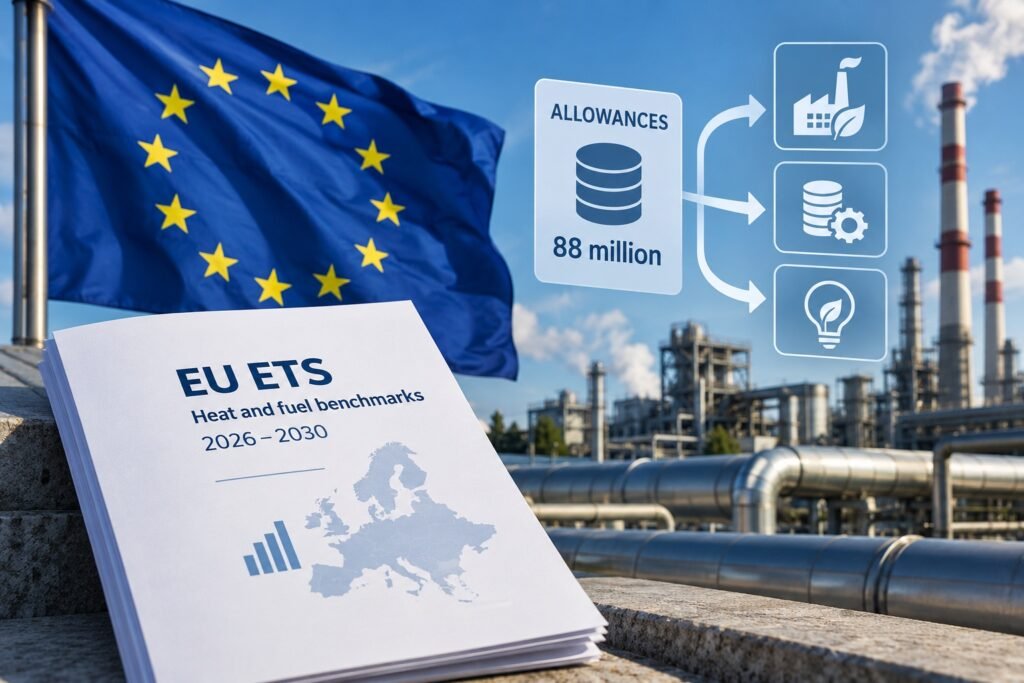
The plan would split redirected allowances among free allocation, modernisation and innovation, while adding sector-specific fuel benchmarks.

European Parliament Committee Proposes Changes to EU ETS Heat and Fuel Benchmarks
Created by Refindustry using AI

The European Parliament’s Committee on the Environment, Climate and Food Safety has proposed amendments to EU Emissions Trading System (EU ETS) rules governing free emission allowances for industrial heat and fuel use. The amendments, dated 20 October 2026, concern revised benchmark values for 2026–2030 and aim to provide additional protection against carbon leakage.

The committee proposes increasing the allowances available for free allocation under heat and fuel benchmarks. Its amendments refer to approximately 88 million allowances available for 2026–2030, alongside an additional 11 million allowances from reductions in free allocation. The proposal indicates average heat and fuel benchmark values of 41.4 and 37.3 allowances/TJ, respectively, representing an indicative 12.5% reduction compared with 2021–2025.

The amendments would also redistribute allowances resulting from reductions in free allocation. One-third would support additional free allocation, one-third would be transferred to the Modernisation Fund, including for investments in district heating system modernisation, and the remaining third would go to the Innovation Fund.

Another proposed change would introduce sector-specific fuel sub-benchmarks where significant discrepancies exist between EU-wide benchmarks and the emissions performance of particular industrial processes. These sub-benchmarks would be based on the average greenhouse gas emission intensity of the 10% most efficient installations in the relevant sector. Priority would be given to activities classified under NACE codes 23.20 and 23.31.

The amendments also propose reducing the maximum annual benchmark reduction rate for 2027–2030 and establishing procedures for determining sector-specific benchmarks. The European Commission would be required to define relevant criteria within three months and establish sub-benchmark values within six months of publication of the amending regulation.

The measures remain proposed amendments to the regulation rather than adopted EU ETS rules.
Get the daily refrigeration briefing

One email a day. Trusted by 3,000+ RACHP professionals.

More on Regulations

All on Regulations →

Insights

EPA Delays Low-GWP Refrigerant Deadlines, Splitting the US Cooling Industry
Market Research

EPA Delays Low-GWP Refrigerant Deadlines, Splitting the US Cooling Industry

The deadline that supermarkets faced to install new refrigeration systems running on low-GWP refrigerants was January 1, 2027. It is now January 1, 2032. On May 21, 2026, alongside President Trump in the Oval Office, EPA Administrator Lee Zeldin announced final revisions to the 2023 Technology Transitions Rule and a proposed technical fix to the

25 May 2026
2025 in Refrigeration — What Changed, What Mattered, What’s Next
Market Research

2025 in Refrigeration — What Changed, What Mattered, What’s Next

Refindustry has released its 2025 year-in-review, compiled from the most-read and most impactful updates published on https://refindustry.com/. The review captures how the industry moved from “refrigerant choice” discussions to real-world transition execution—where compliance pathways, safety engineering, component readiness, service capacity, and digital monitoring determine outcomes on projects and in day-to-day operations. What shaped 2025 in

21 Jan 2026
Ammonia Refrigeration Evolves Amid Growing Competition
Market Research

Ammonia Refrigeration Evolves Amid Growing Competition

By: Ilana Koegelenberg   Ammonia (NH3/ R717) refrigeration continues to dominate industrial applications across the United States and European Union, but the sector is undergoing significant transformation as operators balance traditional advantages with evolving safety requirements, workforce challenges, and competition from alternative refrigerants. While ammonia maintains its stronghold in large-scale facilities, new technologies and regulatory

Ilana Koegelenberg · 25 Jul 2025
Everything on Regulations: 867 articles, 24 insights

Most read this month

All news →