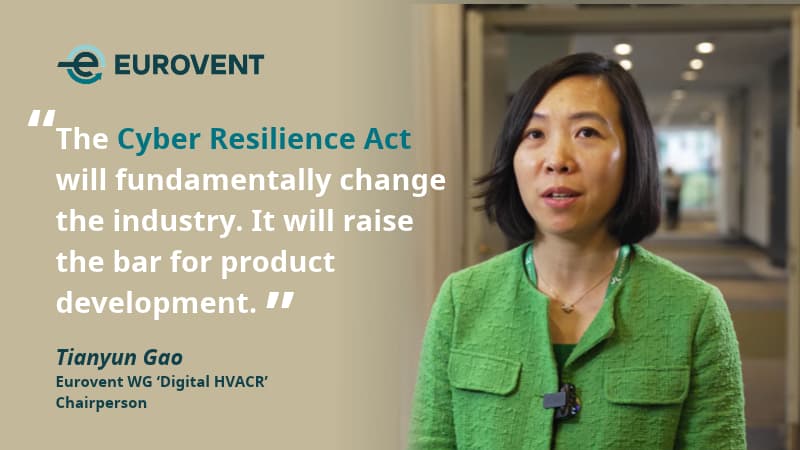
Eurovent has outlined how the EU Cyber Resilience Act (CRA) will affect HVACR manufacturers, particularly those producing connected equipment and digital control systems. In an interview published on 17 November 2026, Tianyun Gao, Chairperson of the Eurovent Working Group ‘Digital HVACR’ (WG-DIGI), discussed cybersecurity requirements covering product design, conformity assessment, software updates and lifecycle support. The CRA’s vulnerability and incident reporting obligations have applied since 11 September 2026, with the main obligations taking effect on 11 December 2027.
The regulation covers products with digital elements that can connect directly or indirectly to other devices or networks. Relevant HVACR equipment may include controllers, building management system (BMS) and building automation and control system (BACS) connected units, products with embedded firmware, wireless service interfaces, mobile-app connectivity and cloud functions. Gao highlighted a cyberattack on supermarket refrigeration controllers in France that caused temperature increases, food spoilage, business interruption and financial losses.
Under the CRA, manufacturers must incorporate cybersecurity into product design based on documented risk assessments. Compliance requirements include technical documentation, conformity assessment and CE marking. Manufacturers must also establish processes for vulnerability handling, security updates and support-period management throughout the product lifecycle.
Gao identified three priorities for small and medium-sized HVACR manufacturers: determine which products fall within the CRA’s scope, establish vulnerability and incident handling procedures, and integrate cybersecurity into product development and supplier management. Recommended actions include reviewing remote access, default settings, update capabilities, third-party components and product support periods.
Eurovent’s WG-DIGI has developed a dedicated CRA guideline to help manufacturers interpret the regulation and apply its requirements to HVACR products. The group is also collecting questions from members and seeking clarification from regulatory authorities on sector-specific implementation issues. WG-DIGI provides a platform for Eurovent members to address digitalisation, controls, building automation and cybersecurity challenges.