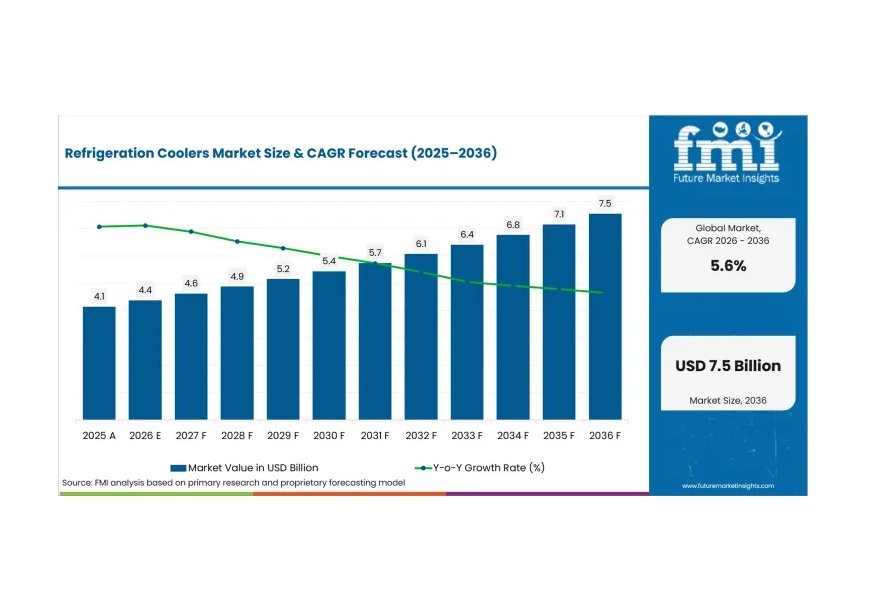
Future Market Insights projects the global refrigeration coolers market to increase from USD 4.4 billion in 2026 to USD 7.5 billion by 2036, representing a compound annual growth rate of 5.6%. The company attributes the forecast growth to investments in cold chain infrastructure, commercial food retail, healthcare storage and industrial refrigeration.
Deep freezers are expected to remain the leading product category, accounting for 18% of market revenue in 2026. The report covers bottle coolers, display showcases, commercial kitchen refrigeration, transportation refrigeration equipment, medical refrigeration, evaporators, condensers and cooling units, among other products and components.
Commercial refrigeration remains the largest application segment, supported by installations in supermarkets, restaurants, hotels, food processing facilities, beverage outlets and retail chains. Industrial demand is also expanding across food processing, chemicals, pharmaceuticals and logistics operations.
FMI identifies natural and low-GWP refrigerants, IoT-enabled temperature monitoring, energy-efficient compressor technologies, predictive maintenance and digital cold chain management as major market trends. High installation costs, changing refrigerant regulations, rising energy prices and maintenance requirements are listed as market restraints.
“The rapid expansion of cold chain logistics, organized food retail, pharmaceutical storage, and commercial hospitality is creating sustained demand for advanced refrigeration coolers. Manufacturers are increasingly investing in energy-efficient technologies, natural refrigerants, and intelligent temperature monitoring systems to improve operational performance while supporting sustainability goals,” said Nikhil Kaitwade, Associate Vice President at Future Market Insights.