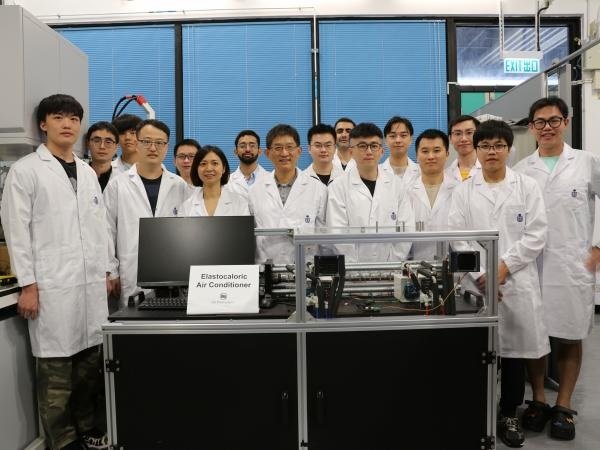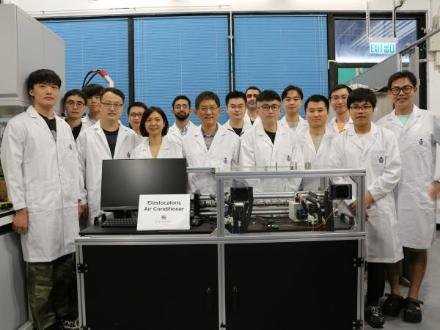
Researchers at the Hong Kong University of Science and Technology’s (HKUST) School of Engineering have unveiled an eco-friendly refrigeration device with world-record efficiency, poised to revolutionize industries reliant on cooling while significantly reducing global energy consumption.
By achieving a 48% boost in efficiency, the new elastocaloric cooling technology presents promising potential for commercialization and mitigating the environmental impact of traditional cooling systems, which often employ high global warming potential refrigerants.
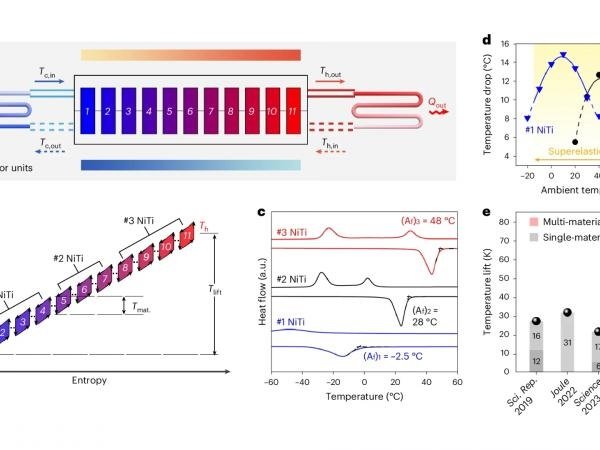
The team, led by Prof. Sun Qingping and Prof. Yao Shuhuai, developed a multi-material cascading elastocaloric cooling device using nickel-titanium (NiTi) shape memory alloys. This innovative device achieved a temperature lift of 75 K on the water side, breaking the previous 50.6 K world record.
The researchers strategically selected three NiTi alloys with varied phase transition temperatures to operate at the cold, intermediate, and hot ends. This approach expanded the device’s superelastic temperature window to over 100 K, significantly enhancing cooling efficiency.
Their groundbreaking study, “A Multi-Material Cascade Elastocaloric Cooling Device for Large Temperature Lift,” was recently published in *Nature Energy*. The team plans to further develop high-performance shape memory alloys and systems for sub-zero elastocaloric cooling and high-temperature heat pumping applications.
“With the continuous advancement in materials science and mechanical engineering, we are confident that elastocaloric refrigeration can provide next-generation green, energy-efficient solutions, addressing the urgent task of decarbonization and global warming mitigation,” said Prof. Sun.
Space cooling and heating currently account for 20% of global electricity consumption and are projected to become the second-largest source of electricity demand by 2050.
The research includes contributions from Postdoctoral Research Associate Dr. Zhou Guoan, PhD student Li Zexi, PhD graduates Zhu Yuxiang and Hua Peng, and a collaborator from Wuhan University.