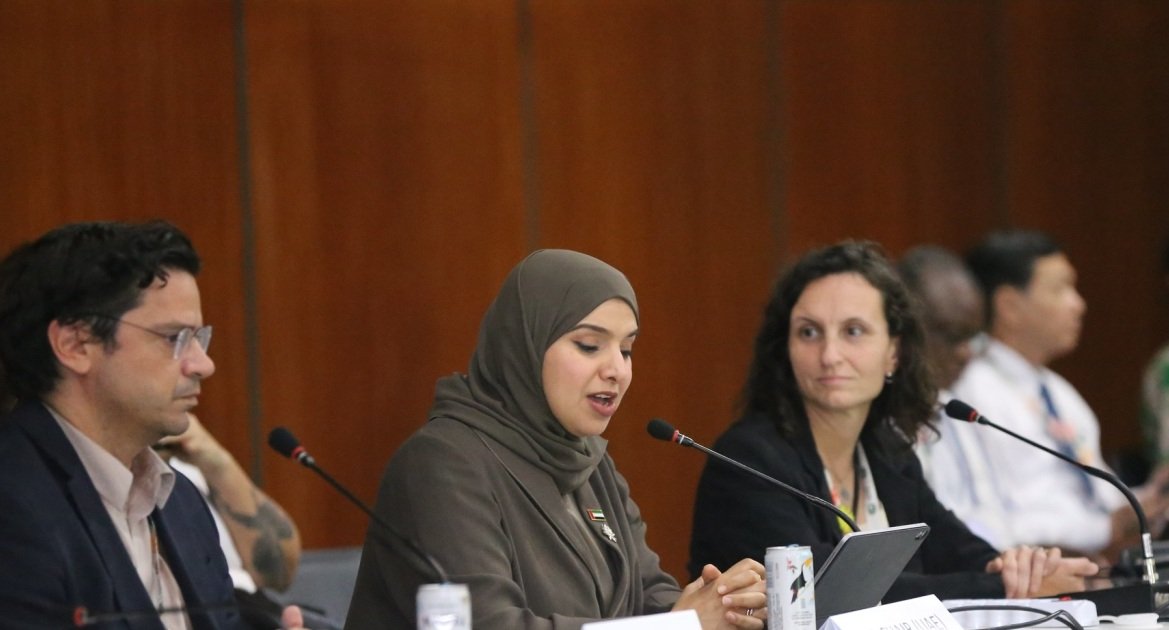
At COP30 in Belém, representatives from 72 countries and international partners adopted the Belém Communiqué on Extreme Heat, reinforcing global commitment to the Global Cooling Pledge and advancing sustainable cooling strategies in response to rising heat risks.
The second Ministerial Dialogue on the Global Cooling Pledge marked a key moment in global climate governance. At this event, attended by over 50 ministers and leaders, governments established a new institutional framework to coordinate global cooling efforts. The Global Cooling Pledge—first launched at COP28—sets a collective target to cut cooling-related emissions by 68% by 2050.
Heatwaves were highlighted as the deadliest climate hazard. UNEP’s Global Cooling Watch 2025 projects that cooling capacity could more than triple by 2050 as urbanization, population growth, and rising incomes coincide with intensifying heat. Countries formally recognized extreme heat as a top-tier climate risk, elevating cooling as a strategic climate priority.
“The urgency is clear. According to the Global Cooling Watch, heat stress could erase the equivalent of 80 million full-time jobs within five years,” said Martin Krause, UNEP’s Climate Change Division Director. “Yet more than 1 billion people still lack access to adequate cooling.”
The Belém Communiqué positions extreme heat as a defining climate challenge requiring cross-sector coordination. It calls for integrated mitigation and adaptation strategies across health, energy, climate, and development sectors. Cooling is recognized as essential infrastructure alongside water, sanitation, and electricity.
To accelerate implementation, governments backed the Beat the Heat / Mutirão contra o Calor Extremo campaign, led by the Brazilian COP30 Presidency and UNEP’s Cool Coalition. This initiative supports cities and sub-national governments through heat risk mapping, passive cooling solutions, and financing strategies. Over 200 cities—including Rio de Janeiro, Chennai, and Paris—have joined the campaign, along with the 72 national signatories.
A new platform, Enabling Pledge Implementation for Cooling (EPIC), was officially launched to support national efforts. EPIC offers tools for deploying sustainable cooling technologies in public institutions and cold chains, and provides technical support for National Cooling Action Plans, energy standards, passive design integration, and investment strategies.
The Ministerial Dialogue also formalized the Intergovernmental Committee on Cooling, tasked with monitoring delivery of the Global Cooling Pledge’s 14 targets. These include expanding passive and nature-based solutions, tightening building codes, improving appliance efficiency, and accelerating the phasedown of high-GWP refrigerants.
“If countries stay the course, Belém could be a turning point for making sustainable cooling one of this decade’s most high-impact climate solutions,” said Krause.
H.E. Dr. Amna bint Abdullah Al Dahak, Minister of Climate Change and Environment of the UAE, stated: “As a global leader in responding to the escalating challenge of extreme heat, the United Arab Emirates continues to set the benchmark for sustainable cooling... [and] is advancing the formulation of its National Cooling Action Plan.”
Singapore’s Minister for Sustainability and the Environment, H.E. Grace Fu, announced: “Singapore will host the Global Cooling Pledge Focal Meeting, as well as share our expertise in urban heat assessments and simulation of cooling solutions through the Digital Urban Climate Twin (DUCT).”
H.E. Seidu Issifu, Minister for Climate Change and Sustainability of Ghana, added: “The Global Cooling Pledge is a battle‑cry: no more dumping obsolete coolers that cripple the poorest... we’re raising Minimum Energy Performance Standards, scaling the EcoFridges GO initiative, and delivering efficient cooling to every Ghanaian home.”
Source