The European Union revised its F-gas Regulation in 2014 to phase down hydrofluorocarbons (HFCs), a family of synthetic chemicals hundreds to thousands of times more potent than carbon dioxide and commonly used in refrigeration, air-conditioning, fire protection, aerosols and foams.
But as supplies shrink and prices rise under the EU’s HFC quotas, illegal trade has flourished to meet demand, with non-quota HFCs entering the EU directly from China or via Russia, Ukraine, Turkey and Albania.
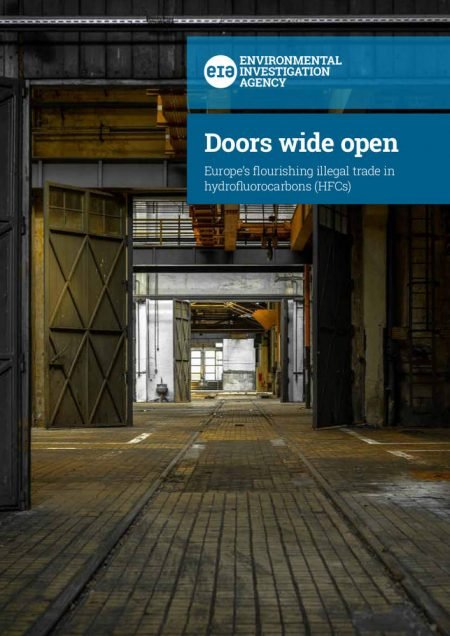
DOW-front-coverKey EU entry points and hotspots for illegal trade are thought to be Bulgaria, Croatia, Denmark, Greece, Italy, Latvia, Poland and Malta.
These alarming findings are featured in new report Doors Wide Open: Europe’s flourishing illegal trade in hydrofluorocarbons (HFCs).
Clare Perry, our Climate Campaigns Leader, warned: “Cutting HFC use is one of the most effective tools to help prevent runaway climate change – but its impact could be significantly undermined by illegal trade.
The report is the most comprehensive research of its kind into the criminal HFC trade and documents how, as early as 2016 and despite huge stockpiling of HFCs in 2014, reports of illegal HFCs in European markets began to emerge.
EIA campaigners have since seen an escalation in reported illegal HFC trade, with 2018 witnessing a deluge of illegal HFC use and trade throughout the EU.
Detailed analysis of customs data for 2018 suggests as much as 16.3 million tonnes of CO2-equivalent (16.3 MtCO2e) bulk HFCs were illegally placed on the market, equivalent to more than 16 per cent of the quota.
It is particularly telling that a large number of EU countries recorded significantly increased HFC imports in 2018, despite the major HFC supply cut of 37 per cent.
Researchers also compared 2017 customs data to figures reported under the F-gas Regulation and found indications that an additional 14.8 MtCO2e of HFCs were placed on the European market compared to reported data, equivalent to 8.7 per cent of the 2017 quota.
Significant discrepancies also exist between Chinese export figures and Europe’s import data, which could indicate fraudulent import declarations.
In survey of key industry stakeholders in late 2018, we found that more than 80 per cent were aware of or suspected illegal HFC trade and 72 per cent had seen or been offered refrigerants in illegal disposable cylinders.
Doors Wide Open’s recommendations include a number of measures to shut out illegal HFCs, including a licensing system allowing customs officials to determine the legality of HFC shipments, improved reporting and monitoring of HFC trade with exporting countries and revising the ban on non-refillable cylinders to prohibit the use of all disposable cylinders.