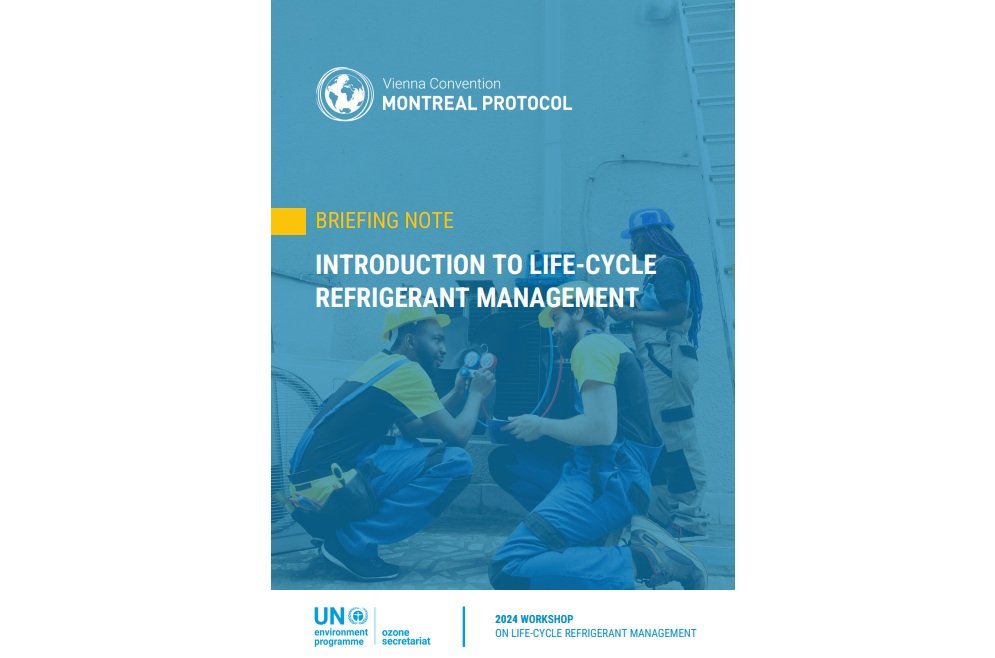
The Ozone Secretariat
has issued a briefing note introducing life-cycle refrigerant management (LRM) in the context of the Montreal Protocol, where ozone-depleting substances and hydrofluorocarbons are widely used as refrigerants. The note says LRM is intended to manage refrigerants in an environmentally sound manner throughout their full life cycle and to support ozone-layer protection, climate mitigation and the circular economy.
According to the briefing note, LRM covers refrigerant production, storage and transportation, as well as the design, manufacturing, installation, operation and maintenance of refrigeration, air-conditioning and heat-pump equipment. It also includes refrigerant recovery, reuse and environmentally sound disposal, along with end-of-life management of used equipment, which is treated as e-waste in some jurisdictions.
The document says business-as-usual refrigerant management still leaves major gaps, including leaks during operation, venting during servicing and releases at end of life. It lists key LRM practices as refrigerant inventories, leak prevention through equipment design and servicing, recovery at decommissioning, recycling or reclamation of used refrigerants, destruction of substances that are no longer viable, and environmentally sound management of decommissioned equipment.
The note says implementation remains challenging because leak-detection tools are not equally accessible, the servicing sector is often seasonal and informal, and recovery, recycling, reclamation and destruction require equipment, logistics and financing. It adds that destruction facilities are unevenly distributed globally, and cross-border transport can be costly when refrigerants are classified as hazardous waste under the Basel Convention.
The Secretariat says current banks of ozone-depleting substances and HFCs, including foams and other non-refrigerant uses, are estimated at 16 gigatons CO2-eq to 24 gigatons CO2-eq. It also cites projections that about 67 gigatons CO2-eq in ODS and HFCs is expected to enter the global market by 2100 even with full compliance with the Montreal Protocol, warning that the Protocol’s climate and ozone benefits could be undermined if LRM is not implemented at scale.