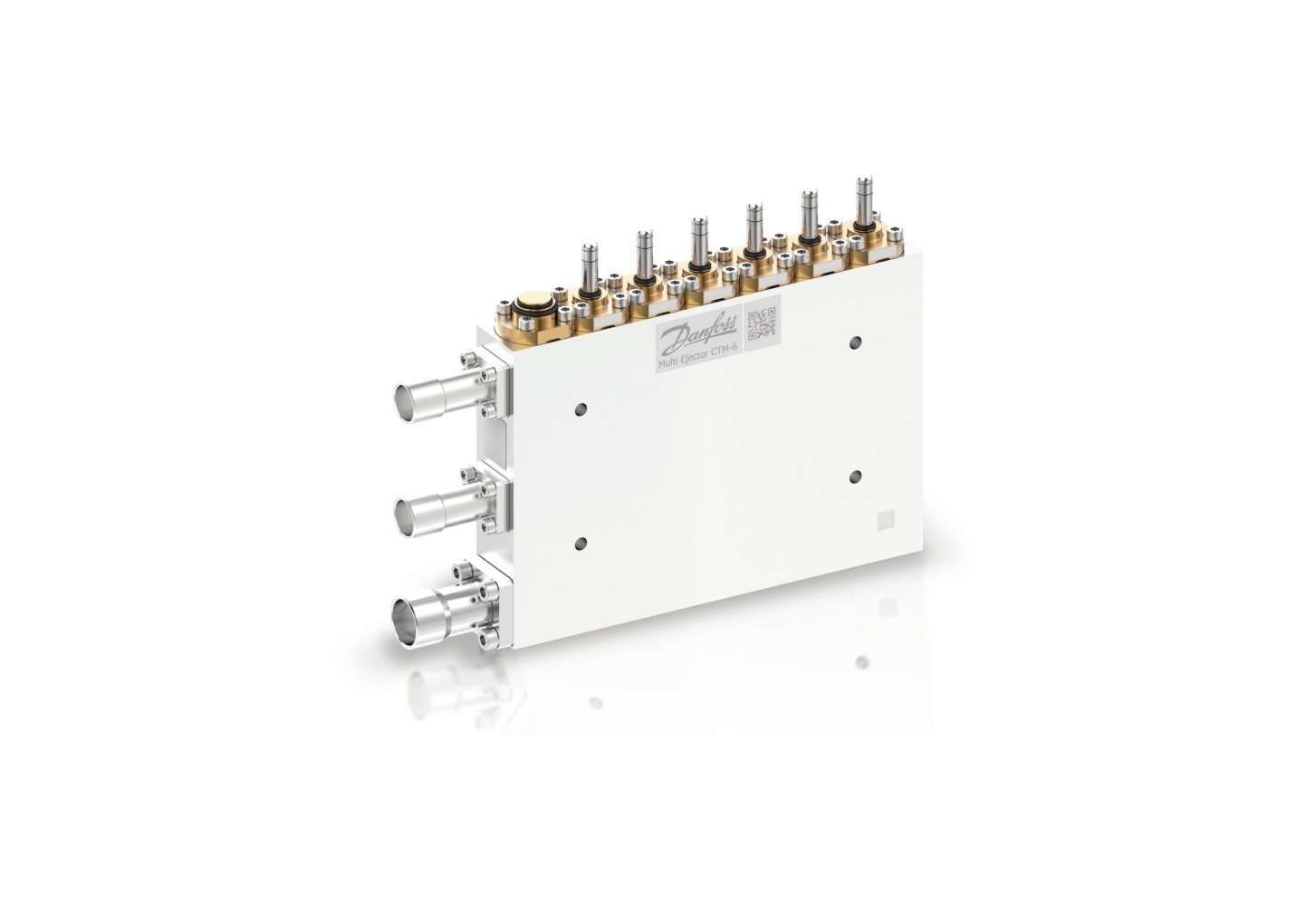
Danfoss said field tests of its Multi Ejector HP in transcritical CO2 booster systems with parallel compression delivered additional energy savings of up to about 13.4% versus the same rack running with parallel compression only. The company said the multi-month evaluation was carried out in two new US supermarket stores, one in a mild climate and one in a warmer climate.
According to the white paper, the savings were measured at ambient temperatures of about 95°F (35°C) and began to appear at lower temperatures than expected, as low as about 50°F (10°C) in the gas-cooler-outlet region. Danfoss also said the actual savings exceeded pre-test projected savings of about 11%.
The test case used a six-cartridge Multi Ejector HP type CTM 6 in a newly installed transcritical booster system with parallel compression, together with a Danfoss AK-PC 782A Pack Controller. For comparison, the controller electrically switched the ejector on and off, while receiver pressure was regulated to approximately 520 psi (35.9 bar). The paper lists system components including a discharge/gas cooler at 50-95°F (10-35°C) and 700-1300 psi (48.3-89.6 bar), LT compressors at -15°F (-26.1°C) and 220 psi (15.2 bar), MT compressors at 18°F (-7.8°C) and 395 psi (27.2 bar), and an IT compressor at 36°F (2.2°C) and 520 psi (35.9 bar).
Danfoss said compressor cycling was reduced by about 43-47% with the ejector on, with weekly counts on the parallel compressor dropping from 499 to 263. The company also said reduced cycling was accompanied by reduced inrush current. In the white paper, Danfoss said HP ejectors can theoretically increase pressure up to 87 psi (6 bar) at 73°F (23°C), and up to 160 psi (11 bar) at 97°F (36°C), at an entrainment ratio of 25%.