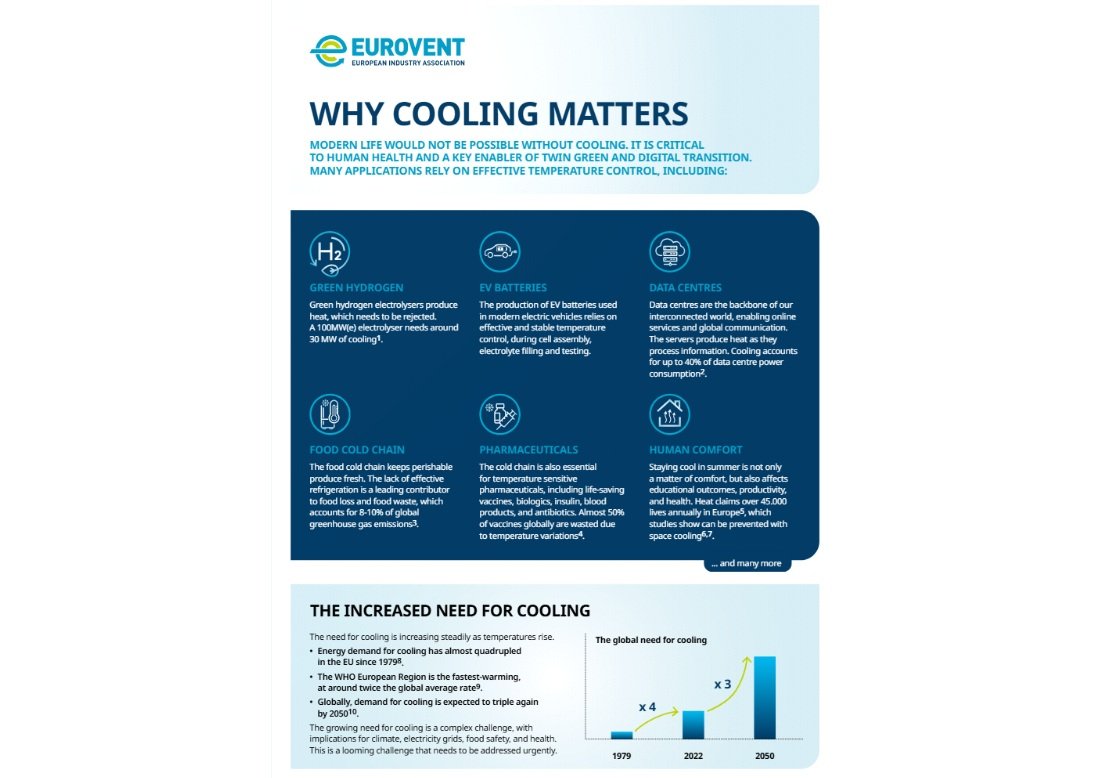
Eurovent has released a policy brief urging the European Union to take immediate steps to support the transition to sustainable cooling, highlighting the growing importance of cooling technologies amid rising temperatures across Europe.
The brief identifies cooling as essential in sectors such as the food cold chain, pharmaceuticals, data centres, electric vehicles, and human comfort. With cooling demand projected to triple globally by 2050, and Europe warming at twice the global average, Eurovent frames sustainable cooling as a central component of the EU’s green transition.
Three pillars are outlined as critical to achieving sustainable cooling: energy efficiency, refrigerant management, and access to low-carbon electricity. The brief notes that efficient cooling systems can reduce stress on power grids, lower costs, and support decarbonisation through technologies such as heat recovery and smart controls.
Eurovent’s recommendations include updating the EU Heating and Cooling Strategy to better address cooling challenges, strengthening Ecodesign and Energy Labelling policies, introducing targeted financial incentives, integrating cooling needs into the Renovation Wave, and fully implementing the F-Gas Regulation. The brief also calls for greater recognition of the HVACR sector’s role in EU industrial strategy.
“After another hot summer, awareness of the importance of sustainable cooling is rising in the Brussels policy sphere,” said Stijn Renneboog, Eurovent Deputy Secretary General. “Cooling is about much more than comfort. It is of critical importance in a wide range of essential applications, including healthcare, food, AI, and net-zero manufacturing. Our policy brief is intended as a conversation starter and to provoke reflections.”
The full policy brief is available for free download on the
Eurovent website.