Between 3.5% and 7% of F-Gas certified personnel are trained on alternatives, depending on the refrigerant. This is one of the main outcomes of an internal survey that AREA has just completed and that also looked at F-Gas certification. 6 years after the entry into force of the revised F-Gas Regulation and as a new HFC phase-down step just started, such a low figure provides clear factual support of AREA’s plea for mandatory certification on alternatives.
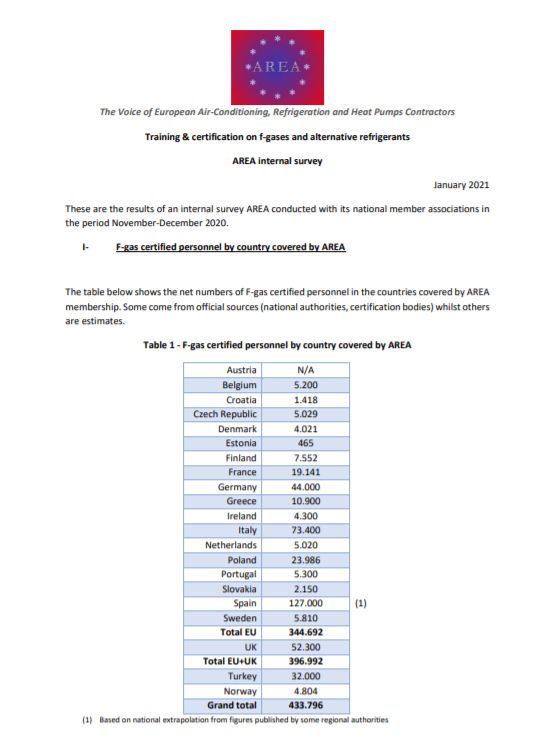
Around 345,000 refrigeration, air conditioning and heat pump (RACHP) personnel are F-Gas certified in the 18 EU countries covered by AREA membership. The figure increases to 397,000 with the UK and over 433,000 with Turkey and Norway. As expected, Category I dominates with 85% of the certifications. In addition, 116,500 companies are F-Gas certified in the 18 EU countries covered by AREA membership, 125,000 with the UK.
Since the phase-down scheme and the bans provided by the F-Gas Regulation are gradually pushing HFCs out the market, the survey also looked at the proportion of F-Gas certified personnel trained on alternatives. Unfortunately, though unsurprisingly, the results are low. Ammonia has the highest rate with 7%, closely followed with CO2 (6.9%). HCs score 6.2% and 5.3%, depending whether the equipment is small or large. Finally, only 3.5% of F-Gas certified personnel is trained on HFOs.
What do these figures tell us? Back in 2012, as the European Commission was working on an HFC phase-down in the context of the revision of the 2006 F-Gas Regulation, AREA alerted on the risk of shortage of contractors trained in the use of low GWP refrigerants. The combination of low training rates and insufficient quantitative and - sometimes – qualitative training offer cast strong doubts on the system’s ability to cope with increasing demand for alternatives resulting from phase-down and bans. Yet, AREA’s call for compulsory certification on alternative refrigerants based on minimum requirements was not heard by EU decision-makers.
9 years later, the situation has not improved. Arguably, it has actually worsened: training rates have remained largely stable whereas demand for low GWP alternatives has substantially increased. The issue is widely acknowledged and considered as a major obstacle to a stronger market take-up of alternative refrigerant solutions. Whereas these alternative solutions are becoming available for an increasing number of applications, they need enough competent contractors to be certificated to work with them safely.
Fortunately, there is one simple solution to the issue: extending the existing mandatory F-gas certification scheme to low GWP alternative refrigerants. This would provide a sufficient number of contractors with the necessary level of competence to ensure safe, efficient and reliable handling of equipment working with low GWP refrigerants. To this end, AREA is now preparing concrete proposals, including minimum requirements.
9 years ago, the discussions on the need for compulsory training and certification on alternative refrigerants were surrounded with some level of uncertainty. One can hardly argue it is the case today. Insufficiencies are known, and needs are understood. The ongoing review process is a great opportunity to correct the situation and remove an obstacle to the achievement of the F-Gas Regulation’s objectives.
Training&Certification