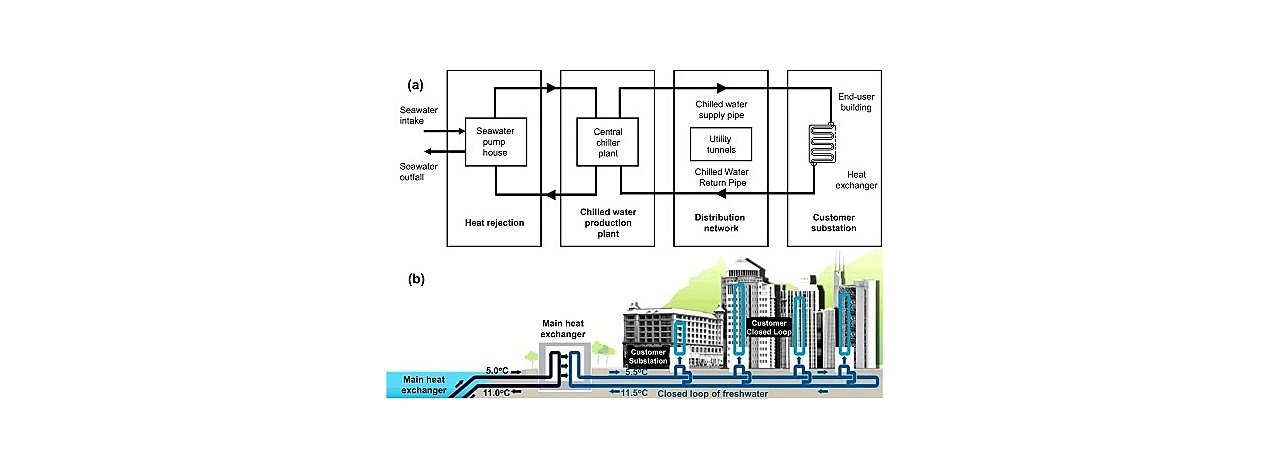
According to a recent study, energy costs can be very high for air-conditioning systems in tropical coastal areas, where electricity generation relies mainly on liquid fossil fuels. Popularized in the 1990s, seawater air conditioning (SWAC) is a district cooling technology that uses deep cold seawater for cooling. SWAC is proposed for tropical and equatorial regions where the distance between the coast and the ocean depth is small, allowing the use of reasonably short cold seawater pipelines. Even in tropical regions, deep seawater can be as cold as 3–5°C at depths between 700 and 2000 m. SWAC replaces chillers used in conventional AC systems, which significantly reduces electricity consumption and cooling costs. Previous research indicates that the electricity cost of a SWAC system is typically 80% lower than that of conventional AC systems.
Based on a literature review, the authors identified a wide range of potential customers with high cooling demands to connect to SWAC district cooling systems: airports, data centres, hotels, resorts, government and military facilities, universities, large offices and commercial buildings, shopping malls, department stores, museums, residential districts, industrial processes, entertainment facilities, artificial ski resorts, temperate fruits and vegetables farming, food and grain storage, etc.
The study proposes a “high velocity SWAC”, a modified version of the normal design that can offer increased efficiency for SWAC projects with long pipelines as well as allow for expansion to meet growing cooling demand. There are seven main components in a “high velocity SWAC”: (1) cold seawater inlet; (2) warm seawater outlet; (3) seawater pump; (4) heat exchanger; (5) thermal energy storage tank; (6) refrigeration systems or district cooling system; and (7) renewable energy sources.
The proposal consists of increasing the excavation depth of the seawater pump station, thus increasing the velocity and flow rate of the seawater inlet pipe. According to the authors, the excavation depth should be up to 20 metres below the sea level, instead of the usual 2–5 metres. This design doubles the seawater velocity in the offshore pipes, resulting in a similar increase in the cooling load provided. The increase in velocity reduces the residence time of water in the pipeline and could reduce heat loss to the environment.
The increase in seawater velocity and cooling load would require additional pumps, heat exchangers, and distribution network, but the authors believe that the offshore pipeline will remain the same. It should be noted that the need for deeper excavation requires additional capital costs. The authors propose that project developers design the project with a small cooling load first, and then implement modular extensions in the cooling load, which will reduce the project implementation costs and risks.
For more details, the full article is available on FRIDOC.