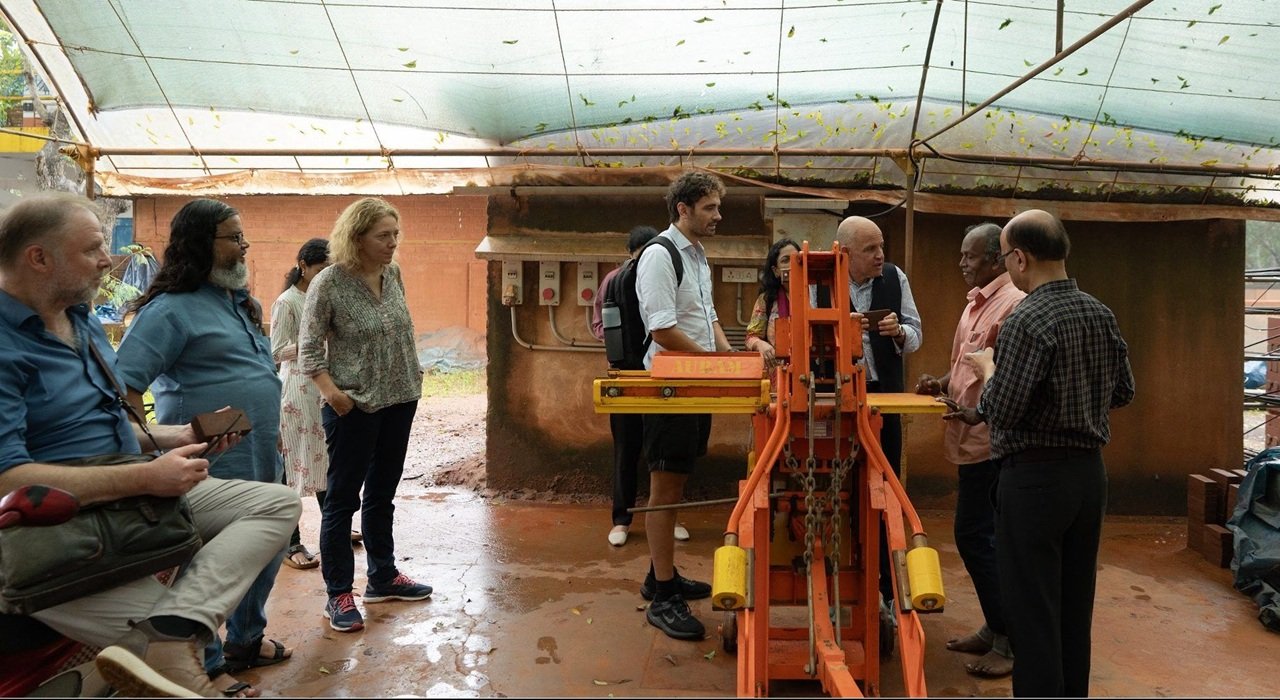
Tamil Nadu is expanding its climate-resilient development strategies through sustainable cooling and low-carbon construction, supported by the BeCool project led by the UNEP Cool Coalition and the Swiss Agency for Development and Cooperation (SDC). From 23–24 November 2025, project teams visited Chennai and Auroville to assess pilot implementations and explore opportunities for scaling passive cooling approaches.
In Chennai, the delegation visited the Perunthalaivar Kamarajar Girls Higher Secondary School in Ambattur, where a cool roof pilot under the BeCool project is improving indoor conditions. Early feedback from teachers and students indicates reduced discomfort due to heat. Based on these results, discussions are underway to expand passive cooling interventions to 300 schools across the state, potentially benefiting over 150,000 students. Additional strategies such as shading, ventilation enhancements, site vegetation, and solar integration are also being considered.
The visit to the Perumbakkam affordable housing project showcased the need and potential for integrating passive cooling in multi-storey residential buildings. Implemented in collaboration with the Tamil Nadu Urban Habitat Development Board (TNUHDB), the initiative aims to enhance climate resilience and energy efficiency in both new constructions and retrofit projects.
On the second day, the delegation visited Auroville to explore low-carbon construction materials and holistic design models. Demonstrations included the use of compressed stabilised earth blocks (CSEB) as thermally efficient alternatives to conventional materials, alongside integrated passive design and circular construction practices.
Key takeaways from engagements with local stakeholders highlighted the effectiveness of passive cooling in reducing heat stress at low cost, the need for integrated solutions in dense urban housing, and the importance of policy support for low-carbon materials. Collaboration between state institutions, technical experts, and communities was identified as critical for scalable, equitable outcomes.
The BeCool project will continue to assist Tamil Nadu in advancing passive cooling strategies in public infrastructure and integrating climate-responsive practices into policy frameworks.
Source