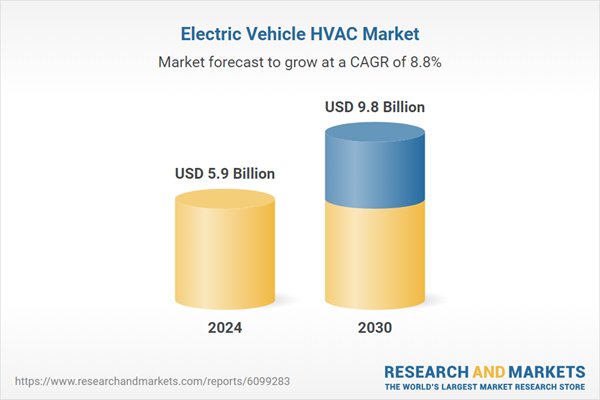
The global Electric Vehicle (EV) HVAC market is projected to grow from US$5.9 billion in 2024 to US$9.8 billion by 2030, according to a new report published by ResearchAndMarkets.com. This represents a compound annual growth rate (CAGR) of 8.8% over the forecast period.
Growth is driven by advances in thermal management and evolving EV architecture. The increasing adoption of heat pump-based HVAC systems, offering 50–70% higher energy efficiency than resistive heating, is a key technology trend. Innovations such as smart sensors, software-defined HVAC controls, and modular low-voltage components are enhancing system efficiency and compatibility with compact EV designs.
Demand for efficient HVAC solutions is growing in electric delivery vehicles, long-range SUVs, and luxury sedans. Regulatory pressure to shift to refrigerants like R-744 (CO2) is prompting HVAC system redesigns. Consumer expectations for in-vehicle air quality, adaptive climate controls, and range optimization in cold climates are also shaping product development.
The report highlights strong growth in key HVAC components. The compressor segment is expected to reach US$3.3 billion by 2030, with a CAGR of 7.1%, while the condenser segment is forecast to grow at 9.2% annually. Regionally, the U.S. market is valued at US$1.5 billion in 2024, and China is projected to grow at an 8.6% CAGR to reach US$1.6 billion by 2030.
The analysis covers components (compressor, condenser, heater core, evaporator, others), technologies (BEV, PHEV), and vehicle types (passenger cars, commercial vehicles), with data provided for regions including North America, Europe, Asia-Pacific, and others.
The report includes profiles of 32 manufacturers, such as DENSO Corporation, Hanon Systems, Valeo SA, BorgWarner Inc., Panasonic Holdings Corporation, and Webasto SE.
Source