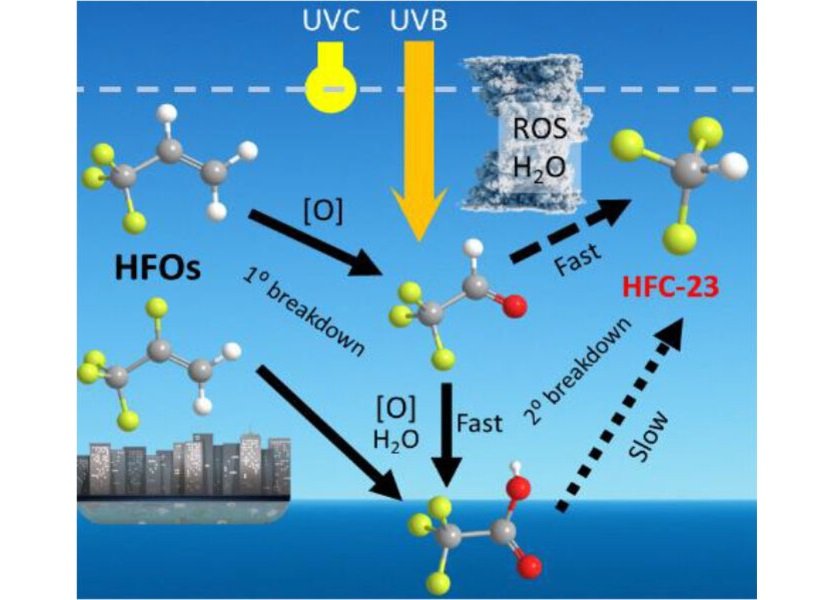
The study “On the Chemical Pathways Influencing the Effective Global Warming Potential of Commercial Hydrofluoroolefin Gases” was published April 4 in the journal ChemSusChem.
Hydrofluoroolefins (HFOs) can produce the super greenhouse gas HFC-23 as a secondary breakdown product via TriFluoroEtanal (TFE) and TriFluoroAcetate (TFA). TFE mineralization experiments in laboratory settings do not use hydrogen donors or liquid water, failing to disprove the pathways connecting TFE to the harmful HFC-23 pollutant. TFA stability in laboratory settings does not reflect the likelihood of a variety of decarboxylation pathways (thermal, overtone, and biological) that lead to HFC-23 formation.
The enforcement of a global hydrofluorocarbon (HFC) refrigerant phase down led to the introduction of hydrofluoroolefins (HFOs) as a low Global Warming Potential (GWP) substitute, given their low atmospheric lifetime. However, to this date it is not fully clear the long-term atmospheric fate of HFOs primary degradation products: trifluoro acetaldehyde (TFE), trifluoro acetyl fluoride (TFF), and trifluoroacetic acid (TFA). It particularly concerns the possibility of forming HFC-23, a potent global warming agent. Although the atmospheric reaction networks of TFE, TFF, and TFA have a fair level of complexity, the relevant atmospheric chemical pathways are well characterized in the literature, enabling a comprehensive hazard assessment of HFC-23 formation as a secondary HFO breakdown product in diverse scenarios. A lower bound of the HFOs effective GWP in a baseline scenario is found above regulatory thresholds. While further research is crucial to refine climate risk assessments, the existing evidence suggests a non-negligible climate hazard associated with HFOs.
The best scientific knowledge to date shows that HFOs degradation goes through different competing pathways, primarily leading to TFE and TFA. This has engendered the notion that that HFOs are low GWP HFCs from an atmospheric lifetime perspective. However, many secondary breakdown pathways are notably leading to HFC-23, a compound considered a super pollutant for its highly elevated GWP and a long atmospheric lifetime. Table 10 summarizes and assesses the likelihood of the TFE and TFA conversion in near environmental conditions. Certain producers of fluorinated gases may advocate for the adoption of HFOs as a replacement for high GWP HFCs within the refrigeration, foam blowing and propellants sector, with the intention of mitigating HFC related greenhouse emissions. However, this comprehensive review underscores a number of pathways through which HFOs could produce the very high GWP HFC-23 as secondary breakdown product within the century of being released. The ozone layer depleting use of CFCs and their subsequent replacement with high GWP HFCs provides a cautionary analogy.
Read More