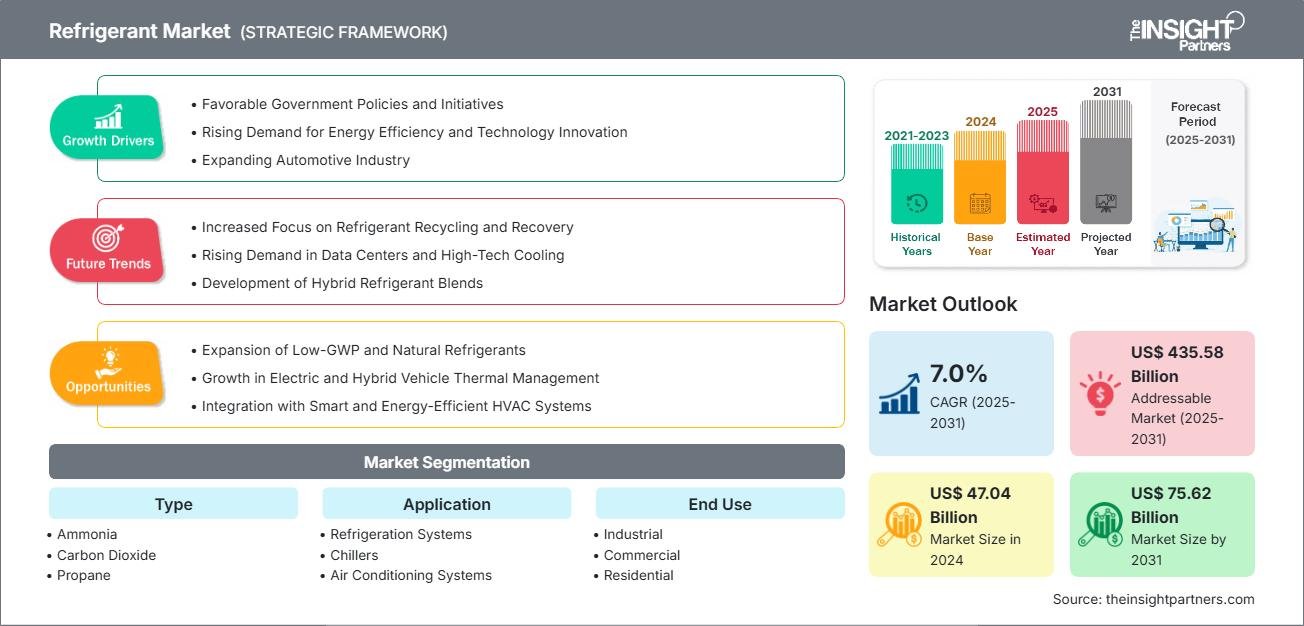
The global refrigerant market is projected to grow from US$47.04 billion in 2024 to US$75.62 billion by 2031, at a CAGR of 7.0% during 2025-2031, according to a report published by The Insight Partners. The report says favorable government policies and initiatives are a primary growth driver, while the expanding automotive industry is increasing demand for refrigerants.
Asia Pacific held the largest market share in 2024 and is expected to record the fastest growth during the forecast period. The report links this outlook to the region’s manufacturing base, investments in infrastructure, retail expansion, rising cold-chain needs, growth in the automotive industry, and government support. In the US, the market is projected to grow at a CAGR of 6.7% from 2025 to 2031.
By product type, hydrofluorocarbons (HFCs) are expected to remain the largest segment, while ammonia is projected to post the highest CAGR at 17.9%. By application, air conditioning systems are expected to hold the largest share. The report also highlights increasing interest in low-GWP refrigerants including CO2, ammonia, hydrocarbons, and low-GWP synthetic blends as regulations tighten.
The study says rising vehicle production, higher demand for personal mobility, and broader use of HVAC systems in passenger and commercial vehicles are supporting market growth. It adds that regulatory requirements for low-GWP refrigerants in automotive air-conditioning systems are accelerating the shift from older refrigerants such as R-134a to alternatives including R-1234yf, while electric vehicles are increasing demand for refrigerants used in cabin comfort, battery cooling, power electronics, and heat-pump systems.
The report identifies rising demand for energy efficiency and technology innovation as a driver, expansion of low-GWP and natural refrigerants as an opportunity, and technical barriers to retrofit and replacement as a challenge. Among recent developments, it cites A-Gas International Limited’s acquisition of Canadian Refrigerant Services Inc. in March 2025 and the company’s expansion of refrigerant separation capacity at its US facilities in April 2024.
Read More