Esta página solo está disponible en inglés. Ir a la portada en español

×

Questa pagina è disponibile solo in inglese. Home page in italiano

×

Diese Seite ist nur auf Englisch verfügbar. Zur deutschen Startseite

×

Cette page est disponible uniquement en anglais. Aller à la page d'accueil en français

×

Marks and Spencer Chooses Aerofoils to Save Energy and Carbon Emissions

Marks and Spencer Chooses Aerofoils to Save Energy and Carbon Emissions

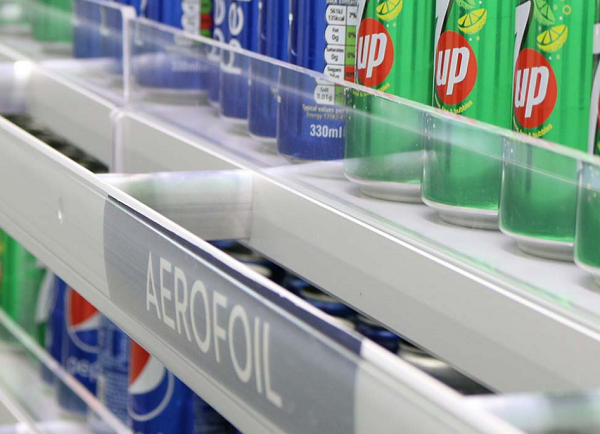
Marks and Spencer has chosen to roll out Aerofoils, the Formula One-inspired energy saving device for open-fronted retail fridges from Aerofoil Energy Ltd.

Open-fronted fridges are the largest consumer of power in stores and after extensive laboratory and store trials, M&S has seen proven energy savings from Aerofoils, with the added benefit of a more comfortable temperature for customers and colleagues. Results from existing client adoption of Aerofoils prove that customers can save up to 30% on refrigeration energy costs through this straightforward, cost-effective and retrofittable solution.

Aerofoil, from Aerofoil Energy, is influenced by Formula One aerodynamics from Williams Advanced Engineering, part of the Williams Group that also includes the Formula One team, and is similar in appearance to the rear wing of a Formula One car. It uses aerodynamics to guide cold air down the fridge more efficiently, meaning substantially less cold air is lost from the chiller unit, resulting in lower energy use, fewer carbon emissions and warmer aisles in stores.

Paul McAndrew, CEO of Aerofoil Energy, said: “Aerofoil Energy is delighted to be working with such an internationally iconic brand in food retail as M&S.  This was a very interesting development project for us, because M&S has its own bespoke refrigeration cabinets.  The whole design process required close collaboration from the Aerofoil team with M&S to arrive at the most favourable and energy-efficient solution.  As a result of this relationship, M&S will deploy three new technologies, taken from our Vortex project, that together have enhanced the performance and aesthetics of Aerofoils.”

Ian Moore, Head of Store Development at Marks and Spencer, said: “We’re excited to be collaborating with Aerofoil Energy to reduce the energy consumption and environmental footprint of our stores.  This technology will also help us offer a better shopping experience for customers by improving the temperature in our aisles.”
Get the daily refrigeration briefing

One email a day. Trusted by 3,000+ RACHP professionals.

Related news

Most read this month

All news →

Related insights

Article

Secop’s Solar Direct Drive (SDD) System Earns WHO PQS Approval – The Team Behind It

Partner's material In March 2026, Secop’s Solar Direct Drive Power Management Module was granted WHO PQS prequalification and officially listed in the WHO Catalogue of Prequalified Immunization Devices. The WHO IMD-PQS (Immunization Devices Performance, Quality and Safety programme) is the global benchmark for cold chain equipment used in immunisation. Being listed in its catalogue is

22 Jun 2026
Tech Guide

Case Study – Effect of Louvers or diffusers on air flow distribution and cooling time on a meat log during Chill cycle

By Kushal Aurangabadkar An experimental analysis was conducted on a cooler space measuring 3.66 m × 6.096 m (12.0 ft × 20.0 ft), equipped with an ammonia refrigeration coil, five 30 cm (12 in.) fans, and five diffusers. The study measured airflow patterns, cooling rates, and heat transfer efficiency in meat storage by testing two configurations:

Kushal Aurangabadkar · 21 Jan 2026
Tech Guide

Total Cost of Ownership (TCO) for Modular Refrigeration Systems in Life Sciences Distribution Centers

by Ramez Naguib, P.E. Introduction Life sciences distribution centers are under immense pressure to deliver consistent temperature control, comply with increasingly stringent regulations, and optimize operational efficiency. Traditional built-up refrigeration systems often prove cumbersome, costly, and slow to implement. In contrast, modular, factory-assembled refrigeration systems have emerged as a compelling alternative. Drawing on lessons from

14 Jan 2026