Daikin Industries, Ltd., Tokyo Gas Engineering Solutions Co., Ltd. (hereinafter referred to as “TGES”) and National Research and Development Agency RIKEN developed the world's first laser-based remote sensing technology for the R32. In addition, Daikin and TGES jointly developed a prototype R32 remote detector that incorporates this technology and demonstrated the detector's ability to remotely detect R32.
Air conditioners are filled with a gas called refrigerant, which is needed to cool or heat the air, and the refrigerant is mainly HFC (hydrofluorocarbon). In recent years, the global warming effect caused by refrigerant leakage has become an issue internationally, and there is a need to reduce the global warming potential (GWP) of refrigerants and take measures to prevent leakage. Under these conditions, Japan is ahead of the world in switching to R32, a low-GWP refrigerant that is 1/3 of the GWP of HFC-410A (hereinafter referred to as “R410A”) *1, which was previously used as the main refrigerant. Conversion has advanced and now almost 100% of residential air conditioners manufactured and sold in Japan are R32. In addition, R32 is gaining recognition as a low-GWP refrigerant worldwide and is already used in more than 130 countries.
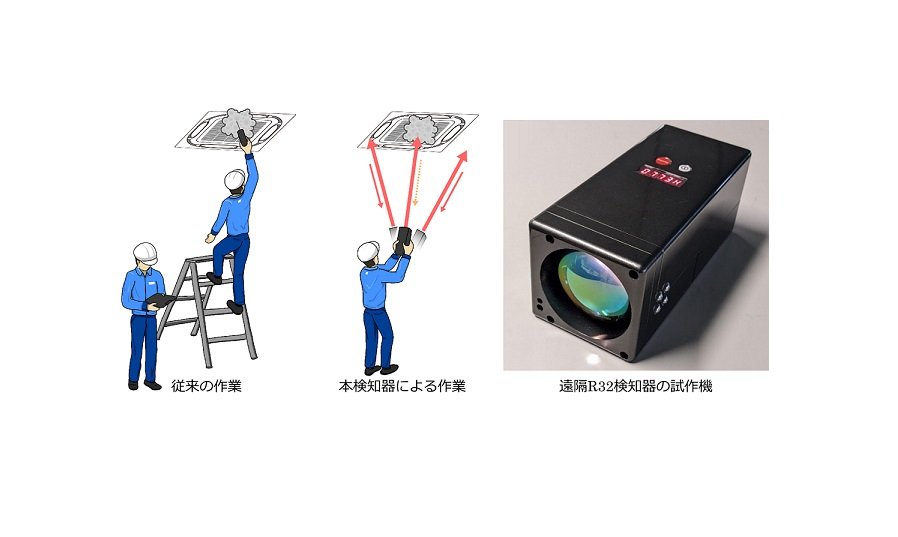
Currently, to check for refrigerant leaks during on-site air conditioner maintenance, an air sampling method*2 is commonly used, which involves bringing test equipment close to the suspected leak location and sampling the surrounding gas. In this method, the air conditioner body and piping are often installed in high places, such as behind the ceiling, where a stepladder is required, or in narrow places that are difficult for people to reach, so the work simply takes time and effort, it was difficult to ensure safety, or it was difficult to position the test equipment close to each other. On the other hand, this newly developed detector can effectively confirm the presence or absence of R32 in the path of the laser beam by emitting the laser beam from a distant location towards the target object. Compared to traditional air intake methods, this method can be expected to significantly reduce operating time and improve safety, as well as lead to faster response times down the line.
In addition, this technology and this detector can also detect mixed refrigerants including R32, so it can be used for example for R410A refrigerant, which was previously used as the main refrigerant. In addition to detecting refrigerant leaks from in-use equipment, it can also be used in various situations in the refrigerant cycle, such as detecting leaks from dismounted equipment and monitoring leaks in refrigerant recovery units. It is also expected to help reduce gas emissions.
This technological achievement will be presented at the International Symposium "Environment and New Refrigerants 2023", sponsored by the Japan Refrigeration and Air Conditioning Industry Association, which will be held at the Kobe International Convention Center from November 16 (Thursday) to November 17 (Friday). , 2023. The event will feature the launch and announcement of a new product.
*1 R410A is a refrigerant that is a 50:50 mixture of R32 and R125 and has a global warming potential approximately three times higher than R32.
*2 A method to detect refrigerant that has come into contact with a sensor built into inspection equipment.
R32 Remote Detector Review
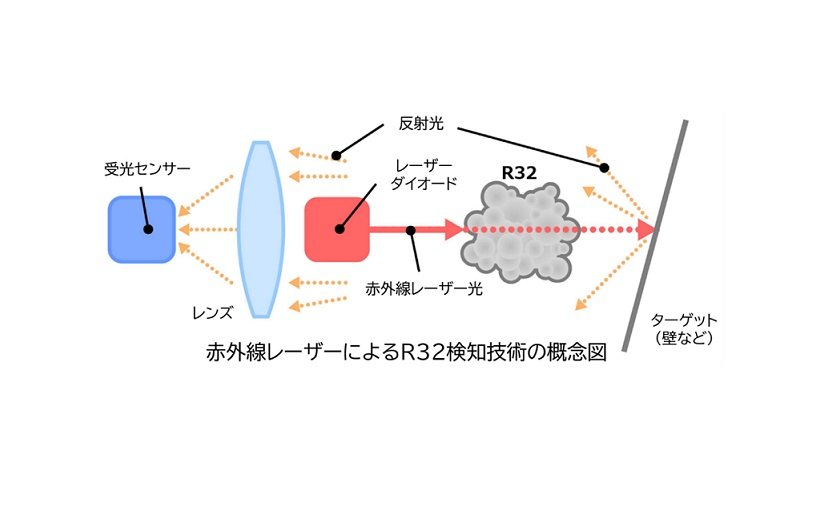
This detector emits an infrared laser at a wavelength that matches the near-infrared absorption wavelength range unique to the R32, which was jointly identified by RIKEN and Daikin*3, and uses a lens to collect light diffusely reflected from walls. This is an application of the remote methane detector *4, which was introduced into the practical use of TGES for the purpose of detecting methane, the main component of city gas, on R32, as well as attenuating the reflected light produced by the presence of R32. along the laser beam path is measured using highly sensitive TGES detection technology, and the presence or absence of R32 is instantly detected. Detection from a distance of approximately 10 meters or through a window is also possible.
*3 Patent No. 7114832.
*4 Developed for the first time in the world in 2001 to detect city gas leaks. Detectors equipped with this technology are used in 30 countries around the world.
When using the currently popular air sampling method, it is necessary to carry the test equipment from the ceiling through the inspection hole near the indoor unit of the air conditioner and test multiple indoor units by moving a stepladder, etc. Since this detector can effectively detect from a distance, it is expected that will significantly reduce labor costs and increase occupational safety, which will also lead to the adoption of prompt countermeasures.
Separate efforts to develop detection technologies and detectors using lasers
As measures to combat leaks of R32, which is becoming increasingly popular around the world, become increasingly important, RIKEN, which has optical remote gas detection technology using lasers, and Daikin, which has the know-how in combating refrigerant leaks, use lasers to effectively eliminate refrigerant leaks.
"We began developing technology that could be used to discover new things, and succeeded in identifying the near-infrared absorption wavelengths unique to R32 that were needed for this technology. Daikin subsequently developed the world's first remote methane detector using lasers and proprietary TGES sensitivity enhancement technology, which was introduced into practical use in 2001. We have been working to develop equipment capable of highly sensitive detection,” Daikin said.
This initiative is based on the possibility that R32 (CH2F2), which has a structure similar to methane (CH4), which has the property of strongly absorbing near-infrared rays of a certain wavelength, can also be detected using laser and various batches are associated with demonstrations. This joint creative activity. Going forward, Daikin and TGES will strive to further improve detection sensitivity and reduce the size to a size that can be carried in the field, with the goal of commercializing this detector in 2025.