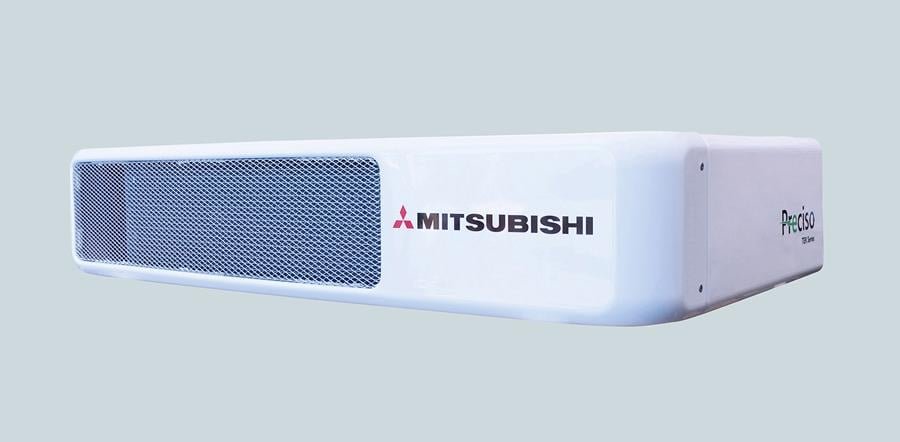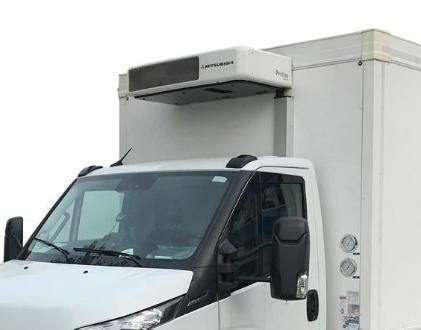
Mitsubishi Heavy Industries Thermal Systems, Ltd. has launched sales of the TEK series of compact electric-driven transport refrigeration units for small and mid-size trucks. Mitsubishi Heavy Industries Thermal Transport Europe GmbH (MTTE), the Company’s European sales arm based in Osnabruck, Germany, is in charge of sales. In addition to the compact size, the TEK series offers enhanced cooling/heating capacity which enables expansion from the TE20/30 series’ mountable range to include small and mid-size trucks.
The TEK series adopts the plug-in hybrid system which has already been highly acclaimed in the TE20/30 series. The system combines a commercial plug-in power source and a power source dedicated to the refrigerator. It can automatically switch between plug-in charging and charging battery while running and operating by battery depending on the status of vehicle operation (idling, running, etc.). Additionally, the system automatically switches to one of three modes (power save, high efficiency, full capacity) depending on the refrigerator battery’s remaining charge volume and the cargo room temperature. Because operation of the refrigerator continues even while the vehicle is parked or idling, the driver can focus on driving and delivery, without having to operate the refrigerator, and cargo room temperature can be precisely maintained and controlled which is demanded for perishable food and pharmaceutical transportation.
A new type of fan in the evaporators enhances airflow volume and refrigeration capacity, while optimization of the air outlet enables to reach quickly and maintain the target temperature in the cargo room. The evaporators available in three different sizes can be installed in separate partitioned compartments enabling setup of different temperatures according to cargo volume and content. In response to the request for higher heating capacity in Europe’s low-temperature regions, pressure control has been improved by modifying the circuitry, resulting in approximately 50 percent improvement in heating capacity at -20℃ ambient temperature compared to the TE20/30 series.