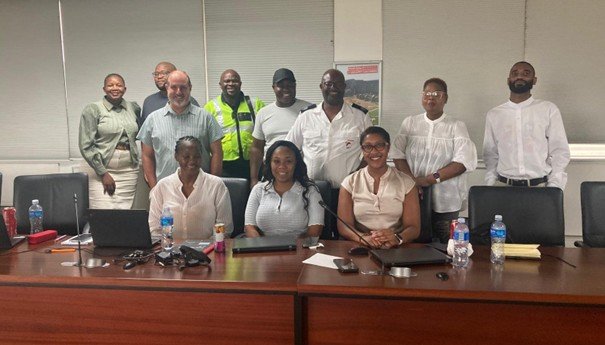
Within the Greener Reefers project, Transnet hosted a Terminal Hazard Identification (HAZID) Workshop at the port of Durban, South Africa, to assess how refrigerated containers using propane (R290) as a natural refrigerant interact with terminal operations. The workshop aimed to identify and evaluate terminal-specific hazard scenarios linked to the use of flammable refrigerants in a busy port environment.
The session is a central element of the project’s Operational Modes Risk Assessment (OMRA) framework and focused on operational realities in dynamic terminal settings. Participants examined scenarios including loading and unloading, routine handling and inspections, maintenance tasks, and internal transport and storage within the terminal.
Transnet staff from different departments and operational areas reviewed these scenarios, identified potential hazards, and discussed existing and additional control measures to support safe handling of flammable refrigerants. The HAZID involved responsible personnel from container handling, safety and operations, and legal and risk-related functions, including terminal management, SHEQ specialists (Safety, Health, Environment and Quality), compliance monitoring, and legal risk management, including insurance claims. The MRU (mobile refrigeration unit) manufacturer also contributed via its engineering and product management departments.
The HAZID work with Transnet was described as representative for South Africa, covering Durban, Eastern Cape and Western Cape terminals and drawing on expertise and incident analysis from a database for eight terminals. The outcome was a jointly developed set of terminal-specific hazard scenarios spanning technical, operational and organizational perspectives, intended to inform the qualitative risk assessment phase of the OMRA process being developed within Greener Reefers.
Greener Reefers, implemented by GIZ Proklima in Costa Rica and South Africa, is commissioned by the German Federal Ministry for the Environment, Climate Action, Nature Conservation and Nuclear Safety (BMUKN) under the International Climate Initiative (IKI). The project promotes refrigerated containers using natural refrigerants such as propane and CO2 and includes training for technicians and operators to support safe adoption and maintenance.
Source