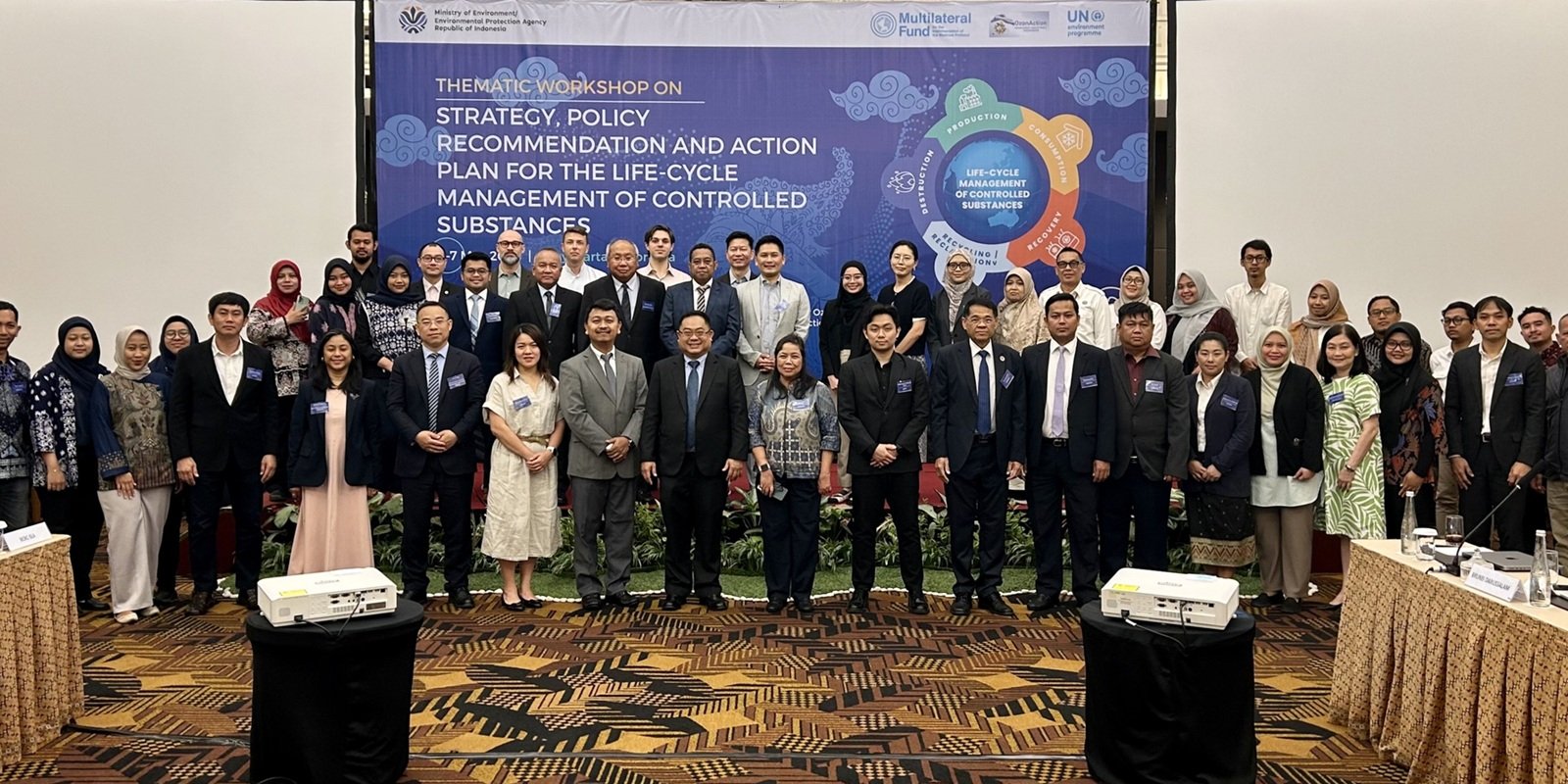
National focal points of the Montreal Protocol and the Basel Convention met in Yogyakarta, Indonesia, for a workshop on lifecycle management of controlled substances, organised by UNEP OzonAction with Indonesia’s Ministry of Environment and Forestry.
Government representatives shared experiences as they prepare national inventories of used or unwanted controlled substances under the Montreal Protocol. The workshop focused on strategy, policy recommendations and action plans for controlled substances across their lifecycle.
Lifecycle refrigerant management aims to prevent and reduce refrigerant leaks at every stage of the refrigeration, air conditioning and heat pump lifecycle. This includes refrigerant production, storage and transport; equipment design, manufacture and installation; operation and maintenance; and recovery, reuse and safe disposal at end of life.
Denise San Valentin, the Climate and Clean Air Coalition Secretariat’s Cooling focal point, presented the forthcoming UNEP/CCAC guide “National Plans for Lifecycle Refrigerant Management: A Practical Guide for Developing Countries”. She also led sessions on financing lifecycle refrigerant management and managing cross-border refrigerant movement.
The Executive Committee of the Multilateral Fund established a funding window in December 2022 to help countries prepare inventories of stored or unwanted controlled substances and plans for collection, transport and disposal, including recycling, reclamation and cost-effective destruction. As of December 2025, 127 countries are receiving support through MLF implementing agencies: UNDP, UNEP, UNIDO, the World Bank and GIZ.
“Recycled and reclaimed refrigerants can significantly reduce countries’ reliance on importing new refrigerant,” said Jim Curlin, Head of UNEP OzonAction. “But this requires a joined-up approach: strong national inventories, sound policies and regulations, the right infrastructure, capacity building, sustainable financing, and engagement across the full refrigerant lifecycle.”