Esta página solo está disponible en inglés. Ir a la portada en español

×

Questa pagina è disponibile solo in inglese. Home page in italiano

×

Diese Seite ist nur auf Englisch verfügbar. Zur deutschen Startseite

×

Cette page est disponible uniquement en anglais. Aller à la page d'accueil en français

×

Thermo King offers new advancer trailer refrigeration units in a “Trade In – Trade Up” program across the UK

Thermo King offers new advancer trailer refrigeration units in a “Trade In – Trade Up” program across the UK

Up to 30% better fuel efficiency of the Thermo King Advancer units can help transport companies mitigate the expected fuel price increase after the withdrawal of “red” diesel.

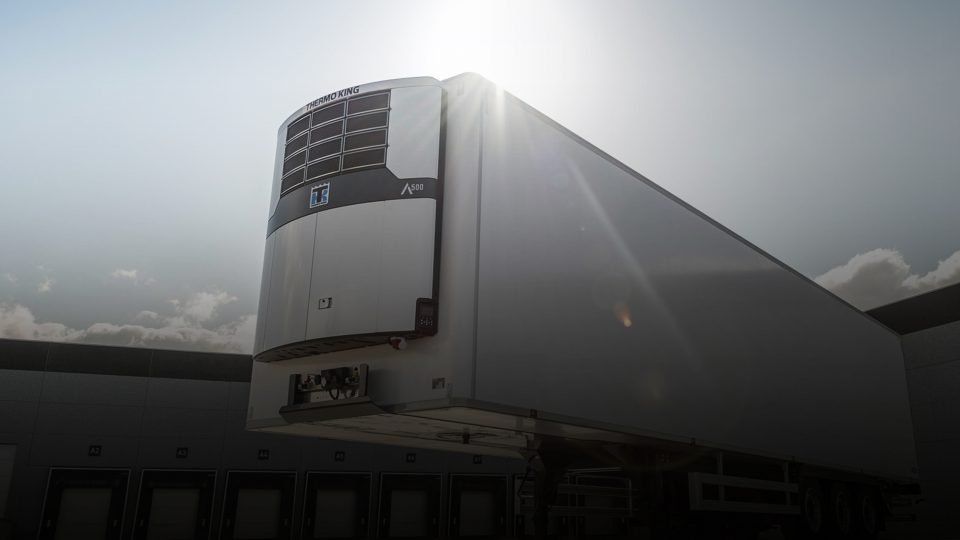
Thermo King, a leader in transport temperature control solutions and a brand of Trane Technologies, announced a new program that allows hauliers across the United Kingdom to trade-in their used single-temperature trailer refrigeration units and upgrade to the new Thermo King Advancer A-Series. Thermo King A-Series units are up to 30% more fuel-efficient than the market average offering the potential to completely mitigate the potential fuel cost increase expected after the withdrawal of rebated “red” diesel in April 2022.

“With this program, Thermo King wants to help transport companies’ address the impact, which the upcoming changes in fuel duty in the United Kingdom will have on their operations,” said David O’Gorman, regional sales director at Thermo King. “Hauliers willing to trade in and upgrade their used trailer refrigeration units – no matter the brand – can simply contact their local Thermo King dealer, replace it with a brand new Advancer unit and start benefiting from the market leading performance, temperature control, and fleet connectivity.”

Thermo King Advancer A-Series is available in three different versions, the A-360, A-400, and A-500, and includes unique features that comprehensively address a wide range of operational and financial challenges, including:

  • Up to 40% quicker pull down and up to 30% better fuel-efficiency than the market average
  • Fully variable airflow that can be regulated for each journey and cargo, and is independent from unit engine speed
  • Unrivalled electrical and fuel efficiency contributing to lower CO2 footprint and engines with 50% less emissions than the maximum allowed by latest NRMM Stage V emission standards
  • Electronic engine speed control on the A-400 and A-500 units, which makes them the first units on the market to give complete transparency of fuel levels and fuel consumption. The fuel consumption data will be recorded, displayed, and made available remotely via telematics
  • Lower maintenance costs and enhanced serviceability compared to the predecessor, thanks to sensors offering more insight into the engine, fuel, battery and the performance of other key components
  • Future-ready power agnostic capabilities that can utilize diesel, axle generator, or shore power sources with ease
  • Fleet intelligence as standard, with Advancer being the first-ever unit to offer 2 years of full telematics connectivity in the purchase price.
Get the daily refrigeration briefing

One email a day. Trusted by 3,000+ RACHP professionals.

More on Cold Chain

All on Cold Chain →

Insights

Secop's Solar Direct Drive (SDD) System Earns WHO PQS Approval – The Team Behind It
Article

Secop’s Solar Direct Drive (SDD) System Earns WHO PQS Approval – The Team Behind It

Partner's material In March 2026, Secop’s Solar Direct Drive Power Management Module was granted WHO PQS prequalification and officially listed in the WHO Catalogue of Prequalified Immunization Devices. The WHO IMD-PQS (Immunization Devices Performance, Quality and Safety programme) is the global benchmark for cold chain equipment used in immunisation. Being listed in its catalogue is

22 Jun 2026
Case Study - Effect of Louvers or diffusers on air flow distribution and cooling time on a meat log during Chill cycle
Tech Guide

Case Study – Effect of Louvers or diffusers on air flow distribution and cooling time on a meat log during Chill cycle

By Kushal Aurangabadkar An experimental analysis was conducted on a cooler space measuring 3.66 m × 6.096 m (12.0 ft × 20.0 ft), equipped with an ammonia refrigeration coil, five 30 cm (12 in.) fans, and five diffusers. The study measured airflow patterns, cooling rates, and heat transfer efficiency in meat storage by testing two configurations:

Kushal Aurangabadkar · 21 Jan 2026
Total Cost of Ownership (TCO) for Modular Refrigeration Systems in Life Sciences Distribution Centers
Tech Guide

Total Cost of Ownership (TCO) for Modular Refrigeration Systems in Life Sciences Distribution Centers

by Ramez Naguib, P.E. Introduction Life sciences distribution centers are under immense pressure to deliver consistent temperature control, comply with increasingly stringent regulations, and optimize operational efficiency. Traditional built-up refrigeration systems often prove cumbersome, costly, and slow to implement. In contrast, modular, factory-assembled refrigeration systems have emerged as a compelling alternative. Drawing on lessons from

14 Jan 2026
Everything on Cold Chain: 2,038 articles, 1 case study, 23 insights

Most read this month

All news →