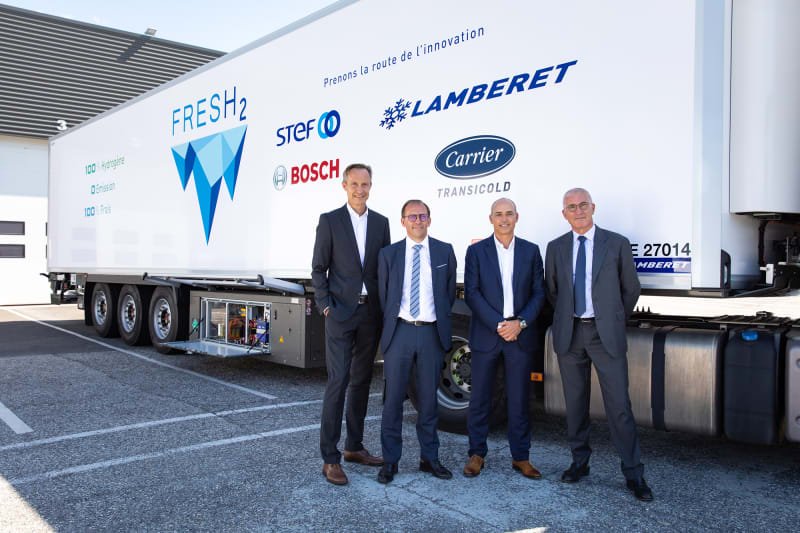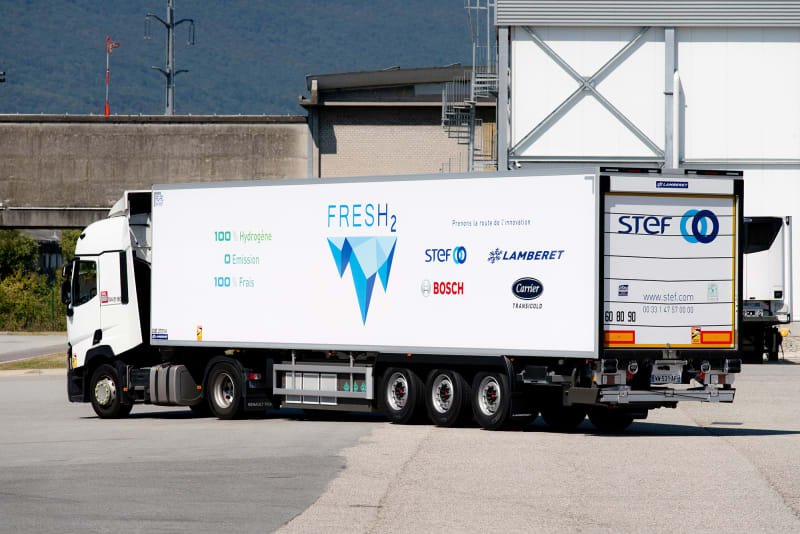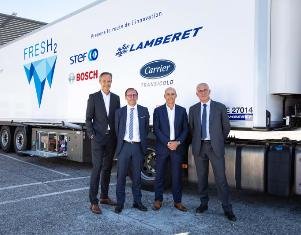
FresH2*, the innovative fuel cell project initiated by Bosch and Carrier Transicold, in collaboration with bodybuilder Lamberet and the European specialist in temperature-controlled food transport STEF, has entered the road testing phase on September 6.
FresH2 is a clean and quiet solution designed to deliver electricity required by refrigeration units installed on temperature-controlled road transport semi-trailers. The semi-trailers are primarily used to transport fresh and frozen food products, pharmaceuticals and all other heat-sensitive goods.
The hydrogen fuel cell technology offers a relevant alternative to replace the diesel engine usually used in refrigerated transport, which is a source of carbon dioxide (CO2), nitrogen oxide (NOx) and particulate emissions. As for the hydrogen cell, it does not release any emissions or noise.
FresH2 consists of a fuel cell powered by hydrogen tanks, to which an electronic unit is added, enabling it to convert the direct current provided by the cell into the alternating current needed to operate the refrigeration unit. The innovation lies in the direct interfacing of the fuel cell with the refrigeration unit, without the use of a bulky and expensive on-board buffer battery system.
To successfully carry out the first tests of this project, Carrier Transicold and Bosch have surrounded themselves with leading partners in the sector: the companies Lamberet (bodybuilder) and STEF (Transport and logistics specialist).
The Bosch Rodez team developed this innovative hydrogen solution by combining it with a Carrier Transicold Vector HE 19 multi-temperature refrigeration unit.
“The FresH2 project perfectly illustrates our passion for innovation and reflects our commitment to a sustainable cold chain, particularly through the electrification of our product lines,”said Jean-Pascal Vielfaure, Managing Director France and Southern Europe, Carrier Transicold. “With the FresH2 project, we are pleased to contribute to the energy transition and participate in developing a hydrogen-powered solution of the future for semi-trailers. Thank you to all of our partners for their commitment and trust.”
Energy efficient solutions such as the FresH2 project, support Carrier’s aim to reduce its customers’ carbon footprint by one gigaton, part of its 2030 Environmental, Social and Governance (ESG) Goals.
The system will be tested this month under actual usage conditions by STEF Chambéry site teams in France, as part of a round of food product distribution. “STEF’s participation in the FresH2 fuel cell project is a new strong marker of the Group’s commitment to green energy,” said Damien Chapotot, Managing Director, STEF Transport. “The testing of this operational prototype in real operating conditions is a first for STEF, which strongly believes in hydrogen as the fuel of the future.”
Once it has passed all certifications required for road licensing, the system will be tested to evaluate efficiency and to identify any areas of improvement for the future industrialized version. Bosch’s ultimate goal with this innovation is to produce a competitive, turnkey solution at the Rodez factory that can be integrated into any type of refrigerated semi-trailer, whether new or used, thereby contributing on a large scale to the climate neutrality target set for the transport sector in the Paris Agreement.
“In this period of expansion resulting from the implementation of all these new environmental technologies, the involvement of Lamberet and its expertise as a bodybuilder in this FresH2 project is a challenge that demonstrates our ability to carry out developments in partnership with the world’s largest groups and to adapt our products to these new technologies while respecting the specifications of our transport customers,” said Eric Méjean, Managing Director, Lamberet.
The FresH2 project is part of Carrier’s healthy, safe and sustainable cold chain program to preserve and protect the supply of food, drugs and vaccines.