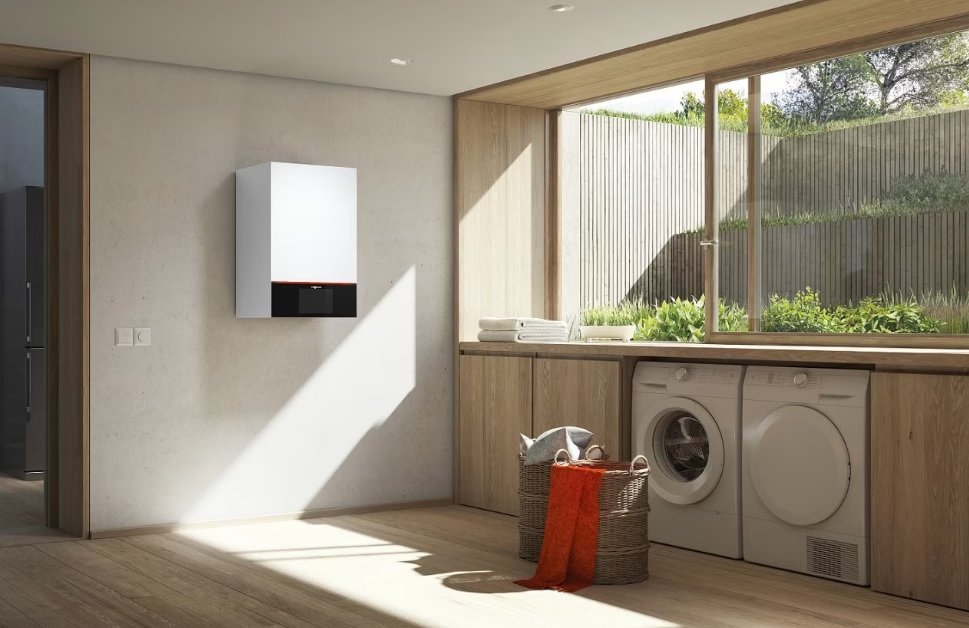
Gas condensing boilers from the Vitodens 300 and Vitodens 200 series manufactured from January 2024 can be converted to run on pure hydrogen in the future according to the requirements of the German Building Energy Act (GEG), Section 71k (Appendix B). Viessmann Climate Solutions has announced this in a manufacturer’s declaration. Homeowners who opt for these units are therefore on the safe side in the long term: You can continue to heat with natural gas for the time being and are also well prepared when your gas supply is converted to hydrogen.
Conversion kits enable simple and time-saving conversion to hydrogen
The manufacturer’s declaration applies to the Vitodens 300-W (type B3HG), Vitodens 200-W (types B2HF, B2KF) and Vitodens 222-W (type B2LF) wall-mounted boilers and the Vitodens 333-F (type B3TG) and Vitodens 222-F (types B2TF, B2SF) floorstanding compact boilers. With outputs of 1.9 to 32 kilowatts, they are primarily designed for use in single- and two-family homes and as floor heating systems. As standard, these heat generators can be operated with natural gas, bio natural gas, liquid gas (also bio LPG depending on the specification) and gas mixtures with up to 20 percent hydrogen. According to current plans, conversion kits will be available starting at the beginning of 2026 for converting units to run on pure hydrogen. This means that in future the conversion can be performed easily as part of the gas grid area transformation plan. The certification of the units in combination with the conversion kits is performed according to the valid specifications of ZP 3100.100 and EN 15502.
GEG amendment suspends EE obligation for convertible gas heating systems
The GEG amendment, which becomes effective on January 1, 2024, is intended to make a decisive contribution to achieving Germany’s climate protection targets. While only heating systems that use at least 65% renewable energy will be permitted in new development areas, owners of older houses will only find out which heat supply options will be available to them in the future once their local municipality has drawn up a heating plan. In cities with over 100,000 inhabitants, the municipal heating plan must be available by June 30, 2026, and in smaller municipalities by June 30, 2028, at the latest. If it is necessary to install a new heating system beforehand, gas condensing boilers may be used, provided they can be gradually operated with an increasing proportion of green gases, such as biogas.
However, section 71k, paragraph 1, of the GEG makes a significant exception for gas heating units that can be converted to run on pure hydrogen, given that the local heat planning provides a hydrogen network, and the grid operator has submitted a binding plan for the conversion to the new fuel source by the end of 2044. In this case, the units can be installed without having to meet the requirements for the use of renewable energy.