Esta página solo está disponible en inglés. Ir a la portada en español

×

Diese Seite ist nur auf Englisch verfügbar. Zur deutschen Startseite

×

Cette page est disponible uniquement en anglais. Aller à la page d'accueil en français

×

Carrier Transicold supplies 19 Supra units for Hunt’s England fleet

The multi-temperature systems will support up to 30 stops a day, with BluEdge maintenance covering trucks expected to serve at least seven years.

Carrier Transicold supplies 19 Supra units for Hunt’s England fleet

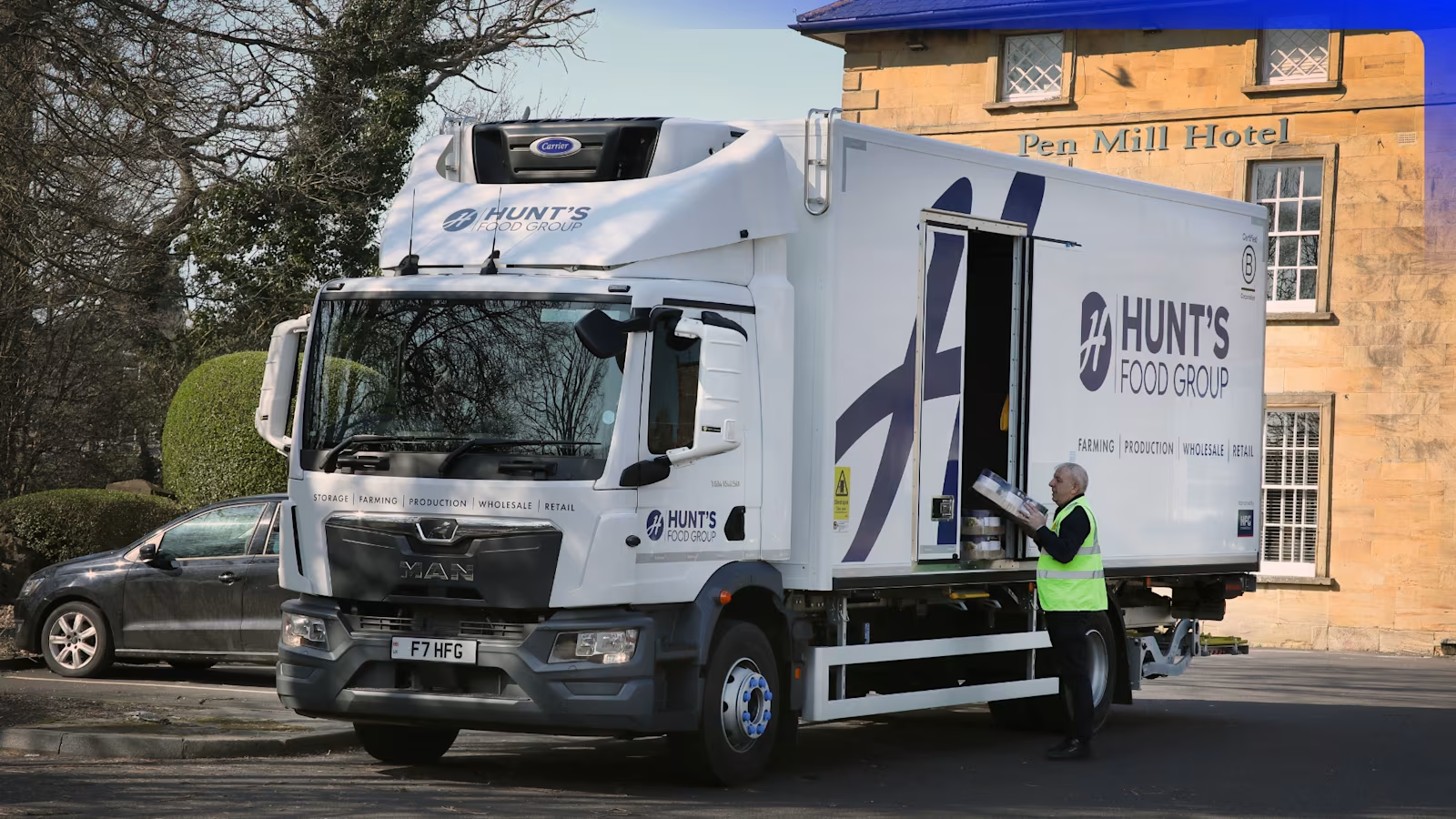
Hunt’s Food Group has added 19 new rigid trucks fitted with Carrier Transicold Supra 850 MT and Supra 1250 MT systems to strengthen its temperature-controlled distribution network in southern England. The vehicles are intended to help the distributor maintain consistent temperature control across high-frequency, multi-drop delivery routes.

The order includes nine Supra 850 MT units mounted on 15-tonne MAN TGM rigids (approx. 33,070 lb) and 10 Supra 1250 MT systems paired with 18-tonne versions of the same vehicle (approx. 39,680 lb). Each truck has an insulated box body supplied by Solomon Commercials. The delivery combines fleet replacements with targeted expansion, and means most of Hunt’s Food Group’s 160 temperature-controlled vehicles will continue to operate with Carrier Transicold technology.

Hunt’s Food Group said it has continued to use the Supra range because of its performance and reliability. According to the company, the system provides constant airflow independent of truck engine speed, as well as rapid pull-down and accurate multi-temperature set point control. These capabilities are used on routes that can include up to 30 stops per day.

The new vehicles are covered by Carrier Transicold’s BluEdge fixed-cost, full-service maintenance package, including annual temperature control testing and certification, regulatory checks and access to the oneCALL 24/7 incident management service. The rigids are expected to stay in the fleet for at least seven years and typically operate six days a week, delivering frozen and chilled goods, including fresh meats and ice cream, while covering up to 70,000 kilometres per year (approx. 43,500 miles).

“Maintaining cold chain integrity across busy multi-drop delivery routes demands equipment we can trust,” said Phil Hopkins, Transport Director, Hunt’s Food Group. “Since we took our first unit in 2015, the Supra range has reliably delivered the pull-down speeds and temperature control we require.”

Get the daily refrigeration briefing

One email a day. Trusted by 3,000+ RACHP professionals.

Related news

Most read this month

All news →

Related insights

Article

Secop’s Solar Direct Drive (SDD) System Earns WHO PQS Approval – The Team Behind It

Partner's material In March 2026, Secop’s Solar Direct Drive Power Management Module was granted WHO PQS prequalification and officially listed in the WHO Catalogue of Prequalified Immunization Devices. The WHO IMD-PQS (Immunization Devices Performance, Quality and Safety programme) is the global benchmark for cold chain equipment used in immunisation. Being listed in its catalogue is

22 Jun 2026
Tech Guide

Case Study – Effect of Louvers or diffusers on air flow distribution and cooling time on a meat log during Chill cycle

By Kushal Aurangabadkar An experimental analysis was conducted on a cooler space measuring 3.66 m × 6.096 m (12.0 ft × 20.0 ft), equipped with an ammonia refrigeration coil, five 30 cm (12 in.) fans, and five diffusers. The study measured airflow patterns, cooling rates, and heat transfer efficiency in meat storage by testing two configurations:

Kushal Aurangabadkar · 21 Jan 2026
Tech Guide

Total Cost of Ownership (TCO) for Modular Refrigeration Systems in Life Sciences Distribution Centers

by Ramez Naguib, P.E. Introduction Life sciences distribution centers are under immense pressure to deliver consistent temperature control, comply with increasingly stringent regulations, and optimize operational efficiency. Traditional built-up refrigeration systems often prove cumbersome, costly, and slow to implement. In contrast, modular, factory-assembled refrigeration systems have emerged as a compelling alternative. Drawing on lessons from

14 Jan 2026