Esta página solo está disponible en inglés. Ir a la portada en español

×

Diese Seite ist nur auf Englisch verfügbar. Zur deutschen Startseite

×

Cette page est disponible uniquement en anglais. Aller à la page d'accueil en français

×

RWTH Aachen researchers call for better heat pump performance data

The study links oversizing to higher costs and says ErP tests can overstate COP, prompting calls for dynamic operating data.

RWTH Aachen researchers call for better heat pump performance data

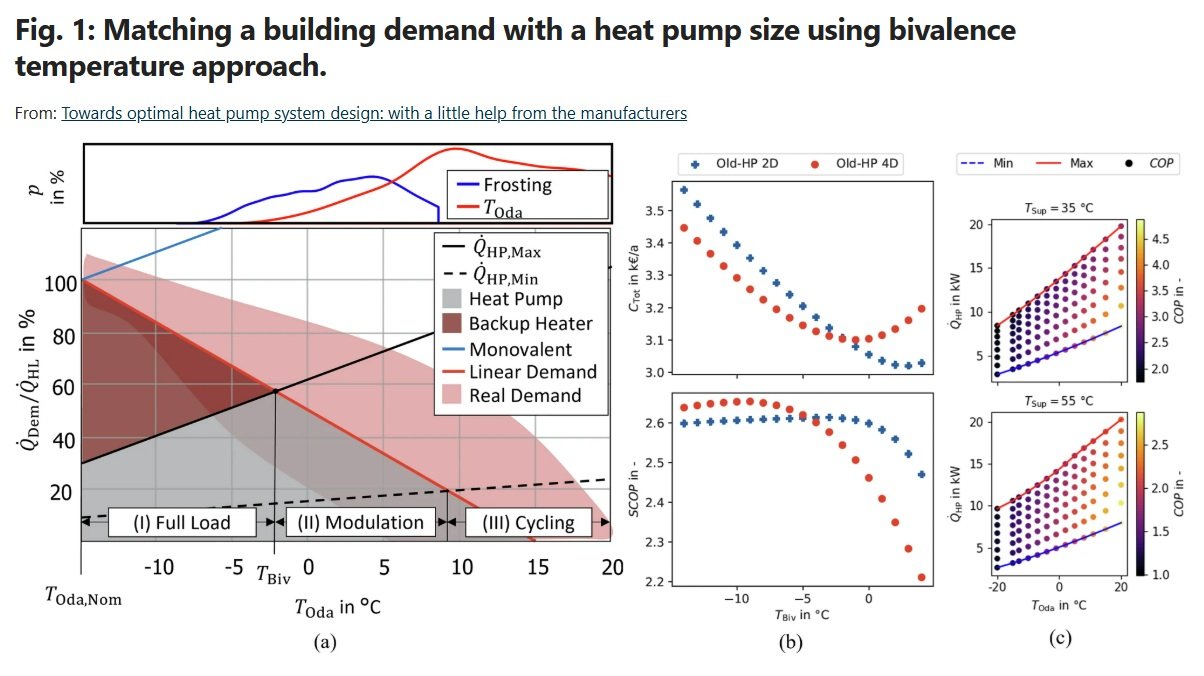
Researchers at RWTH Aachen University say heat pump systems should be designed to minimize total costs rather than defaulting to oversized, monovalent configurations. They argue that existing standards and energy labels can overestimate real-world seasonal coefficient of performance (SCOP) because standardized tests do not fully account for controller interactions, cycling losses and defrost effects.

Under EN 15450, a monovalent heat pump covers the nominal heat load defined by EN 12831 without a second heat source. A bivalent system can use a smaller heat pump with a backup heater, reducing capital costs but potentially increasing operating costs when the backup heater runs.

The researchers report that, across 72 typical German scenarios, sizing a heat pump at twice the capacity associated with the optimal bivalence point increased total costs by more than 15%. Limiting the oversizing factor to 1.2 kept the total cost increase to no more than 5%. Using proposed utilization thresholds, the authors estimate that about 53% or 65% of systems in an earlier field-test dataset would be classified as oversized.

The study also identifies five limitations in the ErP energy-label procedure based on EN 14825 and EN 14511. These include deactivated native controls, no direct cycling assessment, insufficient evaluation of defrost operation, combined specification of heat pump and backup-heater capacity, and flexibility in selecting nominal heating capacity. RWTH Aachen measurements found that the ErP method overestimated COP by 12.7% at one part-load test point and 18.9% at another.

The authors propose that manufacturers publish additional measurements and dynamic time-series data covering full-load, modulation and cycling operation. They recommend testing at supply temperatures of at least 35°C (95°F) and 65°C (149°F), together with information on backup-heater control, while further research determines the minimum measurements required for accurate SCOP prediction.

Source

Get the daily refrigeration briefing

One email a day. Trusted by 3,000+ RACHP professionals.

Related news

Heat Pumps

EHPA Seeks Application-Specific PFAS Derogations for Heat Pumps

The group says transition timelines should reflect refrigerant readiness, redesign needs and safety constraints across product categories.

6 Aug 2026
Heat Pumps

EPEE backs EU electrification plan, urges heating and cooling support

The association seeks VAT cuts and financing for heat pumps while highlighting waste heat recovery across refrigeration, industry and data centres.

29 Jul 2026
Heat Pumps

EU plan calls for 4 million annual heat pump installations by 2030

The European Commission’s Electrification Action Plan calls for annual heat pump installations to rise from 2.4 million in 2025 to 4 million by 2030. Published on 17 July 2026, the plan includes measures covering energy taxation, electricity and gas price ratios, financing, system flexibility and industrial electrification. The Commission proposes reducing national electricity-to-gas price ratios

22 Jul 2026
Heat Pumps

Mitsubishi Electric urges UK heat pump regulatory reform

A new white paper says high-temperature heat pumps could cut retrofit time, cost and disruption by retaining existing radiators and pipework.

10 Jul 2026
CO₂

Beijer Ref expands natural refrigerant offering with Lithuanian acquisition

The deal adds Refra’s CO2 refrigeration and propane chiller and heat pump expertise, pending Lithuanian competition approval.

Today
Data Centres

Danfoss reports 18% organic growth in Climate Solutions in H1 2026

Data center demand and heat pump uptake lifted the segment's operational EBITA margin to 18.1%, prompting a higher group outlook.

Today

Most read this month

All news →

Related insights