Refrigeration doors and gates are important elements of the low-temperature warehouses and refrigerated chambers, whose construction is reduced due to thermal insulation and operating costs. Typically, the refrigeration gates are selected from a wide range of types and sizes still even during the process of structural design of the cold rooms.
- Types of doors for cold rooms
- Medium and Low Temperature Doors
- Options and Special Design of Doors
- Which Refrigeration Doors to Choose?
Doors for Cold Rooms
The main purpose of doors for the cold rooms is the thermal insulation of the doorway through which the products are loaded and unloaded. Therefore, the construction, hardware of doors should not have the “thermal bridges”, or reduce them to a minimum. The doors must withstand the temperature conditions and workload in the refrigerated chambers; so it is important, when choosing doors, select the right type of door and its technical characteristics: size, insulation thickness, etc.
Types of Doors for Refrigerated chambers
Depending on the operating conditions and carrying out the loading and unloading operations in refrigerated chambers and warehouses, the following are used:
- hinged doors (swinging);
- sliding doors;
- vertical doors (gates of guillotine type).
Hinged Doors for Cold Rooms
Swing doors are making single- or double-leafed, depended on the doorway size. As a rule, the single-leaf doors are used for a doorway up to 1.2 m; double-leafed ones are usually applied with larger dimensions. The door panel is fastened on two or more hinges, depending on the size (doorway height). The door is called “right” or “left”, depending on the location of the hinges and opens to the corresponding side. Advantages of the hinged doors − ease installation and low price.

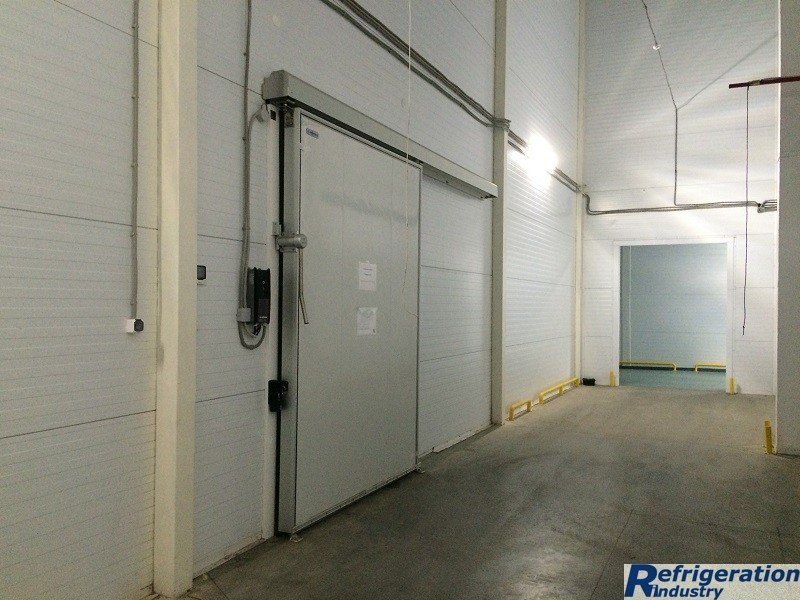
Sliding Doors for Cold Rooms
The panel of sliding doors is moved on rollers along the guide (slide-rail). They can be done with the right or left roll backing (of opening). When the gate is closed, they “sit down” and tightly press under their weight and the actions of clamping rollers, by providing the good sealing of the gate. In addition to the manual opening, the automatic electric drives are used for the sliding gates that can be activated with console and, optionally, radar, photocells, magnetic loops, a remote control.
The main advantages of sliding doors:
- greater reliability and durability of sliding doors − it is a very important requirement with intensive using;
- absence the “dead zone” before entering − it is convenient in the confined spaces, corridors;
- clamping device and seal. The door sealing is automatic under the weight of the door itself, due to the construction of the rail and the special pressure roller;
- possibility of using for the large doorways.
Vertical Gates of Guillotine Type
In that version of the door its panel rises, which is convenient, when there is no free space to open the sliding gates. Such gates are usually used with an electric drive, since they are difficult to open manually.
Disadvantages of the refrigeration vertical gates are:
- the worst tightness;
- the higher price compared to the collapsible gates.
Medium and Low Temperature Doors
The hinged and sliding doors for refrigerated chambers differ in depending on the temperature regime:
- doors of medium temperature mode (from 0 0С and above) for chambers and warehouses;
- low-temperature doors for freezing chambers and warehouses (from -15 to-25 0С and below).
The Main Differences Between Medium- and Low-Temperature Doors
Thermal insulation thickness of refrigeration doors depends on the specific use and can range from 60 to 160 mm. The standard thickness for medium-temperature cold rooms is 60-80 mm, for low-temperature ones − 100-120 mm. In the chambers of shock freezing of products (-30-40 0С) and the warehouse complexes with large doorways, there must be the gates with a heat-insulating thickness of 140-160 mm. Low-temperature doors must be equipped with a built-in heat tracing cable to prevent the freezing of panel to the door frame. In addition, in low-temperature doors, the construction of the frame and handle may be differing due to the need to destroy the “thermal bridges”, which can be neglected in the medium-temperature mode.
Options and Special Design of Doors
Optionally, many manufacturers offer a door trim made of stainless steel, non-ferrous metal or metal with additional polymer coatings (PVC, polyester), or protect the fabric with buffer bumpers made of metal or plastic sheets. In addition, it is possible to equip the doors with the viewing windows, to complete with the different versions of handles, locks, pressure equalization valves, protect the opening area with the various types of special buffer bumpers. The doors of specific configuration are produced for special working conditions:
- Doors and gates with a doorway for the hanging rail used at meat processing plants and slaughter shops;
- Hermetic sliding gates for a controlled atmosphere chamber, which is used mainly for storing fruits and vegetables.
Which Refrigeration Doors to Choose?
The door for a concrete doorway is determined based on its dimensions, space limitations and operating conditions. General recommendations:
- It is convenient to use swinging doors for small doorways for a person’s passage;
- For large doorways and doors with the intensive operation − sliding ones;
- Vertical one is better to use as a last resort, when it is not possible to install or operate other types of doors.
The products of different manufacturers can be differing in quality and price, which, naturally, are interrelated. The main factors affecting the quality of products:
- advantages or disadvantages of the design;
- quality of accessories (hinges, handles, locks, etc.);
- culture of production.
When choosing the doors contact the supplier about the construction of doors and the used fittings. If possible, consult with companies that have experience in operating the doors of this manufacturer.
Read more
Classification of refrigeration systems
Refrigeration Units
How Make Cold Room With Own Hands
Refrigeration compressors