Esta página solo está disponible en inglés. Ir a la portada en español

×

Questa pagina è disponibile solo in inglese. Home page in italiano

×

Diese Seite ist nur auf Englisch verfügbar. Zur deutschen Startseite

×

Cette page est disponible uniquement en anglais. Aller à la page d'accueil en français

×

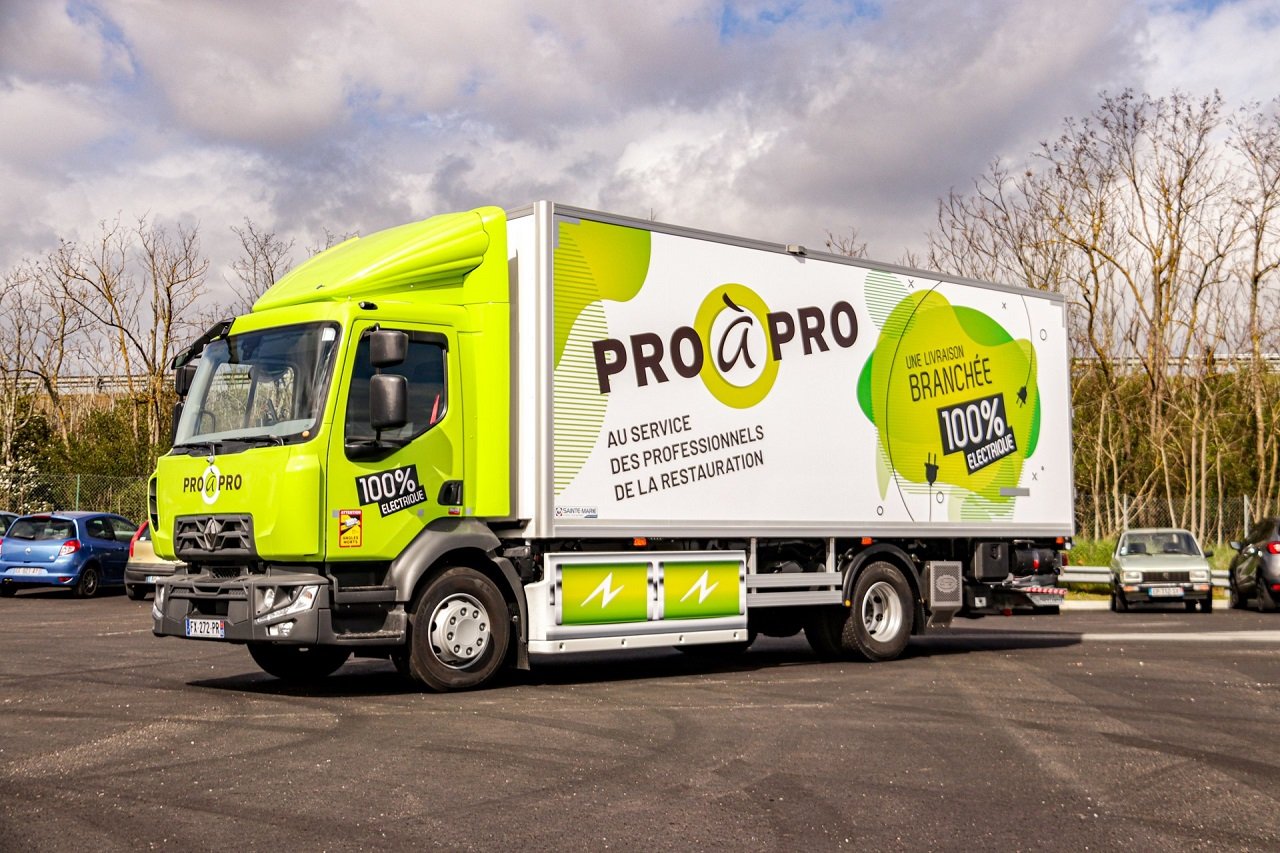
Carrier Transicold Equips First 100% Electric Vehicle Operated by Pro à Pro

Carrier Transicold Equips First 100% Electric Vehicle Operated by Pro à Pro

Pro à Pro, a subsidiary of the Métro Group, a leading supplier to the catering sector, has selected Carrier Transicold’s Iceland 8 engineless refrigeration unit to equip its first 100% electric vehicle.

Pro à Pro recently purchased a new 16-metric ton all-electric truck, the first of its kind in its fleet. Designed by Renault Trucks, with bodywork by Sainte-Marie, this vehicle underlines Pro à Pro’s commitment to reducing its environmental impact and meeting future traffic standards in city centers.

“At the start of the project, we chose Carrier Transicold because it had the technological solutions to meet our exact requirements, namely to transport goods at three different temperature levels – for dried, fresh and frozen products, with a lowest temperature of -22 C – while reducing our carbon dioxide (CO2) and noise emissions to zero, when delivering early in the morning in city centers,” said Thierry Demenois, Supply Chain Director at Pro à Pro.

The Iceland 8 is part of the Carrier Transicold truck/trailer refrigeration range. The unit is connected to the vehicle’s battery using Carrier energy management system, which converts the direct current produced and stored by the truck while driving into the alternating current required to operate the refrigeration unit. The Iceland 8 unit is equipped with a hermetically-sealed scroll compressor with only two moving mechanical parts, thus ensuring continuous compression of the refrigerant and minimizing the risk of leakage (about 1% per year). In addition, the defrosting and heating system is managed by an electric resistance, simplifying the system and increasing its reliability.

Energy efficient solutions such as the Iceland 8, support Carrier’s aim to reduce its customers’ carbon footprint by one gigaton, part of its 2030 Environmental, Social and Governance Goals. The unit is energy-efficient, quiet and environmentally sustainable.

“This first 100% electric truck is a perfect example of the two companies’ ability to innovate in order to deliver solutions that address the transport challenges of the future,” said Jean-Pascal Vielfaure, Carrier Transicold’s Director for Southern Europe.

Get the daily refrigeration briefing

One email a day. Trusted by 3,000+ RACHP professionals.

More on Cold Chain

All on Cold Chain →

Insights

Secop's Solar Direct Drive (SDD) System Earns WHO PQS Approval – The Team Behind It
Article

Secop’s Solar Direct Drive (SDD) System Earns WHO PQS Approval – The Team Behind It

Partner's material In March 2026, Secop’s Solar Direct Drive Power Management Module was granted WHO PQS prequalification and officially listed in the WHO Catalogue of Prequalified Immunization Devices. The WHO IMD-PQS (Immunization Devices Performance, Quality and Safety programme) is the global benchmark for cold chain equipment used in immunisation. Being listed in its catalogue is

22 Jun 2026
Case Study - Effect of Louvers or diffusers on air flow distribution and cooling time on a meat log during Chill cycle
Tech Guide

Case Study – Effect of Louvers or diffusers on air flow distribution and cooling time on a meat log during Chill cycle

By Kushal Aurangabadkar An experimental analysis was conducted on a cooler space measuring 3.66 m × 6.096 m (12.0 ft × 20.0 ft), equipped with an ammonia refrigeration coil, five 30 cm (12 in.) fans, and five diffusers. The study measured airflow patterns, cooling rates, and heat transfer efficiency in meat storage by testing two configurations:

Kushal Aurangabadkar · 21 Jan 2026
Total Cost of Ownership (TCO) for Modular Refrigeration Systems in Life Sciences Distribution Centers
Tech Guide

Total Cost of Ownership (TCO) for Modular Refrigeration Systems in Life Sciences Distribution Centers

by Ramez Naguib, P.E. Introduction Life sciences distribution centers are under immense pressure to deliver consistent temperature control, comply with increasingly stringent regulations, and optimize operational efficiency. Traditional built-up refrigeration systems often prove cumbersome, costly, and slow to implement. In contrast, modular, factory-assembled refrigeration systems have emerged as a compelling alternative. Drawing on lessons from

14 Jan 2026
Everything on Cold Chain: 2,042 articles, 2 case studies, 23 insights

Most read this month

All news →