AT&T, ndustrial.io are helping Lineage with new tech to improve food safety and reduce emissions

AT&T, ndustrial.io are helping Lineage with new tech to improve food safety and reduce emissions

Lineage Logistics (“Lineage”), a leading cold food storage operator, has teamed up with ndustrial.io and AT&T IoT to help keep food safe, save energy and reduce carbon emissions as frozen food makes its way from farms to tables across America.

Freezing preserves food from the time it is prepared to the time it is eaten, but doing so requires a lot of electricity – especially in the cold storage facilities that keep meat, seafood, fruits, vegetables and other packaged foods cold during distribution.

To increase food storage capacity and improve energy efficiency at Lineage cold storage facilities, ndustrial.io installed smart meters and about 1,000 sensors, connected by the AT&T Internet of Things, to better measure temperature and humidity. This wealth of data allows Lineage’s data science experts to identify when and where to make temperature adjustments, so Lineage facilities only use as much energy as they need.

“We collect energy and temperature data from across these warehouses. By using the ndustrial.io platform and AT&T connectivity to get the whole picture, Lineage is able to tell a good kilowatt from a bad kilowatt and adjust the cooling equipment accordingly. This adds up to substantial savings where the cleanest watt is the watt not used,” said Jason Massey, CEO ndustrial.io.

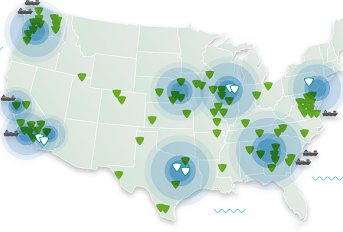
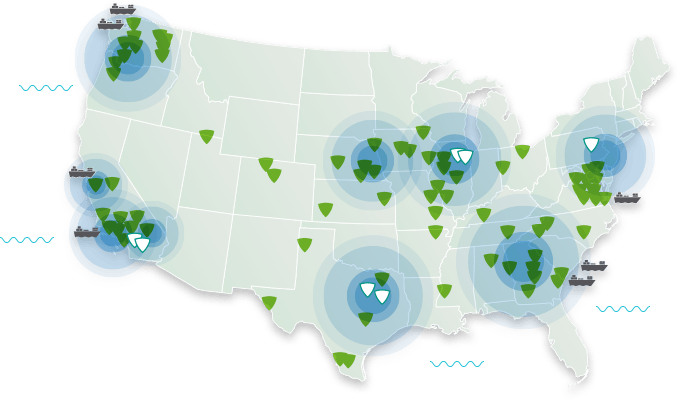
Thanks to the AT&T IoT-enabled ndustrial.io system, Lineage was able to reduce its electricity usage by 34% (per item stored) in 78 different warehouses nationwide. This system also helped avoid the equivalent of consuming 2.4 million gallons of gasoline in carbon emissions, significantly reducing Lineage’s annual energy spend and environmental footprint.

Get the daily refrigeration briefing

One email a day. Trusted by 3,000+ RACHP professionals.

Related news

Most read this week

All news →

Related insights

Article

Secop’s Solar Direct Drive (SDD) System Earns WHO PQS Approval – The Team Behind It

Partner's material In March 2026, Secop’s Solar Direct Drive Power Management Module was granted WHO PQS prequalification and officially listed in the WHO Catalogue of Prequalified Immunization Devices. The WHO IMD-PQS (Immunization Devices Performance, Quality and Safety programme) is the global benchmark for cold chain equipment used in immunisation. Being listed in its catalogue is

22 Jun 2026
Tech Guide

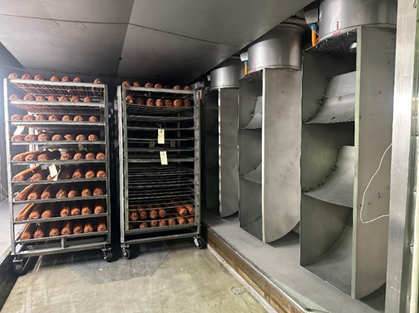
Case Study – Effect of Louvers or diffusers on air flow distribution and cooling time on a meat log during Chill cycle

By Kushal Aurangabadkar An experimental analysis was conducted on a cooler space measuring 3.66 m × 6.096 m (12.0 ft × 20.0 ft), equipped with an ammonia refrigeration coil, five 30 cm (12 in.) fans, and five diffusers. The study measured airflow patterns, cooling rates, and heat transfer efficiency in meat storage by testing two configurations:

Kushal Aurangabadkar · 21 Jan 2026
Tech Guide

Total Cost of Ownership (TCO) for Modular Refrigeration Systems in Life Sciences Distribution Centers

by Ramez Naguib, P.E. Introduction Life sciences distribution centers are under immense pressure to deliver consistent temperature control, comply with increasingly stringent regulations, and optimize operational efficiency. Traditional built-up refrigeration systems often prove cumbersome, costly, and slow to implement. In contrast, modular, factory-assembled refrigeration systems have emerged as a compelling alternative. Drawing on lessons from

14 Jan 2026