Esta página solo está disponible en inglés. Ir a la portada en español

×

Questa pagina è disponibile solo in inglese. Home page in italiano

×

Diese Seite ist nur auf Englisch verfügbar. Zur deutschen Startseite

×

Cette page est disponible uniquement en anglais. Aller à la page d'accueil en français

×

EHPA urges EU to prioritise heat pumps in new Heating and Cooling Strategy

EHPA urges EU to prioritise heat pumps in new Heating and Cooling Strategy

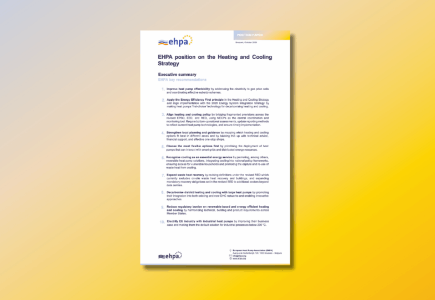
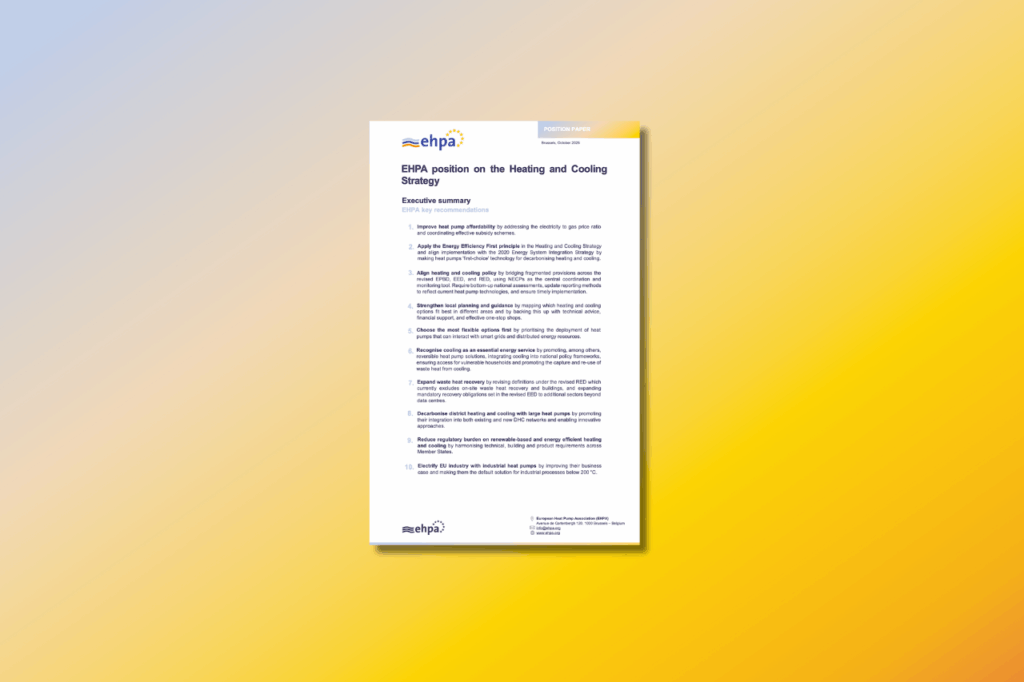
The European Heat Pump Association (EHPA) has issued a position paper outlining its recommendations for the European Commission’s forthcoming Heating and Cooling Strategy, emphasising the need to make heat pumps the central technology for decarbonising the sector.

Heating and cooling account for over 50% of the EU’s total energy consumption, with around 70% still sourced from fossil fuels as of 2023. EHPA argues that heat pumps offer a mature and efficient alternative capable of providing both heating and cooling, while supporting the integration of renewables and waste heat into the energy system.

The EHPA paper calls for alignment of EU legislation, including the Energy Performance of Buildings Directive (EPBD), the Energy Efficiency Directive (EED), and the Renewable Energy Directive (RED), to ensure consistent and enforceable policies. It suggests using the National Energy and Climate Plans (NECPs) as a coordination tool and recommends updating outdated reporting methodologies to reflect current heat pump technologies.

To improve deployment, EHPA highlights the need to revise electricity pricing structures, coordinate national subsidy schemes, and promote financing models such as social leasing. The organisation also stresses the importance of supporting local heat planning, implementing one-stop shops for technical and financial advice, and recognising cooling as a basic energy service.

In its ten key recommendations, EHPA also advocates for:

  • Broader definitions and obligations for waste heat recovery,

  • Expansion of district heating and cooling (DHC) networks powered by large heat pumps,

  • Reduction of regulatory complexity across Member States,

  • Prioritisation of heat pumps for industrial processes below 200°C.

“Heat pumps represent the most efficient and scalable solution to decarbonise heating and cooling, while strengthening Europe’s energy security,” the paper concludes.

The position paper was published in October 2025.
Get the daily refrigeration briefing

One email a day. Trusted by 3,000+ RACHP professionals.

Related news

Heat Pumps

EHPA Seeks Application-Specific PFAS Derogations for Heat Pumps

The group says transition timelines should reflect refrigerant readiness, redesign needs and safety constraints across product categories.

Yesterday
Heat Pumps

EPEE backs EU electrification plan, urges heating and cooling support

The association seeks VAT cuts and financing for heat pumps while highlighting waste heat recovery across refrigeration, industry and data centres.

29 Jul 2026
Heat Pumps

EU plan calls for 4 million annual heat pump installations by 2030

The European Commission’s Electrification Action Plan calls for annual heat pump installations to rise from 2.4 million in 2025 to 4 million by 2030. Published on 17 July 2026, the plan includes measures covering energy taxation, electricity and gas price ratios, financing, system flexibility and industrial electrification. The Commission proposes reducing national electricity-to-gas price ratios

22 Jul 2026
Heat Pumps

RWTH Aachen researchers call for better heat pump performance data

The study links oversizing to higher costs and says ErP tests can overstate COP, prompting calls for dynamic operating data.

17 Jul 2026
Heat Pumps

Mitsubishi Electric urges UK heat pump regulatory reform

A new white paper says high-temperature heat pumps could cut retrofit time, cost and disruption by retaining existing radiators and pipework.

10 Jul 2026
Air Conditioning

New Zealand adds MEPS rules for air conditioners above 65 kW

From May 1, 2026, covered products must meet minimum AEER and ACOP thresholds and be registered before they can be supplied.

1 Jun 2026

Most read this month

All news →

Related insights