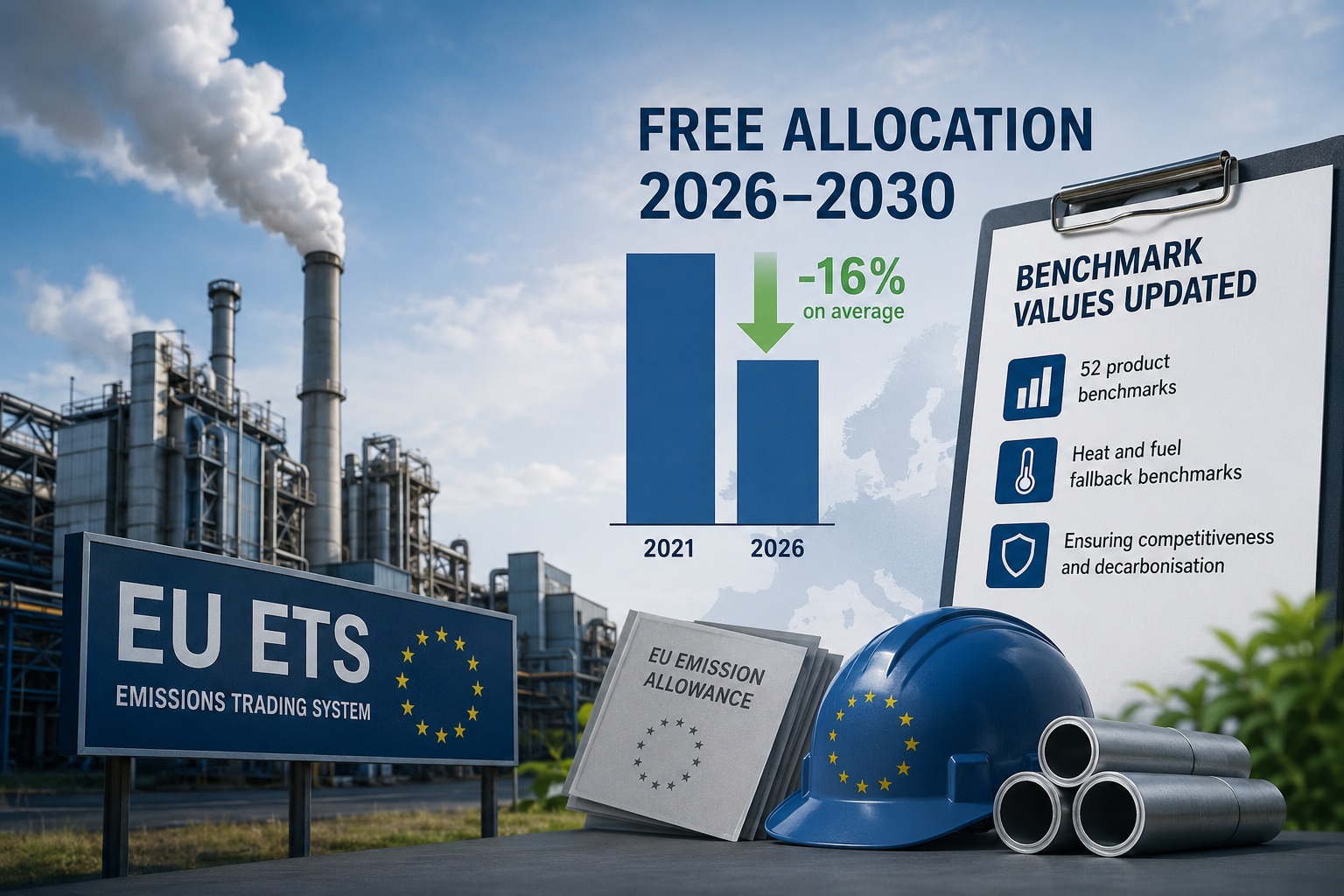
The European Commission adopted revised EU emissions trading system benchmark values on 29 June 2026. The benchmarks determine the free emission allowances granted to eligible industrial installations during 2026-2030 and precede a broader revision of the EU ETS Directive.
The EU ETS uses 52 product benchmarks and two fallback benchmarks for heat and fuel. Product benchmarks for 2026-2030 are based on the 2021 and 2022 greenhouse gas emission intensities of the 10% best-performing installations. Installations with higher emission intensities must purchase additional allowances to cover part of their emissions.
Under the updated values, free allocation is expected to decrease by more than 16% on average in 2026 compared with 2021. The heat and fuel fallback benchmarks are each expected to fall by 34%, while some product benchmarks will increase following the inclusion of indirect emissions from electricity use in their calculation.
Free allocation for sectors covered by the carbon border adjustment mechanism will decline through an annual CBAM factor before ending in 2034. For sectors exposed to carbon leakage but not covered by CBAM, no phase-out deadline has been announced.
The Commission plans to propose a wider revision of the EU ETS Directive in July 2026. The review is expected to address carbon-leakage risks in sectors outside CBAM and include a proposal for sector-specific fallback benchmarks.