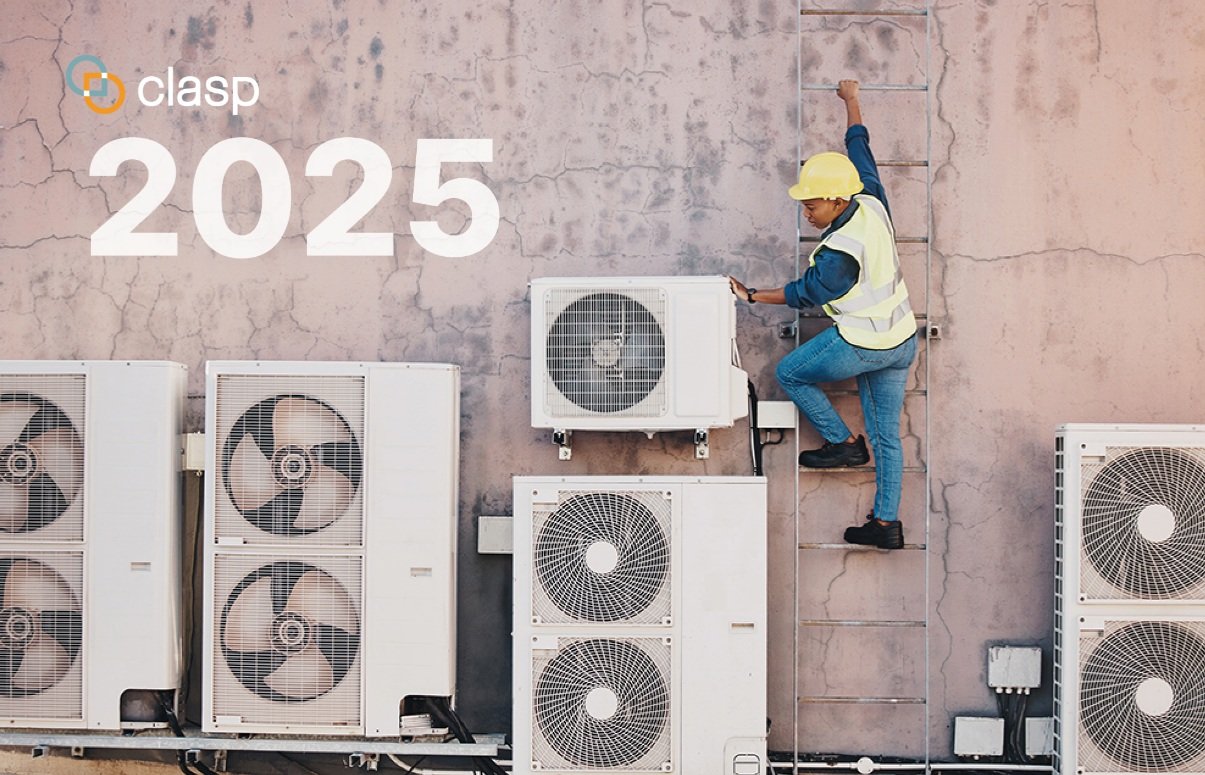
CLASP said 18 appliance and equipment efficiency policies supported by the organization in 2025 are expected to avoid 4.6 gigatons of CO2 by 2050. The results were published in the 2025 CLASP Annual Report, which focuses on energy efficiency as part of climate, energy security, and livelihood strategies.
Ahead of COP30, CLASP led a campaign to increase the inclusion of appliance and equipment efficiency in national climate goals, or nationally determined contributions. According to the report, appliance and equipment efficiency policy is now included in 90% of submitted NDCs, up from below 50% in the previous cycle.
The report says CLASP supported policy work in several markets. Australia passed a lighting policy to move the market toward LED lighting and avoid 41 Mt of CO2 by 2050. Brazil approved a lighting policy package expected to cut nearly 3 Mt CO2 by 2050. In China, seven policy updates, including for compressed air systems, refrigerators, and water pumps, are estimated to cut nearly 3 Gt CO2 by 2050. In India, CLASP supported policies for space cooling appliances expected to cut 1.2 Gt CO2 by 2050.
CLASP also reported that more than 30,000 people experienced improved health and livelihoods through access to efficient, solar-powered appliances and equipment. In Africa, the organization re-launched its Productive Use Financing Facility to support entrepreneurs, farmers, and small businesses in Ethiopia, Kenya, and Nigeria in buying solar-powered appliances and equipment.
The report also highlights work on electric cooking and industrial motor systems. CLASP joined the UK Aid-supported Modern Energy Cooking Services Programme as a core partner with Loughborough University and the World Bank’s ESMAP, and launched the Global LEAP Awards Induction Cooktops Competition in 2025. It also identified motor systems as a priority area, stating that without intervention they will account for 35% of global electricity demand and 19% of energy-related emissions by 2050.
Christine Egan, CEO of CLASP, said: “Appliance and equipment energy efficiency is a triple-win for people, planet, and prosperity. In a time of multiplying global crises, it stands out as a durable climate solution and key element of smart decarbonization strategies.”