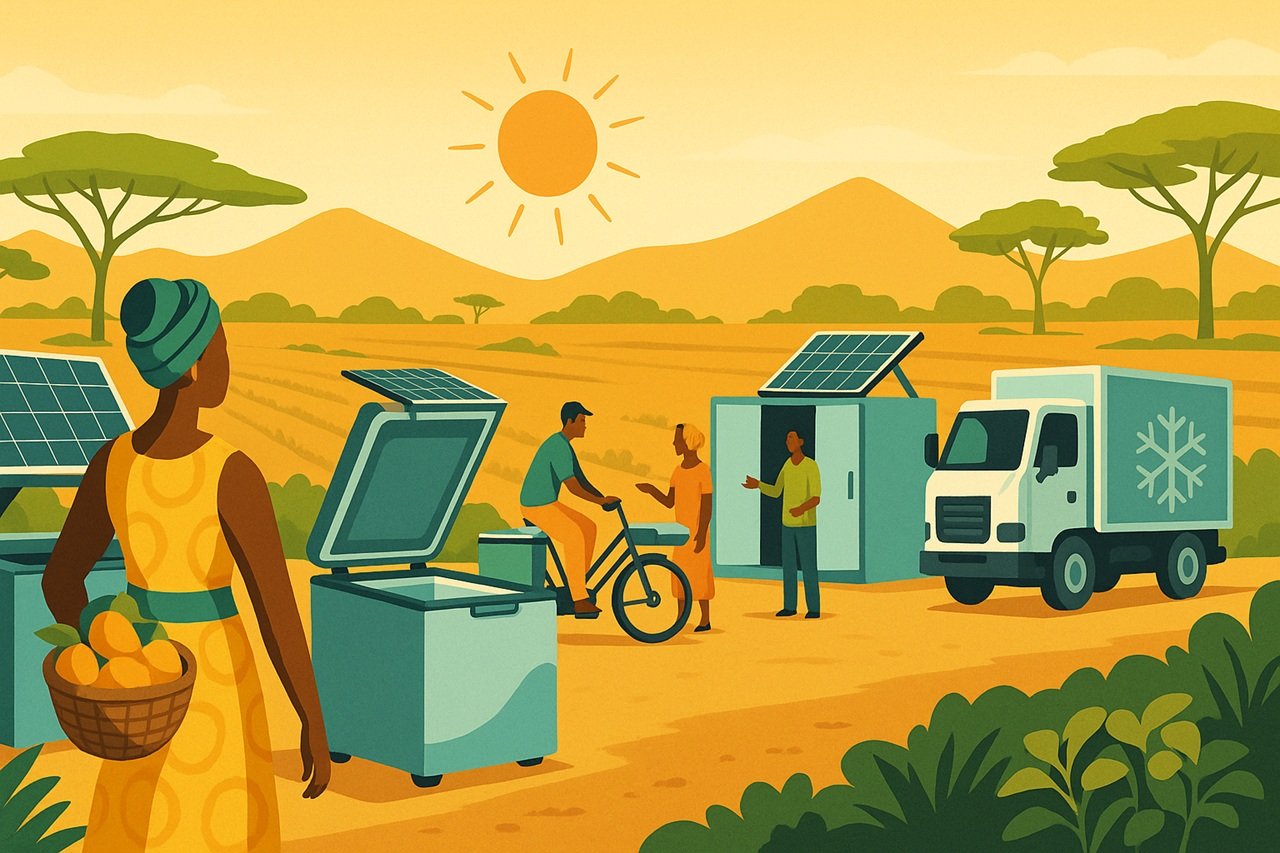
Innovative business models are driving the adoption of sustainable cold chains in agriculture across Africa. The Cooling-as-a-Service (CaaS) model, pioneered by the BASE Foundation with support from the Clean Cooling Collaborative in 2019, allows users to access cooling infrastructure without upfront investment, paying only for the cooling they use. This approach supports farmers, cooperatives, and traders by reducing post-harvest losses and improving food security.
The CaaS model has enabled partnerships in countries such as India, Nigeria, Guinea-Bissau, and Iraq through initiatives like “Your Virtual Cold Chain Assistant,” which combines digital platforms with solar-powered cold storage. The approach is also being scaled across Africa by several local innovators.
Koolboks has deployed over 9,000 solar-powered fridges in 25 countries, offering sustainable cooling to clinics, food vendors, and fishermen. Its recent innovations include PowerFoot, a pedal that enables solar conversion of AC fridges, and PAYGO Locking Technology for flexible payments. In 2025, Koolboks launched KoolBuy, a “Buy Now, Pay Later” platform, now active in over 200 retail stores in Nigeria, with plans to reach 500 by the end of the year. The company has raised $11 million in Series A funding to scale operations and establish its first assembly plant in Nigeria.
ColdHubs continues to expand its solar-powered cold room network in Nigeria, providing affordable, pay-per-use storage at agricultural markets. Its services have saved over 14,000 metric tons of food from spoilage and supported over 20,000 metric tons in transit. Most users are women traders. ColdHubs also supports Smart Cool Markets, a digital marketplace developed with BASE Foundation and LeapEnergy to connect farmers and buyers.
DGrid Energy is deploying modular “Solar Cool Cubes-as-a-Service” in Tanzania, Zambia, the Democratic Republic of the Congo, and Ghana. Its systems serve 8,000 farmers and 500 workers, achieving a 96% utilisation rate and lowering electricity costs by 33%. The company also offers digital tools for real-time monitoring and is developing a carbon credit methodology for clean cooling.
Ghana-based AkoFresh operates solar cold storage units in five communities and launched a pay-per-use rental scheme for refrigerated tricycles in June 2025. Its digital platform links farmers to buyers and storage, helping to reduce losses and increase income. AkoFresh has trained over 3,000 farmers and prevented an estimated 500 metric tons of CO₂ emissions. It plans to expand into 15 communities and enter new markets in Uganda and Nigeria.
In South Africa, Energy Partners has applied the CaaS model to industrial-scale cooling, financing and operating an ammonia refrigeration plant for avocado exporter Letaba Pakkers. The system cut energy use by 20%, reduced emissions by over 4,200 tonnes of CO₂, and eliminated upfront costs for the client. The company plans further rollouts across Africa’s agricultural and industrial sectors.
Source