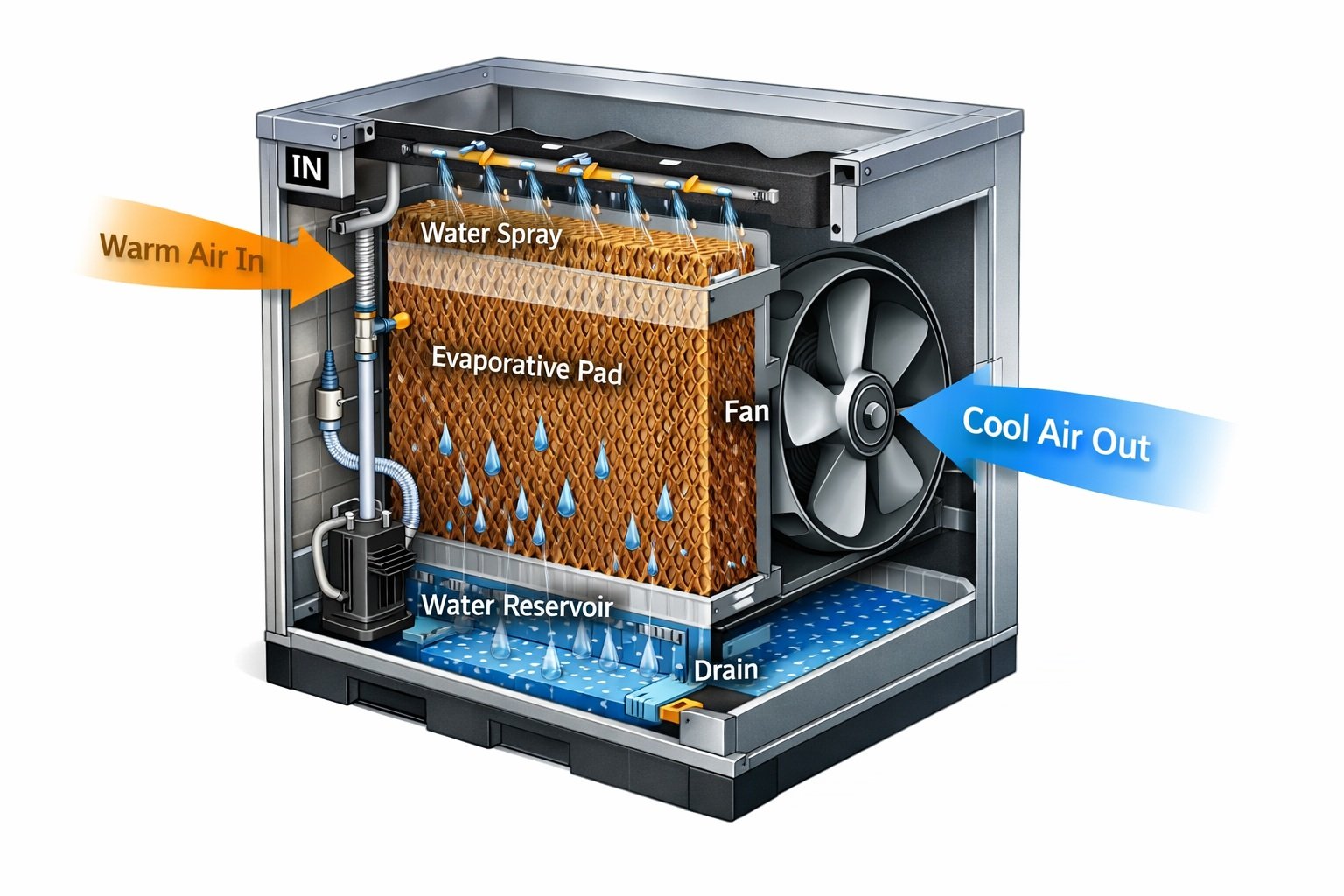
Researchers from Belgium, France and Poland have proposed a unified classification for evaporative coolers and compiled 18 standardised datasets to support model validation. The work aims to make validation against literature data faster and more consistent as evaporative cooling gains attention as an alternative to vapour-compression air conditioning.
According to the paper, the terminology used for evaporative cooler configurations is not unified across the literature, and existing classifications do not cover all indirect evaporative cooler variations. The authors said this creates difficulties when comparing configurations and using published experimental data for simulation and validation.
The paper introduces a vertical classification based on channel characteristics and common configuration changes, including primary air regeneration and perforations between dry and wet channels. It also provides schematic representations of air-condition evolution inside seven evaporative coolers on a psychrometric diagram and identifies the strengths and limitations of each configuration.
To support model validation, the authors reviewed the literature and assembled 18 datasets from existing experimental and numerical studies. The datasets cover various operating conditions, use a standardised presentation format and follow the nomenclature proposed in the paper. The full datasets are available in an online open-source database intended to be collaborative and regularly updated.
The study is part of the International Energy Agency’s Annex 85 project on indirect evaporative cooling, launched in 2020. The authors said the work also forms part of scientific cooperation between France and Belgium supported by the Hubert Curien Programme and Belgium’s INEScot project.