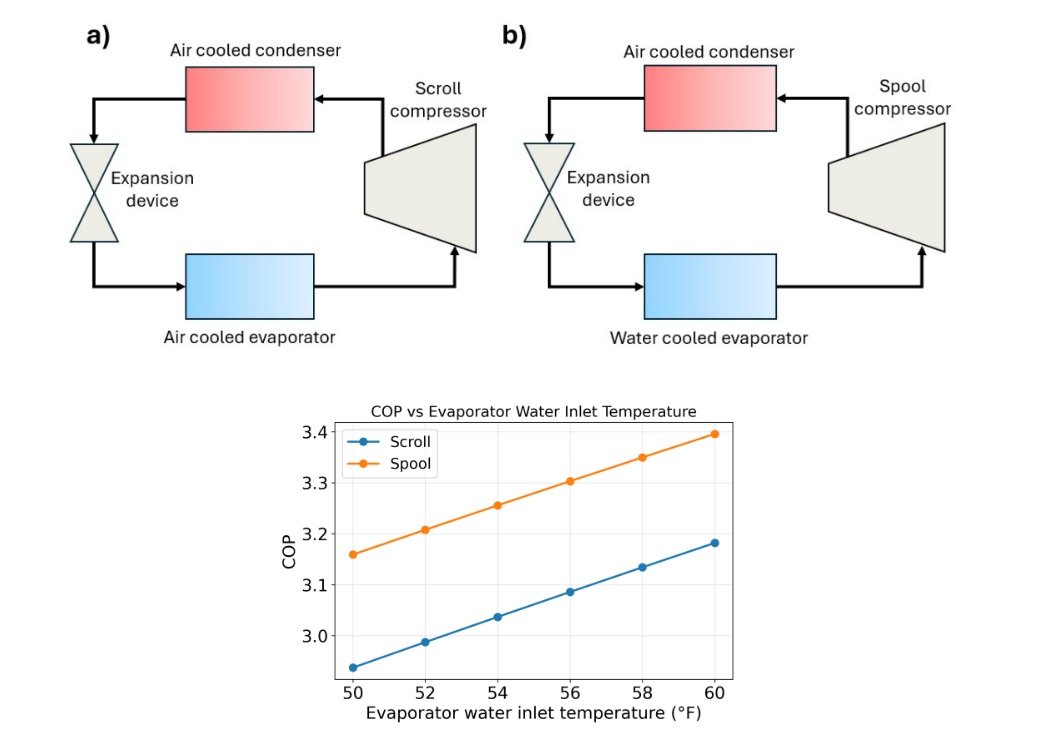
A technical assessment prepared for Torad Engineering Inc. found that spool compressors delivered higher coefficient of performance than scroll compressors in modeled chiller and DX cooling applications using R-1234ze(E).
The report was conducted by the Air Conditioning and Refrigeration Center, Department of Mechanical Science and Engineering, University of Illinois Urbana-Champaign.
The study used steady-state vapor-compression cycle models and AHRI 540 polynomial compressor map models. Three comparisons were performed: the same air-cooled chiller architecture, the same chiller architecture with refrigerant-side pressure drop, and a spool-based chiller compared with a scroll-based DX system at equal rated cooling capacity.
Across the analyses, the spool compressor showed COP improvements of approximately 2% to 10% compared with the scroll compressor. The report attributed the advantage mainly to lower compressor power consumption, with reductions of approximately 4% to 11%, while cooling capacity remained similar and in some cases was slightly lower than the scroll compressor.
At 95°F (35°C) outdoor air temperature in the same chiller architecture, the spool compressor recorded a COP of 3.26 compared with 3.04 for the scroll compressor. Compressor power was 20.62 kW (approx. 70,400 BTU/h) for the spool unit and 22.28 kW (approx. 76,000 BTU/h) for the scroll unit.
The report also found that the spool compressor maintained lower discharge temperatures across the comparisons. The authors concluded that the results support continued evaluation of spool compressor technology for high-efficiency cooling applications and possible system-level architectural optimization.