Esta página solo está disponible en inglés. Ir a la portada en español

×

Questa pagina è disponibile solo in inglese. Home page in italiano

×

Diese Seite ist nur auf Englisch verfügbar. Zur deutschen Startseite

×

Cette page est disponible uniquement en anglais. Aller à la page d'accueil en français

×

Russell WBHO completes Heywood logistics superhub

Russell WBHO completes Heywood logistics superhub

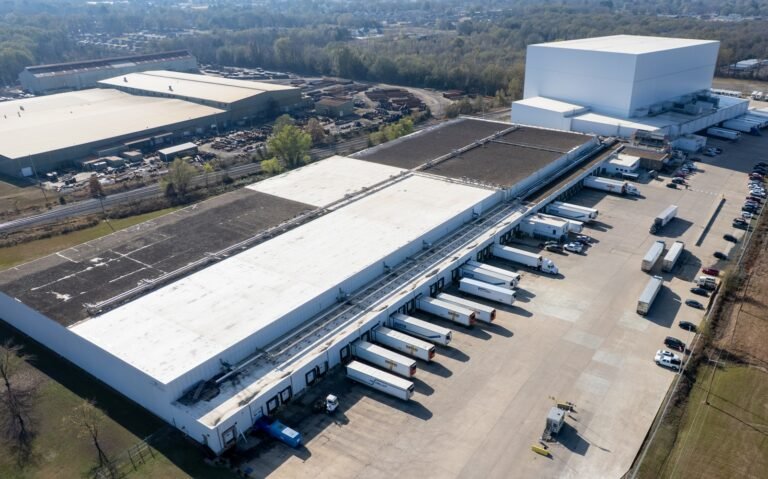
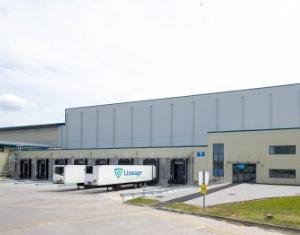
Russell WBHO has completed the final phase of works for Lineage Logistics at its UK headquarters in Heywood, Greater Manchester.

The main contractor has just handed over a new 70,000 sq ft temperature-controlled cold store with the capacity to hold 22,500 pallets, bringing the facility total to 78,000 pallets.

This final 12-month build was the completion of a three-phase extension to the global operator’s Heywood Superhub which Russell WBHO began in 2011. The first two phases completed in 2013 and comprised 100,000 sq ft of space and 28,000 pallets.

Lineage’s 20-acre site off Hareshill Road now boasts a total 425,000 sq ft of space providing consolidated storage for the UK’s major food manufacturing, food service and food retail brands.

The project saw the introduction of the new style single-skin cold store, now preferred over the traditional ‘box-in-box’ construction where the internal refrigerated chamber sits separately within the outer building. The use of single skin maximises internal area and thereby pallet space capacity.

The Russell WBHO team successfully linked the new building to the existing older design, with no compromise to the integrity of the minus 30-degree temperature during the construction programme or ongoing operation.

Strict carbon reduction targets have also been met, with state-of-the art materials and mechanical systems installed. The new facility will provide Lineage with a 75% operational energy cost saving when compared to the European energy consumption average, thanks to the installation of the award-winning Azanefreezer 2.0 system from Star Refrigeration.

The extension provides another eight double-height loading docks and a temperature-controlled loading area to ensure a secure cold chain for products as they enter the facility from the temperature-controlled lorries.

In linking the structures together, the team had to consider conflicting priorities between ensuring temperature integrity, dehumidification and reduction in energy use, and the ability to move seamlessly around the building and between chambers. This required careful design and the use of specialist products such as insulation and fast-closing door seals, and management of the construction work alongside that of the existing operational chamber.

Get the daily refrigeration briefing

One email a day. Trusted by 3,000+ RACHP professionals.

More on Cold Chain

All on Cold Chain →

Insights

Secop's Solar Direct Drive (SDD) System Earns WHO PQS Approval – The Team Behind It
Article

Secop’s Solar Direct Drive (SDD) System Earns WHO PQS Approval – The Team Behind It

Partner's material In March 2026, Secop’s Solar Direct Drive Power Management Module was granted WHO PQS prequalification and officially listed in the WHO Catalogue of Prequalified Immunization Devices. The WHO IMD-PQS (Immunization Devices Performance, Quality and Safety programme) is the global benchmark for cold chain equipment used in immunisation. Being listed in its catalogue is

22 Jun 2026
Case Study - Effect of Louvers or diffusers on air flow distribution and cooling time on a meat log during Chill cycle
Tech Guide

Case Study – Effect of Louvers or diffusers on air flow distribution and cooling time on a meat log during Chill cycle

By Kushal Aurangabadkar An experimental analysis was conducted on a cooler space measuring 3.66 m × 6.096 m (12.0 ft × 20.0 ft), equipped with an ammonia refrigeration coil, five 30 cm (12 in.) fans, and five diffusers. The study measured airflow patterns, cooling rates, and heat transfer efficiency in meat storage by testing two configurations:

Kushal Aurangabadkar · 21 Jan 2026
Total Cost of Ownership (TCO) for Modular Refrigeration Systems in Life Sciences Distribution Centers
Tech Guide

Total Cost of Ownership (TCO) for Modular Refrigeration Systems in Life Sciences Distribution Centers

by Ramez Naguib, P.E. Introduction Life sciences distribution centers are under immense pressure to deliver consistent temperature control, comply with increasingly stringent regulations, and optimize operational efficiency. Traditional built-up refrigeration systems often prove cumbersome, costly, and slow to implement. In contrast, modular, factory-assembled refrigeration systems have emerged as a compelling alternative. Drawing on lessons from

14 Jan 2026
Everything on Cold Chain: 2,051 articles, 2 case studies, 23 insights

Most read this month

All news →